


MOSCOW -- Russian President Vladimir Putin signed a decree approving Russia's updated nuclear doctrine, the Kremlin reported Tuesday.
The decree, published on the Kremlin website, states that aggression by any state in a military coalition or bloc against Russia or its allies is seen as aggression by the entire bloc as a whole and aggression from a non-nuclear state, with the involvement or support of a nuclear power, will be regarded as a joint attack on Russia.
According to the document, Russia views nuclear weapons "as a means of deterrence ... which is a last-resort and forced measure," and the country is taking "all necessary efforts" to reduce the nuclear threat and prevent the escalation of interstate tensions that could lead to military conflicts, including nuclear ones.

The revised doctrine further clarifies the states and military alliances subject to nuclear deterrence. According to the decree, nuclear deterrence is aimed at potential enemies, which are defined as "individual states and military coalitions that view Russia as a potential enemy" possessing nuclear weapons or significant general-purpose military capabilities.
Nuclear deterrence is also aimed at states that allow their territory and resources to be used for aggression against Russia, the decree added.
BEIJING, (Xinhua) -- New equipment, including the J-35A fighter jet, will debut at the 15th China International Aviation and Aerospace Exhibition, also known as Airshow China, China's Air Force announced on Tuesday.
Apart from the J-35A medium-sized stealth fighter, the HQ-19 surface-to-air missile weapon system and a new attack reconnaissance unmanned aerial vehicle will also be unveiled for the first time at the air show, said Niu Wenbo with the Air Force equipment department at a press conference.
The air show, scheduled for Nov. 12-17 in the southern Chinese city of Zhuhai, features a diverse range of activities including aerobatic displays, according to Air Force spokesperson Xie Peng.
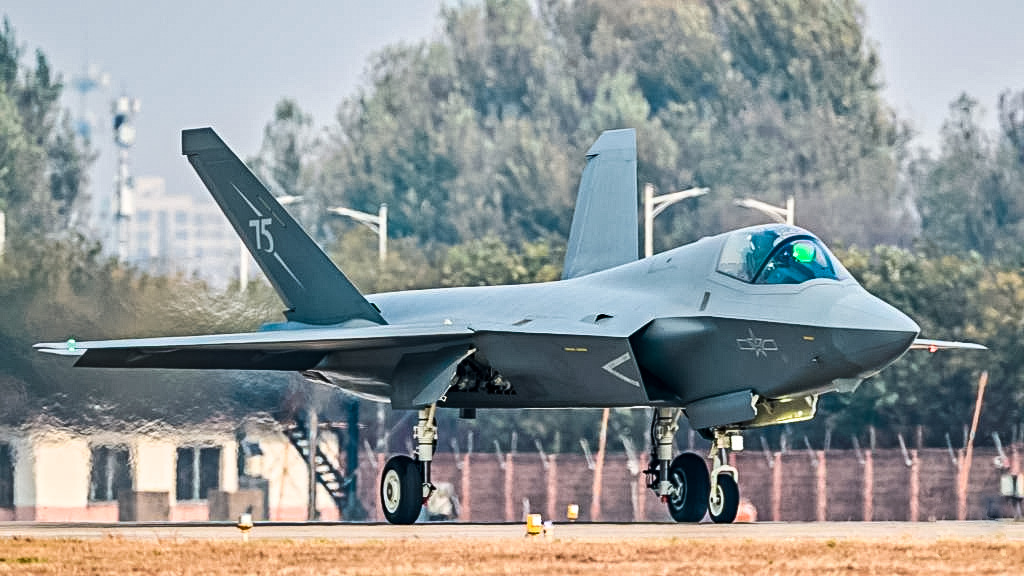
The aircraft set to fly at the show include the J-20, J-16, and the YY-20A for refueling. The cargo hold of Y-20 aircraft will also be open to the public.
The event coincides with the commemoration of the 75th anniversary of the founding of the Chinese People's Liberation Army Air Force, which falls on Nov. 11. ■
To understand what makes a DANA so destructive, it is first necessary to understand what this phenomenon consists of. Depressions, in meteorology, are areas of low atmospheric pressure, which means that the air is denser in the surroundings than in the center of this "bubble." This imbalance of pressures is essential to generate rain, storms and strong winds.
 In the case of a DANA, the situation is even more complex. This phenomenon, which is also known as a "cold drop," occurs when a mass of very cold polar air is isolated at high altitude, between 5,000 and 9,000 meters above sea level. Unlike other storms, the DANA forms in isolation from the air currents that normally regulate the climate in the northern hemisphere, such as the polar jet stream or the subtropical jet stream. This isolation allows the cold air mass to begin to interact with the warm, humid air in its surroundings, generating conditions of atmospheric instability. The orography of the Iberian Peninsula, particularly the arrangement of the mountains in the Valencia region, favors the rise of warm, humid air from the sea into the atmosphere, where it meets the cold air of the DANA. This clash between air masses in different states of temperature and humidity intensifies rainfall and generates extremely unstable conditions.
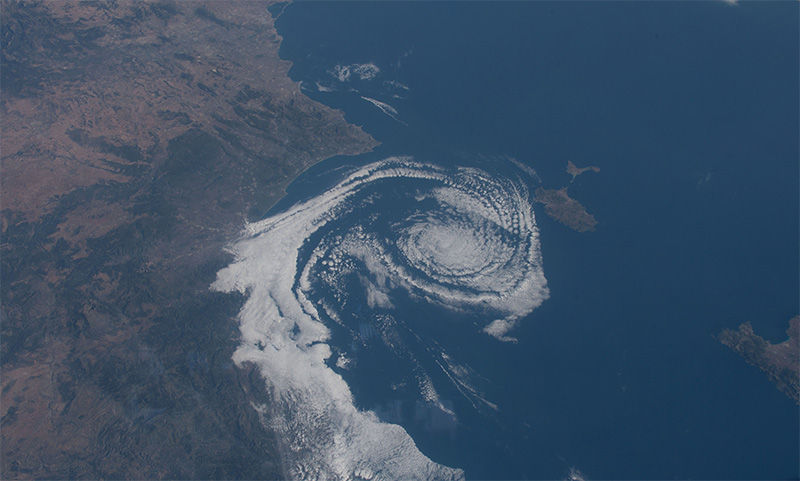 During the days of greatest activity, some areas of Valencia recorded more than 500 (mm) of water, the equivalent of a year's worth of rain in a matter of hours. This led to massive flooding that swept away entire towns and left thousands of people trapped in their homes and vehicles. The combination of heavy rain, water-saturated land, and an urban drainage system unable to handle this extreme volume of rainfall contributed to the water accumulating rapidly. It should be added that the rains were not only accompanied by thunderstorms, but also by strong winds and, in some cases, tornadoes that hit the region. The magnitude of this phenomenon led the Emergency Coordination Centre (CCE) to raise the alert level to red in several areas of Valencia, issuing warnings to the population to avoid non-essential travel. The frequency and intensity of DANAs have been increasing in recent years. A recent study by the American Meteorological Society confirms that since the 1960s, the number of episodes of this type has grown significantly in the Mediterranean, and many experts point to climate change as a fundamental factor.
 Global warming raises the temperature of the Mediterranean, allowing DANAs to be more intense. The World Weather Attribution organisation, which is dedicated to analysing the effects of climate change on extreme phenomena, estimates that torrential rains of this type are now 12% more intense and twice as likely compared to the pre-industrial climate. Friederike Otto, a researcher at Imperial College London, explains that “we are seeing events from the past, but they are becoming more common and extreme due to global warming.” This phenomenon in Valencia is an example of how climate change is already affecting communities and ecosystems, and emphasizes the need to take measures to prepare for an increasingly unpredictable climate.
Three days after historic flash floods swept through several towns south of Valencia in eastern Spain, killing at least 205 people, the initial shock gave way to anger, frustration and a wave of solidarity on Friday. Spanish emergency authorities raised the death toll to at least 205 victims, 202 of them in Valencia alone. Many streets were still blocked by vehicles and piled-up debris, in some cases trapping residents in their homes. Some places remained without electricity, running water or stable telephone connections.
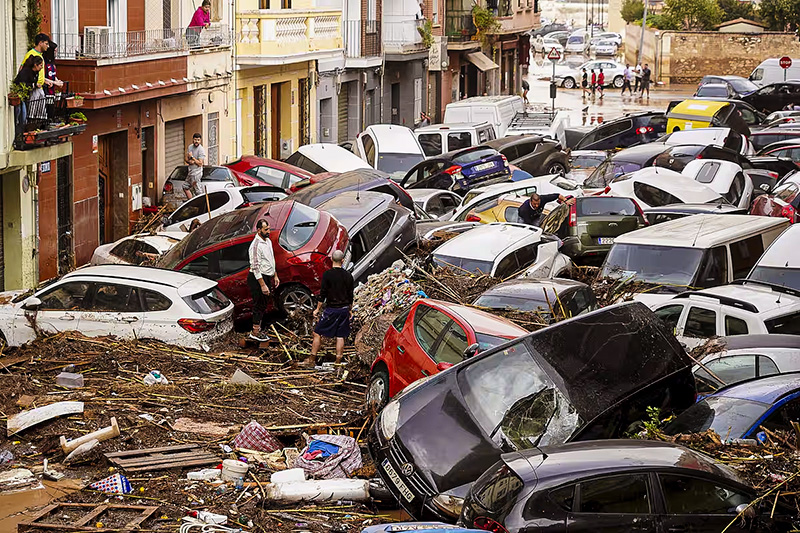 The damage from Tuesday and Wednesday's storm was reminiscent of the effects of a tsunami, with survivors picking up the pieces as they mourned loved ones lost in the deadliest natural disaster in Spain's living memory. "The situation is unbelievable. So much disaster and so little help," said Emilio Cuartero, a resident of Masanasa, outside Valencia. “We need machinery, cranes, to make the sites accessible. We need a lot of help. And bread and water.” In Chiva, residents were working on Friday to clear debris from mud-filled streets. The Valencian town received more rain in eight hours on Tuesday than in the previous 20 months and water overflowed a ditch that runs through the town, tearing away roads and walls of houses. Mayor Amparo Fort told RNE radio that “whole houses have disappeared, we don’t know if they have people inside or not.” Security forces and soldiers were working to search for an unknown number of missing people and many were feared still trapped in wrecked vehicles or flooded garages. Chiva resident Juan Vicente Perez said in statements near the site of his former home that if he had waited five more minutes before evacuating, he would have died.
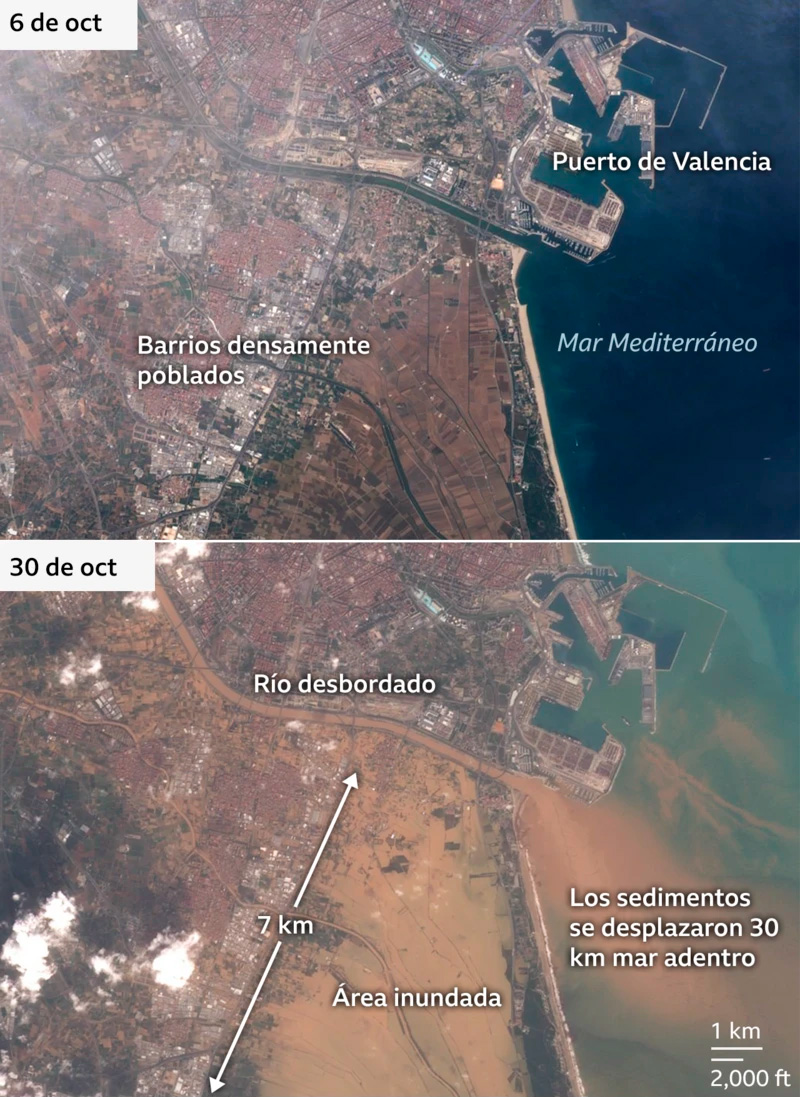
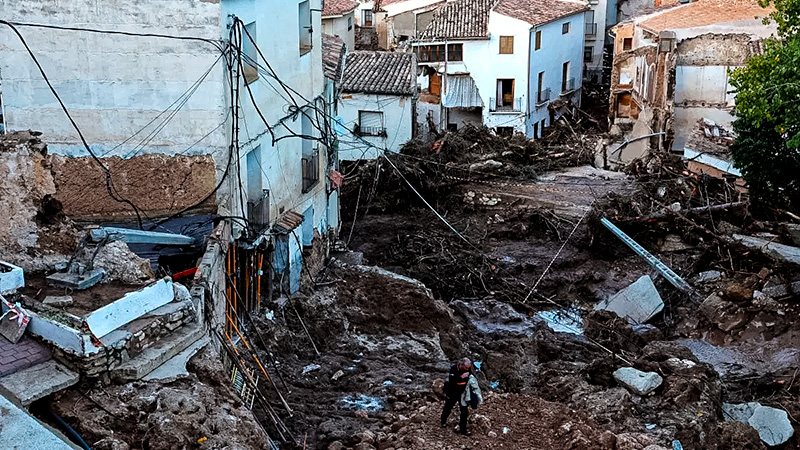 Images from Valencia before and after the disaster showed the scale of the catastrophe, which had turned the Mediterranean city into a landscape of murky waters. The V-33 motorway was stained brown by a thick layer of mud. The tragedy has unleashed a wave of local solidarity. Some residents in towns such as Paiporta, where at least 62 people died, and Catarroja, have walked kilometres to Valencia to get supplies, passing neighbours from unaffected areas who bring water, essential products or shovels to help remove the mud. The large number of people coming to help led the authorities to ask them not to drive there, because they were blocking roads needed for emergency services. In addition to contributions from volunteers, associations such as the Red Cross and local councils were distributing food. And as the authorities repeated again and again, more storms were expected. The State Meteorological Agency (Aemet) issued warnings for heavy rain in Tarragona, Catalonia, as well as in parts of the Balearic Islands. Meanwhile, flood survivors and volunteers were focused on the titanic task of clearing an ever-present layer of thick mud. “This is a disaster. There are many elderly people who do not have medicine. There are children who do not have baby food. We do not have milk, we do not have water. We do not have access to anything,” a resident of Alfafar, one of the worst-affected towns in southern Valencia, told state broadcaster TVE. “Nobody has come here even to warn us on the first day.” Juan Ramón Adsuara, the mayor of Alfafar, one of the worst-affected towns, said that the aid was not enough for residents trapped in a “critical situation.” “There are people living with corpses at home, that is very sad. We are organizing ourselves, but we are running out of everything,” he told reporters. “We go to Valencia with the vans, we shop and we come back, but here we are totally forgotten.” The rushing water turned narrow streets into death traps and created torrents that swept away homes and businesses, leaving many uninhabitable. There was some looting in shops, and authorities arrested 50 people. Social media has channelled the needs of those affected. Some posted images of missing people in the hope of obtaining information about their whereabouts, while others launched initiatives such as Suport Mutu – or Mutual Support, in Valencian – that connected requests for help with people offering it. Others organised collections of basic goods across the country or started fundraisers.
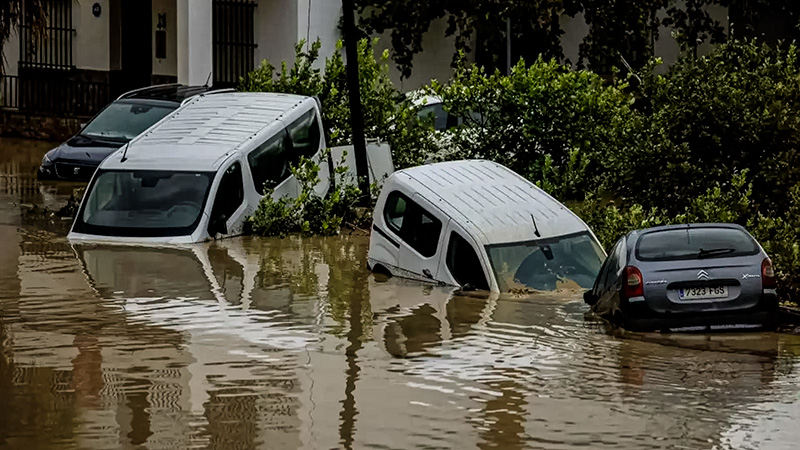
Spain's Mediterranean coast is accustomed to autumn storms that can cause flooding, but this was the most severe flash flood in recent memory. Scientists link it to climate change, which is also behind rising temperatures and droughts in Spain and the warming of the Mediterranean Sea. Man-made climate change has doubled the likelihood of a storm like this week's deluge in Valencia, according to a partial analysis released Thursday by World Weather Attribution, a group of dozens of international scientists who study the role of global warming in extreme weather. Spain has suffered a drought for nearly two years, which worsened flooding because dry soil was so hard it couldn't absorb water. Meanwhile, efforts continue to search for missing people and rehabilitate homes, streets and infrastructure. Since Friday morning, 500 more soldiers have joined the search efforts, along with the 1,200 UME soldiers deployed from almost the first moment.
Document generated in 0 second