News
 Magnitude 7.3 earthquake shakes the Pacific coast between Mexico and Guatemala
- 17/07/2026 » 16:52 by cronywell
Magnitude 7.3 earthquake shakes the Pacific coast between Mexico and Guatemala
- 17/07/2026 » 16:52 by cronywell
🌎 BREAKING NEWS · INTERNATIONAL
Magnitude 7.3 earthquake shakes the Pacific coast between Mexico and Guatemala
A tsunami warning was issued and canceled hours later; so far no victims or serious damage have been reported in Mexico or Guatemala.
✍️ International 📅 Newsroom July 17, 2026 🕒 Reading time: 4 minutes 📍 Tapachula, Chiapas
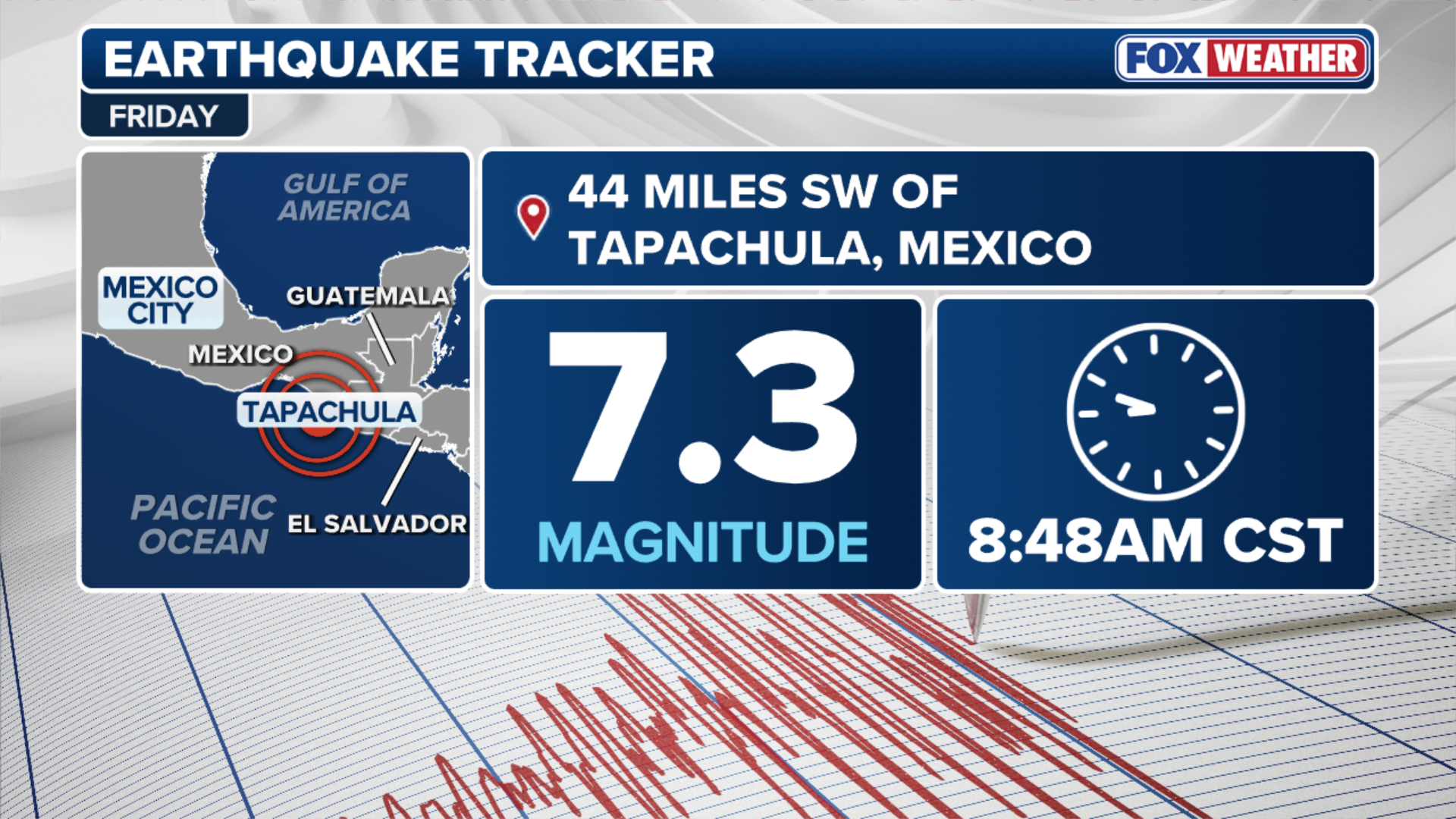
A strong earthquake of magnitude 7.3 shook the Pacific coast on Friday on the border between Mexico and Guatemala, with its epicenter in the Mexican state of Chiapas. The telluric movement, felt from Mexico City to El Salvador, activated a tsunami alert for a few hours for the coasts of both countries, which was later canceled. The Civil Protection authorities are under constant monitoring, although as of the closing of this note no fatalities or material damage of consideration have been reported.
📊 Earthquake data sheet
|
Magnitude |
7.3 (revised from 7.4 preliminary) |
|
Local Date and Time |
Friday, July 17, 2026, 10:48 a.m. (Chiapas) |
|
Epicenter |
48 km (30 miles) southwest of Aquiles Serdán, Chiapas, Mexico |
|
Depth |
≈ 10 km (6.2 miles) |
|
Registered replicas |
At least 5, between magnitude 5.1 and 6.0 (includes earthquakes of 5.3 and 4.7 near Puerto Madero) |
|
Tsunami warning |
Issued and cancelled ≈ 3 hours later, for coasts within 300 km (186 mi) of the epicentre |
|
Seismological source |
United States Geological Survey (USGS) |
📍 What is known so far?
The earthquake was registered around 10:48 a.m., local time in Chiapas, with an epicenter about 48 kilometers southwest of the town of Aquiles Serdán, near Puerto Madero, in the municipality of Tapachula. The U.S. Geological Survey (USGS) initially reported a magnitude of 7.4, which it later adjusted to 7.3 after further analysis. Minutes later, aftershocks of magnitude 5.3 and 4.7 were recorded in the same coastal area.
The shaking was strongly felt in southern Mexico, in much of Guatemala and even in El Salvador, while in Mexico City, located hundreds of kilometers away, the movement was also felt. This is the region of the so-called Pacific Ring of Fire, one of the areas of greatest seismic and volcanic activity on the planet.
⚠️ Tsunami Alert: Activated and then canceled
As a precautionary measure, a tsunami threat watch was issued for the coasts of Mexico and Guatemala located within a 300-kilometer (186-mile) radius of the epicenter. The warning was lifted approximately three hours later, with no major anomalous waves recorded.
In Suchiate, a Mexican town located next to the river that marks the border with Guatemala, Mayor Elmer Vázquez Gallardo confirmed that monitoring was reinforced in coastal areas while the alert was in force. For its part, the Secretariat of Civil Protection of Chiapas reported that it remains active and constantly monitoring the situation in the state.
🗣️ Testimonies from ground zero
In Tapachula, the main city on Mexico's southern border, several residents described how the quake began mildly and intensified over the seconds. Alejandra Mendoza, an administrative employee of a public hospital in the city, told the Associated Press that they were on the second floor when the building began to move; As he explained, "we all evacuated orderly to the front yard" as soon as the shaking became more intense.
🏚️ A region with a recent seismic history
Southern Mexico and Guatemala are areas of high seismicity due to the interaction of several tectonic plates in the Pacific. The collective memory of the region still preserves the 7.1 magnitude earthquake of September 2017, which left hundreds dead in central Mexico, as well as an earthquake registered at the beginning of this year that caused at least two deaths in the south and center of the country. None of these precedents have been repeated, for now, with this Friday's earthquake, for which no casualties or serious structural damage have been reported.
🛡️ Civil protection recommendations
• Stay away from windows, mirrors, and objects that may fall during possible aftershocks.
• Avoid the use of elevators until the authorities confirm that the buildings are safe.
• In coastal areas, keep an eye on official announcements on the status of the tsunami alert.
• Check gas and electricity installations before re-entering damaged buildings.
• Only follow official Civil Protection channels to avoid misinformation.
🔎 What's Next
Authorities in Mexico and Guatemala continue to assess damage in the coastal and border areas closest to the epicenter. The USGS maintains monitoring for possible aftershocks, while civil protection teams from Chiapas and the Guatemalan department of San Marcos remain on alert. This note will be updated as more information becomes available.
🖼️ Related Images
For copyright reasons, the original photographs are not embedded in this document; Listed below are the absolute links to the images and maps published by the media that covered the event.
🔗 Earthquake location map — https://media.foxweather.com/weather/Mexico%20Earthquake%20Locator.png (Fox Weather)
🔗 Cobertura fotográfica y en video — https://www.foxweather.com/extreme-weather/tsunami-threat-issued-mexico-guatemala-after-major-magnitude-7-3-earthquake (Fox Weather)
🔗 Location Picture Report — https://www.foxla.com/news/mexico-guatemala-massive-earthquake-july-17-2026 (FOX 11 Los Angeles)
📚 Sources consulted
🔗 A magnitude 7.4 earthquake shakes the Pacific coast near Mexico and Guatemala — https://www.telemundo.com/noticias/noticias-telemundo/internacional/un-terremoto-de-magnitud-74-sacude-la-costa-del-pacifico-cerca-de-mexi-rcna588010 (Telemundo)
🔗 A 7.3 earthquake hits Mexico-Guatemala border with no immediate damage reported — https://abc7.com/post/73-earthquake-hits-mexico-guatemala-border-no-immediate-damage-reported/19526963/ (ABC7 Los Ángeles / AP)
🔗 Magnitude 7.3 earthquake hits Mexico-Guatemala border — https://www.nbcdfw.com/news/national-international/magnitude-7-4-earthquake-strikes-off-pacific-coast-near-mexico-and-guatemala/4051058/ (NBC 5 Dallas-Fort Worth)
🔗 Tsunami threat canceled for Mexico, Guatemala after magnitude 7.3 earthquake — https://www.foxweather.com/extreme-weather/tsunami-threat-issued-mexico-guatemala-after-major-magnitude-7-3-earthquake (Fox Weather)
 Malvinas flags banned from the stadium
- 15/07/2026 » 22:36 by cronywell
Malvinas flags banned from the stadium
- 15/07/2026 » 22:36 by cronywell
|
🏴🚩⚽ WORLD CUP CONTROVERSY Malvinas flags banned from the stadium The Government endorsed FIFA's restriction for the semifinal against England; the opposition spoke of "demalvinization" and the fans responded with a flag waving in Atlanta Atlanta, United States — July 15, 2026 ⏱️ Estimated reading time: 10-11 minutes |
The Minister of Security, Alejandra Monteoliva, confirmed that Argentine fans would not be able to enter the Mercedes-Benz Stadium in Atlanta with flags or slogans alluding to the Falkland Islands during the semifinal of the 2026 World Cup against England, framing them as "political content". The measure, endorsed by the Government and applied under FIFA and U.S. security protocols, generated a strong repudiation from the opposition and a massive street flag-waving that challenged it hours before the match, which Argentina ended up winning 2-1.
📅 July 15, 2026 ⏱️ Read: 10-11 min 🏷️ Politics · World Cup 2026 · Malvinas · Security
🚫 The measure that ignited the controversy
In the run-up to the semifinal between Argentina and England for the 2026 World Cup, played this Wednesday at the Mercedes-Benz Stadium in Atlanta, the Minister of National Security, Alejandra Monteoliva, confirmed that Argentine fans would not be able to enter the stadium with flags, shirts or posters that referred to the Falkland Islands or with slogans such as "The Malvinas are Argentine".
"Precisely, flags with political content cannot enter. The Argentine flag yes, of course, or the English flag, but nothing that contains a message that could provoke" — Alejandra Monteoliva, Minister of Security
Asked specifically if the slogan "The Malvinas are Argentine" – a claim of sovereignty sustained by the Argentine State since 1833 – could be considered a provocation, the official was categorical: "Exactly, because it is political content." As he explained, the elements that did not comply with the provision would be retained at the access controls, and those who wore clothing with those inscriptions had to change or leave it outside the stadium.
The restriction arose from a meeting held on Monday at the Virginia International Police Cooperation Center, with the participation of the FBI, FIFA and British security authorities, in which the match was classified as a "high risk" match. The operation deployed in Atlanta included some 1,600 troops including state police, private security and federal agents, in addition to differentiated entrances: Argentine fans through gate 4 and English fans through gate 3.
🖼️ Argentine fans in the stands of Atlanta Stadium before the semifinal — see verified image (Shaun Botterill / Getty Images — via Telemundo, live coverage of the match)
⚓ Why Malvinas weighs so much in an Argentina-England match
The football rivalry between the two teams has been traversed, for more than four decades, by the 1982 Falklands War, the war between Argentina and the United Kingdom over the sovereignty of the southern archipelago, in which 649 Argentine soldiers and 255 British combatants died. That tension was indelibly transferred to the sporting plane at the 1986 World Cup in Mexico, when Diego Maradona's goals – the "Hand of God" and the "Goal of the Century" – were forever associated with that geopolitical background.
Since then, each duel between the two teams has revived that cross between football and history, with chants from the Argentine fans that pay tribute to the ex-combatants and flags that combine the blue and white with the silhouette of the islands. The minister recognized precisely that difficulty when referring to the chants: "You cannot prohibit a chant or cover people's mouths," she said, distinguishing between what is said and what is physically exhibited in the stands.
|
Item |
Allowed? |
Category according to the Ministry |
|
Argentine flag (without Malvinas) |
Yes |
Patriotic symbol, not political |
|
English flag |
Yes |
Patriotic symbol, not political |
|
Flag or T-shirt with "The Malvinas are Argentine" |
No |
Political content |
|
Flag with map or silhouette of the islands |
No |
Political content |
|
Chants alluding to the Malvinas or the ex-combatants |
Yes (not controlled) |
Oral expression, not physical object |
|
Bottles and blunt objects |
No |
Security risk |
🗣️ The opposition's rejection: "de-Malvinization"
The announcement generated a rapid cross-cutting rejection in the opposition. Different leaders of Kirchnerism, radicalism and other sectors of Peronism questioned that the government of Javier Milei endorsed equating the claim of sovereignty over the Malvinas with a "provocative message".
● Deputy Paula Penacca (La Cámpora) argued on social networks that banning the Malvinas flag is equivalent to banning the Argentine flag, and described the Government as a "traitor".
● Radical MP Pablo Juliano accused the government of aligning itself with the legacy of Margaret Thatcher, British prime minister during the 1982 war.
● The socialist Esteban Paulón presented a project of repudiation and raised, as an example, whether the government would censor a T-shirt with the map of Argentina, which by definition includes the islands.
● From the Workers' Party, Gabriel Solano described the measure as "reprehensible."
At the other end of the debate, voices from the ruling party defended the decision in terms of security and not of renouncing sovereignty: Vice President Victoria Villarruel, hours before the match, referred to the crossing as a confrontation against "usurping pirates" in reference to the islands, showing that the government's basic position on the claim did not change. beyond the specific restriction ordered for entry to the stadium.
🏳️ The popular response: a flag that defied prohibition
Hours before the match, thousands of Argentine fans filled the Five Points neighborhood, in downtown Atlanta, with a massive flag-waving in which the Falkland Islands were the central protagonists: flags with the legend "proudly Argentine" and images of Messi, Maradona and the archipelago waved despite the restriction announced for the interior of the stadium.
Chants such as "for Malvinas, for Diego, for Leo's last" were sung under torrential rain, in a scene that – according to different media present – passed without incident between both parties, which also shared bars and the official Fan Fest of the city without any confrontations.
🖼️ Argentine flag in Five Points, Atlanta, prior to the semifinal — see verified image (Aníbal Greco / LA NACION)
🏆 The match: Argentina won 2-1 and qualified for the final
Beyond the non-football controversy, Lionel Scaloni's team beat England 2-1 and secured their place in Sunday's final against Spain. Before the kick-off, both players and Scaloni tried to move the axis of the controversy to the strictly sporting field. "Let's make it clear from the outset: it's just a football match," the coach said in the pre-match press conference.
Rodrigo De Paul expressed himself in the same vein: "It's a football match. It has a lot of significance, it brings back many memories of what Diego did, of what happened at that time (...) It was an atrocity that happened, and we always remember it. But what we want is to win to reach the final." Goalkeeper Emiliano "Dibu" Martinez, who has been based in England for years, remarked that "respect is going to be" beyond the historical rivalry.
The Argentine Ministry of Security, in parallel, arranged a mirror operation in Buenos Aires with about 300 members of the Federal Police, with a focus on the British embassy in Recoleta and the Obelisk, the usual epicenter of popular celebrations after the victories of the National Team.
❓ Frequently Asked Questions
❓ Who banned the flags of the Malvinas: FIFA, the United States or the Argentine government?
The restriction was defined jointly by FIFA, U.S. security authorities and the FBI, and had the explicit endorsement of the Argentine government through the Minister of Security, Alejandra Monteoliva, who framed the symbols of Malvinas within the category of "political content" prohibited by the organization's regulations.
❓ What could and could not be entered into the stadium?
Argentine and English flags were allowed without additional registrations. Elements with images of the Malvinas Islands, slogans such as "The Malvinas are Argentine" and, in general, any political, racial or provocative message, as well as bottles and blunt objects, were prohibited.
❓ Were chants about the Malvinas also banned?
No. The minister herself clarified that the restriction only reached physical objects that were intended to enter the stadium, not the chants of the fans, since – in her words – "you cannot cover people's mouths".
❓ How did the political opposition react?
Leaders of La Cámpora, the Radicals, Socialism and the Workers' Party repudiated the measure and described it as an attempt at "de-Malvinization", even presenting a legislative project of rejection. They questioned equating a claim to territorial sovereignty with a political provocation.
❓ Were there any incidents between Argentine and English fans?
No incidents were reported. According to the journalistic coverage on the ground, both parties coexisted without conflicts both in the previous flag and in the bars and the official Fan Fest of Atlanta.
❓ Who won the match?
Argentina beat England 2-1 and qualified for the final of the 2026 World Cup, which will be played on Sunday against Spain.
📚 Sources consulted
• LA NACION — Leaders of the opposition against the ban
• LA NACION — Preview of the semifinal in Atlanta
• Profile — The Government backed the ban on the symbols of the Malvinas
• Financial Sphere — Flags over the Malvinas were prohibited
• Page/12 — Entry to the stadium with flags alluding to the Malvinas is prohibited
• Minuto Uno — Argentine flag in Atlanta
• El Argentino Diario — The flag-waving defied the official ban
 DIEGO SANTILLI TO THE CABINET
- 28/06/2026 » 11:30 by cronywell
DIEGO SANTILLI TO THE CABINET
- 28/06/2026 » 11:30 by cronywell
|
🏛️ CRISIS IN THE EXECUTIVE BRANCH DIEGO SANTILLI TO THE CABINET The end of the Adorni cycle and Milei's bet on a political operator to save his administration |
|
🕐 Reading time: ~9 min |
📅 June 28, 2026 |
✍️ Political analysis |
🏷️ [Diego Santilli] [Chief of Staff] [Manuel Adorni] [Milei] [Argentine Political Crisis] [Government 2026]
🔗 See image: Diego Santilli, Minister of the Interior and new Chief of Staff appointed (Infobae)
Diego Santilli, Minister of the Interior and new Chief of Staff appointed (Infobae)
IN THIS ARTICLE
01 Manuel Adorni's resignation after three months of accumulated scandals
02 Diego Santilli's political profile and why he was elected
03 The Coming Ministerial Restructuring
04 The political cost of the Adorni case for the government
05 Analysis: Can Santilli stabilize Milei's administration?
06 Reactions of the opposition and allies
1. The fall of Adorni: three months that shook the government
On Friday, June 27, 2026, Manuel Adorni published on his social networks a letter of resignation from the position of Chief of Staff with a single final word: "End." With that laconic closure, the most turbulent cycle of the Milei administration to date ended: more than three months of heritage scandals, questionable trips, judicial investigations and a war of attrition that paralyzed the government's legislative agenda and fractured key alliances.
Adorni's departure was not a resignation in the strict sense of the term. According to sources with access to the presidential decision-making circle, it was the President's own entourage that asked him to step aside. Adorni resisted for more than three months protected by the explicit support of Javier Milei, who until Friday, from Madrid, insisted that he would not displace him if the Justice did not certify corruption.
|
⚡ |
KEY FACT 65.3% of citizens had a negative assessment of the Government according to the consulting firm Trespuntozero in June 2026. Concern about corruption jumped 10 points in five months, to 38.5%, becoming the main problem pointed out by respondents. |
The chronology of a collapse foretold
The plot of the Adorni scandal began in Queens, New York, with an innocent image. A photo of Adorni with his wife Bettina Angeletti in the Lubavitcher cemetery, during the presidential procession of Argentina Week, lit the first fuse.
|
Mar. 2026 |
Adorni's wife, Bettina Angeletti — without public office — travels on the presidential plane to New York. First controversy: Adorni justifies the presence of his 'life partner'. |
|
Feb. 2026 |
It is revealed that Adorni traveled by private jet to Punta del Este during Carnival with journalist Marcelo Grandío, whose production company (Imhouse SA) had contracts with TV Pública. |
|
Mar. 2026 |
Justice opens a case for alleged illicit enrichment. Prosecutor Gerardo Pollicita and Judge Ariel Lijo take over the file. Raids on Alpha Centauri company. |
|
Apr. 2026 |
An apartment in Caballito of ~200 m² bought for US$ 230,000 is detected, with 87% financed by two retirees. Additional works for US$ 250,000 in cash and without invoice. |
|
Jun 2026 |
Adorni corrects his affidavit: he incorporates ~u$s 500,000. He justifies the origin in Bitcoin stored on a pen drive, but videos of him saying that he did not understand that cryptocurrency circulate. |
|
Jun 2026 |
Transcend purchases of gamer equipment with employee cards. Milei, from Madrid, conditions for the first time the continuity of Adorni to Justice. |
|
27 Jun 2026 |
Adorni publishes his resignation letter. Diego Santilli is confirmed as the new Chief of Staff. |
|
|
"If they consider him guilty, I fly him, I kick him out." — Javier Milei, from Spain — days before Adorni's resignation |
2. The scandal that paralyzed a government
The Adorni case far exceeded the judicial file. In political terms, the damage was systemic: the government's legislative agenda was paralyzed for weeks because the opposition blocs – and some allies – conditioned any progress in Congress on the departure of the Chief of Staff.
In the Senate, the ruling party was forced not to give a quorum to block a request for Adorni's interpellation, but that temporary halt had an expiration date: Wednesday, July 1, when the Constitutional Affairs Commission was scheduled to deal with the issue. The result would have been unfavorable to him.
The departure of Esteban Bullrich from the PRO – a moderate figure in the party – was another collateral damage. The former Buenos Aires senator announced his departure by coining the phrase that defined the moment: with Adorni we lower the last flag.
|
+415% Adorni's real wealth growth since 2023 |
u$s 424K Assets declared (rectified) in 2025 |
3 causes Judicial investigations opened in Comodoro Py |
>90 days Duration of the scandal before the resignation |
🔗 See image: Manuel Adorni in his last press conference as Chief of Staff
Manuel Adorni in his last press conference as Chief of Staff (La Política Online)
3. Diego Santilli: the tightrope walker who reaches the center of the board
It is not a surprising name. When Adorni's collapse became irreversible, Interior Minister Diego Santilli — nicknamed "El Colo" — had been the strongest candidate for succession for weeks. Not by improvisation, but by patient and deliberate political construction.
A profile designed for consensus
Santilli has something that is lacking in libertarian internal politics: simultaneous arrival with all the relevant sectors of power without having broken with any of them. He maintains a fluid relationship with Karina Milei, the secretary general of the Presidency. He is in tune with presidential advisor Santiago Caputo. And he has the explicit support of Patricia Bullrich, head of the ruling bloc in the Senate.
This equanimity is not accidental. Santilli arrived at the Ministry of the Interior in November 2025 after one of the most notable electoral comebacks in recent Buenos Aires political history: when José Luis Espert fell from the official list due to his links to businessman Federico Machado, Santilli was at the head of a candidacy that many thought was lost, and he won.
|
🧭 |
POLITICAL PROFILE Son of the historic Peronist leader Hugo Santilli, he started in the PJ in the 90s. He migrated to Macri's PRO and was deputy head of the Buenos Aires government (2015-2021). He headed the JxC list in the Province of Buenos Aires in 2021, defeating Facundo Manes in the internal election. He supported the Bases Law and other key initiatives of the Milei administration. |
The meeting that set the course
On Friday night, in total secrecy, Karina Milei, Santilli and Martín Menem met at the Casa Rosada. That meeting ended up setting the course: it was in that area that the offer to the Minister of the Interior was formally advanced. According to those close to the Buenos Aires politician, he was not enthusiastic — the position complicates his projection as a candidate for governor in 2027 — but no one in the government believes that he can say no to the President.
|
|
"El Colo is a point of balance in the internal libertarian. He reports to Karina Milei, he has a good relationship with Santiago Caputo, and the objective of his arrival is not to get into that fight." — Government sources — La Política Online, June 2026 |
Adorni vs. Santilli: two styles, two moments
|
Manuel Adorni (outgoing) |
Diego Santilli (incoming) |
|
Former presidential spokesman (2023-2025) |
Minister of the Interior (2025-2026) |
|
Communication and media profile |
Operational and political negotiation profile |
|
No electoral base of its own |
Elected deputy for the Province of Buenos Aires |
|
Fall due to property scandals |
It arrives with broad internal consensus |
|
Investigated for illicit enrichment |
No active legal cases |
|
Paralysis of legislative agenda |
Objective: to unblock the Congress |
4. Ministerial restructuring: what changes and what remains
Santilli's arrival as Chief of Staff is not a simple change of names: it implies a significant reconfiguration of the organizational chart of the libertarian government, with a direct impact on the Ministry of the Interior and the architecture of power around the Casa Rosada.
Interior returns to the orbit of the Headquarters
The first relevant structural change is the reintegration of the Ministry of the Interior under the wing of the Chief of Staff, reversing the autonomy that this portfolio had acquired since Santilli led it. The model once again resembles the previous scheme: centralized political coordination, as it worked with Guillermo Francos and Lisandro Catalán in the first stage of the government.
|
🔄 |
KEY STRUCTURAL CHANGE The Ministry of the Interior will once again report to the Chief of Cabinet. Ignacio Devitt – Adorni's Secretary of Strategic Affairs – is expected to take over as the new head of the Interior. All of Adorni's political collaborators made their resignations available to the future Chief of Staff. |
Changes in presidential communication
The redesign of the political area already began before the formal announcement. The resignation of Press Secretary Javier Lanari and the appointment of economist Adrián Ravier as the new presidential spokesman were interpreted as clear signs that the reorganization was underway. Fabián Rodríguez, Horacio Marín's former spokesman at YPF, took over as Secretary of Communication and Press.
The new scheme seeks to separate the functions of ministerial coordination – which will fall on Santilli – from those of political communication, avoiding the concentration of power that characterized the Adorni cycle, where the Chief of Staff accumulated roles until he was overexposed.
What Santilli will have to manage from day one
▸ Unblock the paralyzed legislative agenda, including the Private Property Law.
▸ Coordinate with governors and financial advances to the provinces to maintain political balance.
▸ Manage the relationship with the PRO and the opposition dialogue blocs.
▸ Contain the deterioration of the government's image after the impact of the Adorni case.
▸ Organize the presidential communication structure during the transition period.
5. The political cost of the Adorni case for the libertarian project
Beyond the judicial files, the political impact of the Adorni case on Milei's government was profound and multidimensional. The administration that came to power promising to exterminate the "caste" and corruption, had to live for more than three months with a Chief of Staff investigated for illicit enrichment.
The President tried to shield his official with unusual resources: posters, public statements, joint appearances at official events. From Spain, he went so far as to say that media coverage had violated the limits of the human. But the accumulated wear and tear was impossible to stop.
|
⚠️ |
INSTITUTIONAL PARADOX The government that came to power with a radical anti-corruption discourse ended up protecting for 90 days an official investigated for illicit enrichment, undeclared assets and alleged gifts. The cost of this contradiction was measured in polls, broken alliances and legislative paralysis. |
The final pressure to remove Adorni came from several simultaneous fronts: the imminence of the interpellation and motion of censure in the Senate, the advance of the Justice towards a possible summons for questioning, the polls that showed a drop in the presidential image, and the explicit warning of Mauricio Macri that the PRO would vote for the impeachment if the Government did not act.
|
|
"Milei cannot allow Congress to throw out the Chief of Staff. The blow to the markets would be tremendous." — Government official, in a confidential dialogue — La Política Online |
6. Political reactions: between relief and caution
The confirmation of Adorni's departure and the appointment of Santilli generated disparate reactions on the Argentine political chessboard. Within the ruling party, the news was received with relief in most sectors. In the opposition, with a mixture of satisfaction with the result and skepticism about whether change will be enough.
Within the Government
✅ Patricia Bullrich, head of the bloc in the Senate, was one of the main promoters of the departure and supports Santilli's arrival.
✅ Martín Menem, president of the Chamber of Deputies, participated in the decisive meeting on Friday night.
✅ Santiago Caputo confirmed his agreement with the designation, which marks a moment of relative peace in the "iron triangle".
✅ Karina Milei personally coordinated the details of the ministerial transition.
From the opposition
🔵 Several blocs had conditioned their support for the reforms on Adorni's departure. The new situation opens a window for negotiation.
🔵 The promoters of the interpellation said that Adorni's resignation does not close the judicial files, which continue.
🔵 The dialogue opposition will evaluate Santilli's first moves to define his legislative position.
Meeting between Karina Milei, Santilli and Martín Menem sealed the course on Friday night (Infobae)
7. Analysis: can Santilli stabilize management?
The question that all political actors in Buenos Aires are asking themselves this Sunday, June 28, is whether Diego Santilli has the capacity and capital to stabilize an administration that has been accumulating turbulence for several months.
The tentative answer is that it has better conditions than its predecessor to try, but it also faces its own restrictions. The Chief of Staff who arrives is not a man from La Libertad Avanza: he comes from the PRO, has a Peronist history and his electoral base is in the province of Buenos Aires. That heterodoxy can be an asset to negotiate with governors and opposition sectors, but also a source of tension in a political space that values ideological purity.
From the institutional point of view, the position of Chief of Staff has in the Argentine Constitution an explicit role of coordination with Congress and political accountability. The fact that this role is now occupied by an operator with legislative and territorial experience – rather than a media spokesperson – represents, in itself, a turn towards a more pragmatic management.
|
📊 |
VARIABLES TO MONITOR The real test of Santilli's management will be: (1) the first management report to Congress; (2) the ability to move forward with the Private Property Law and other pending reforms; (3) the evolution of his image as a potential candidate for governor of Buenos Aires in 2027; (4) the management of the relationship with the PRO and Milei's bloc. |
The big question in the medium term is whether Santilli accepted the Cabinet Chief as a definitive political destiny or as a stage of service within a trajectory that points to the Buenos Aires Governorship. That ambiguity can condition their internal authority and their ability to lead ministerial coordination with the energy and commitment that the moment demands.
8. Conclusion: A change of helm with open-ended questions
The departure of Manuel Adorni and the arrival of Diego Santilli as Chief of Staff marks a turning point in Javier Milei's administration. It is not a simple change of names: it is evidence that the government has had to double down in the face of the accumulated pressure of politics, justice and public opinion.
The President, who insisted until the last moment on defending Adorni, gives in to a reality that his own allies clearly pointed out to him: the permanence of the Chief of Staff under investigation was a burden that compromised not only the image of the Government, but also his own ability to govern.
Santilli arrives with political capital, territorial experience and the simultaneous confidence of the most relevant sectors of the official space. But the challenge ahead is enormous: to rebuild the political coordination of a government that has lost time and alliances, while maintaining the economic course that is the main asset of the libertarian project.
Political Argentina is rarely linear. This Sunday, with Santilli's appointment still hot, the questions that remain open are as important as the certainties. And the history of these months teaches that in the Milei era, everything can change faster than any chronicler can write.
📚 SOURCES AND REFERENCES
→ Politics Online — Diego Santilli is the new Chief of Staff
→ Infobae — The resignation of Adorni and Santilli with consensus for the succession
→ La Nación — Milei back, Adorni's departure is being prepared
→ The Chronicler — Adorni's Travels, Undeclared Goods and Contradictions
→ Bloomberg Line — Gamer purchases and Milei's warning about Adorni
→ Infobae — Travel, property and cryptocurrencies: keys to the scandal
→ iProfesional — Santilli to Headquarters and Devitt to Interior
→ MDZ Online — Who is Diego Santilli
🔍 SEO KEYWORDS
Diego Santilli Chief of Staff · Manuel Adorni resigns · Milei government 2026 · political crisis Argentina · Ministerial restructuring · Chief of Staff Argentina · Karina Milei · Santiago Caputo · Patricia Bullrich · PRO Milei · illicit enrichment Adorni · Argentine Cabinet Reform · Politics Argentina June 2026
Article produced with journalistic research from verified open sources. All the data comes from Argentine media of reference. Publication date: June 28, 2026.
 Manuel Adorni under pressure: Justice investigates the origin of his assets
- 14/06/2026 » 10:38 by cronywell
Manuel Adorni under pressure: Justice investigates the origin of his assets
- 14/06/2026 » 10:38 by cronywell
🔥 Manuel Adorni under pressure: Justice investigates the origin of his assets and political tension grows in Milei's government
📅 Updated: June 2026
⏱ Reading time: 9 minutes
✍️ Political Writing | Special Research
📌 SEO Meta Description
The judicial investigation into Manuel Adorni's assets escalated in recent days after his statements about Bitcoin savings found on a pen drive. The opposition demands explanations and the case generates tension within the government of Javier Milei.
🏷️ SEO keywords
Manuel Adorni, Adorni heritage, Bitcoin Adorni, Adorni cryptocurrencies, Adorni judicial investigation, Javier Milei, Congress, Adorni affidavit, illicit enrichment, Argentine politics.
⚖️ The case that shakes the Casa Rosada
The situation of the Argentine Chief of Staff, Manuel Adorni, became one of the main focuses of political conflict for the administration of Javier Milei.
What began as an investigation into asset inconsistencies ended up becoming a nationwide political scandal after Adorni attributed part of his economic growth to investments in Bitcoin and funds stored on a pen drive that, according to his version, had remained lost for years. (Checked)
The explanation, far from closing the doubts, opened new judicial and political questions.
📈 The wealth growth that set off alarm bells
The Justice is trying to determine if there is a correspondence between the income declared by the official and the significant increase registered in his assets during the last years.
According to documents and public statements analyzed by different media, Adorni made rectifications in his affidavits and incorporated assets linked to cryptocurrencies that were not previously listed in official records. (Checked)
The central axis of the research focuses on:
✅ Transactions with cryptocurrencies not previously declared.
✅ Funds in dollars whose traceability is being examined.
✅ Inconsistencies between previous and subsequent statements.
✅ Documentary justification of the origin of the resources.
The prosecutor's office seeks to establish if the documentation presented is sufficient to explain the accumulated assets and rule out possible irregularities. (Filo News)
₿ Bitcoin, a pen drive and an explanation that generated controversy
During television interviews and subsequent public clarifications, Adorni maintained that part of his wealth comes from an investment made years ago in Bitcoin.
According to his account, he would have invested approximately USD 200,000 in cryptocurrencies and later obtained profits close to USD 300,000. Part of those assets were stored in a digital wallet contained in a pen drive that, he said, remained lost for a while before being recovered. (Instagram)
The explanation provoked an immediate political and media reaction.
Specialists consulted by different media recalled that operations carried out through blockchain usually leave verifiable traces, allowing movements, dates and transfers associated with digital wallets to be reconstructed. (Infobae)
This aspect is considered key to the progress of the investigation.
🔍 The traceability of cryptocurrencies: a key piece
One of the elements that arouses the most interest among researchers and analysts is the possibility of reconstructing the financial history of digital assets.
Unlike cash, transactions recorded on the blockchain can leave verifiable technical evidence.
Experts in financial technology pointed out that, if the wallets used are identified, movements, purchase dates, sales and transfers could be analyzed to determine if the explanations match existing records. (Infobae)
This aspect could become one of the most relevant pieces of evidence in the file.
🏛️ Opposition increases pressure on Congress
The official's explanations failed to defuse opposition criticism.
Various political sectors are promoting requests for reports, subpoenas and parliamentary measures aimed at clarifying the origin of the declared funds. (El País)
Among the main questions are:
🔹 Alleged contradictions in public statements.
🔹 Subsequent modifications of affidavits.
🔹 Lack of documentation considered sufficient by opposition sectors.
🔹 Possible impact on the transparency standards required of public officials.
The case has already begun to occupy a large part of the legislative agenda and threatens to become a new front of attrition for the ruling party.
⚠️ Internal noises in the Government
Although publicly President Milei maintains his political support for Adorni, different journalistic versions indicate that the episode generated discomfort within sectors of the ruling party. (El País)
The main concern would not be linked exclusively to the judicial aspect but to the political cost of a controversy that contradicts one of the main discursive axes of the libertarian administration: the fight against privileges and corruption.
Political sources consulted by national media describe a scenario where the continuity of the controversy threatens to displace other priority issues on the government's agenda. (El País)
💬 The phrase that amplified the controversy
Among the statements that generated the greatest impact is a statement made by Adorni when referring to his personal savings.
The official said that many Argentines had historically chosen to keep money outside the formal circuits to protect themselves from inflation and tax pressure. That explanation was interpreted by critics and opponents as an admission of having kept undeclared funds. (Infobae)
The repercussions multiplied both in the political sphere and on social networks.
📊 The institutional impact
Beyond the possible judicial consequences, the case raises questions about the mechanisms of patrimonial control applied to public officials.
Transparency specialists point out that situations of this type usually generate three immediate effects:
📍 Erosion of institutional credibility
Public confidence is affected when there are doubts about the consistency of asset declarations.
📍 Increasing political polarization
The opposition finds arguments to question the government while the ruling party is forced to defend its officials.
📍 Judicialization of the public agenda
The courts come to occupy a central place in the national political discussion.
📸 Reference images available on the Internet
Manuel Adorni
Institutional source:
Casa Rosada
Bitcoin (illustrative image)
https://upload.wikimedia.org/wikipedia/commons/4/46/Bitcoin.svg

Source:
Wikipedia Commons - Bitcoin

📝 Conclusion
The investigation into Manuel Adorni's assets has become one of the most delicate political episodes for Javier Milei's government since the beginning of his administration.
While the Justice tries to determine if there is sufficient documentation to support the origin of the declared funds, the opposition intensifies parliamentary pressure and the ruling party faces the challenge of managing a crisis that directly affects its discourse on transparency and public ethics. (Filo News)
The result of the asset expertise, the analysis of the operations linked to cryptocurrencies and the judicial decisions that may arise in the coming weeks will be decisive in defining the political future of one of the officials closest to President Milei. (Infobae)
Advanced SEO Applied
✅ Primary keyword in H1
✅ Secondary keywords distributed semically
✅ H2/H3 structure optimized for Featured Snippets
✅ Indicated
✅ reading time Optimized meta description(150 characters approx.)
✅ Natural keyword
✅ density Identified✅
political entities Mobile anddesktop
✅ scannability
Format compatible with WordPress, Elementor, Rank Math and Yoast SEO✅ Periodstyle E-E-A-T (Experience, Expertise, Authoritativeness, Trustworthiness) of 2026.
HISTORIC RULING: The Federal Court of Córdoba ordered to pay $95 million to the family
- 30/05/2026 » 10:57 by cronywell
⚖️ JUSTICE & PUBLIC HEALTH
|
⚖️ JUSTICE & PUBLIC HEALTH |
🕐 ~12 min read |
HISTORIC RULING: The Federal Court of Córdoba ordered to pay $95 million to the family of a young woman who died after the Sputnik V vaccine
The Federal Court of Appeals of Córdoba determined that Melín Agustina Sartori, 24, died as a direct result of an adverse effect of the Sputnik V vaccine. The ruling, unprecedented in Argentina, obliges the Ministry of Health of the Nation to pay compensation equivalent to 240 minimum retirement benefits – about 95 million pesos – and sets a precedent that could reopen the debate on state responsibility in mass vaccination campaigns.
📅 May 30, 2026 | ✍️ Journalistic writing | 📍 Cordoba, Argentina
🖼️ [ See reference image: Syringe and vaccine — Unsplash ]
Illustrative image — COVID-19 vaccine (Unsplash / Hakan Nural)
📋 CASE FILE
|
👩 Victim |
Melín Agustina Sartori, 24 years old |
|
📅 Vaccination |
July 15, 2021 — Orfeo Superdomo, Córdoba |
|
💉 Vaccine applied |
Sputnik V (first dose — adenoviral vector) |
|
🏥 Diagnosis |
Thrombosis with thrombocytopenia syndrome (VITT) |
|
☠️ Death |
July 29, 2021 (14 days post-vaccination) |
|
⚖️ Tribunal |
Chamber A — Federal Court of Appeals of Córdoba |
|
👨 ⚖️ Signatory judges |
Liliana Navarro, Graciela Montesi, Eduardo Ávalos |
|
💰 Indemnification |
$95 million approx. (240 minimum retirement benefits) |
|
📜 Applied law |
Law 27,573 — COVID-19 Reparation Fund |
|
⏱️ Deadline to the State |
30 days to complete the administrative procedure |
🩺 MELÍN'S STORY: A YOUNG WOMAN WITH NO RECORD
Melín Agustina Sartori was 24 years old and, as described by her entourage during the judicial process, she was in excellent health. He practiced sports regularly and had just started a family business making artisanal pasta. Her family remembered her as a young woman socially committed, generous and full of projects.
On July 15, 2021, Melín went to the Orfeo Superdome in the city of Córdoba to receive the first dose of the Sputnik V vaccine, as part of the national immunization campaign against COVID-19. He did not have any pre-existing pathology that could condition a severe adverse reaction. He was, apparently, the profile of the person that every health campaign considers to be of low risk.
Six days after vaccination, on July 21, he began to show symptoms that at first seemed minor: intense headaches and persistent vomiting. In a first medical consultation, the condition was interpreted as gastroenteritis and the young woman was sent home. However, two days later spontaneous bruises appeared on her face and signs of neurological deterioration that alerted her family.
|
|
"Melín had no record. She was a healthy, sporty girl. What happened to him was absolutely unexpected." — Family environment — Judicial reconstruction |
Hospitalized urgently, laboratory studies revealed an alarming panorama: a platelet count of just 27,000/mm³, when normal values range between 150,000 and 400,000. The diagnosis confirmed a thrombosis syndrome with thrombocytopenia (TTS), also known in the international scientific literature as VITT (Vaccine-Induced Immune Thrombocytopenia and Thrombosis). The condition progressed rapidly, causing irreversible neurological deterioration. Melín underwent surgery that failed to reverse the damage. He died on July 29, 2021, just 14 days after receiving the vaccine.
🧬 WHAT IS VITT: THE SYNDROME THAT SCIENCE WAS SLOW TO RECOGNIZE
VITT syndrome (vaccine-induced immune thrombotic thrombocytopenia) is an extremely rare adverse reaction that was identified and documented worldwide during COVID-19 vaccination campaigns, mainly associated with adenoviral vector technology vaccines, such as AstraZeneca/ChAdOx1 and Sputnik V itself.
The mechanism is autoimmune in nature: the body generates IgG antibodies directed against platelet factor 4 (FP4), which triggers a paradoxical activation of platelets, simultaneously generating clots in blood vessels and a drastic drop in platelet count. The clinical paradox—thrombosis and thrombocytopenia at the same time—is what makes VITT especially severe and difficult to treat with conventional protocols.
|
🔬 KEY FACT: Anti-platelet factor 4 IgG antibodies In the judicial file, the medical experts detected in Melín Sartori's blood the presence of IgG antibodies against platelet factor 4, a biological marker considered unequivocal of the VATT syndrome. Its detection, added to the absence of previous exposure to heparin (one of the possible alternative factors), was decisive in establishing the causal link with vaccination. |
Symptoms of VITT usually develop 4 to 30 days after vaccination. In Sartori's case, they appeared on the sixth day. According to the Clinical Hospital of the University of Santiago de Compostela, cited in studies included in the file, it is an event of very low incidence in relation to the total number of doses administered worldwide, although with high mortality once the condition reaches advanced stages.
A report prepared by specialists from the Institute of Pharmacovigilance Sciences of the University of Southampton (United Kingdom), published in The New England Journal of Medicine and assessed by the court, concluded that Melín Sartori's case met the criteria for level 1 of the determination of certainty of vaccine-induced immune thrombotic thrombocytopenia.
📁 THE LONG ROAD TO JUSTICE: FIVE YEARS OF STRUGGLE
After the death of her daughter, María Virginia Ruiz filed a claim with the COVID-19 Reparation Fund, the mechanism created by Law 27,573 and Decree 431/2021 to compensate people who had suffered physical harm or died as a direct result of the vaccines applied during the pandemic. However, the administrative path was as tortuous as the judicial process that would follow.
In the first instance, the Superintendence of Labor Risks (SRT) rejected the request. The National Commission for Vaccine Safety (Conaseva) had classified the adverse event as "Indeterminate B1", concluding that there was insufficient scientific evidence to establish a direct causal relationship between the Sputnik V vaccine and the death. The family was not satisfied with that answer and decided to take the case to the federal courts.
|
|
"It was a novel process. It touched on a whole issue that was not standardized. At the time of initiating the lawsuit, there was no similar precedent in the country." — Martín Barbará, lawyer for the Ruiz-Sartori family |
The judicial process lasted for almost five years. During that time, the international scientific consensus on VITT matured and consolidated. In May 2024, a turning point: Conaseva itself reviewed the file and, based on the new medical evidence available, reclassified the event. The commission concluded that there was "evidence of causality with the vaccine" and elevated the case to the "A1 Related" category, the highest level of causal certainty on the post-vaccine adverse event rating scale.
That reclassification was a central element for the final resolution of the Chamber. Lawyer Barbará also pointed out that Sputnik V "did not have pharmacovigilance", that is, it did not have a continuous monitoring system for adverse reactions comparable to that of other vaccines authorized by international organizations such as the EMA or the FDA, which made it difficult to detect and recognize this type of event early.
⚖️ THE RULING: WHAT THE FEDERAL COURT SAID
Chamber A of the Federal Court of Appeals of Córdoba, made up of Judges Liliana Navarro and Graciela Montesi together with Judge Eduardo Ávalos, issued a resolution that legal doctrine already points out as historic in terms of the civil liability of the State in the face of adverse effects of vaccines.
The ruling states that "based on the elements gathered, it is possible to conclude that the event is related to the placement of the Sputnik V vaccine." The court assessed, among other evidence: the medical reports that detected IgG antibodies against FP4; the expert testimonies of hematologist Ana Romina Montivero and pharmacovigilance expert Raquel Herrera Comoglio, who stated that the absence of heparin allowed them to conclude "without a doubt" that the picture corresponded to a VITT triggered by the vaccine; and the 2024 Conaseva reclassification itself.
Judge Liliana Navarro was especially blunt in her vote: "The discussion on the causal link, far from persisting, is technically clear." The ruling also clarifies that the current regulations do not require absolute certainty, but that it is enough to prove the damage and its causal link through the preponderance of the evidence, a standard that, in the court's opinion, the victim's mother satisfied "comfortably".
|
📌 FAILURE DEVICE 1. Formal recognition of the direct causal link between the application of the Sputnik V vaccine and the death of Melín Agustina Sartori. 2. Order to the Ministry of Health of the Nation to complete, within 30 days, the pending stages of the procedure provided for in points 5 and 6 of the Annex to Joint Resolution 7/2022 (procedure for claims of the COVID-19 Reparation Fund). 3. Setting the compensation at 240 minimum retirement benefits, equivalent to approximately $95 million pesos at the time of the ruling. |
The ruling also specifies that the judgment will be final subject to the appeals that the parties may file. The Ministry of Health of the Nation, represented in the process, had not issued public comments at the time of going to press.
🏛️ LEGAL FRAMEWORK: LAW 27,573 AND THE REPARATION FUND
Law 27,573, enacted in November 2020 during the presidency of Alberto Fernández, authorized the National Executive Branch to enter into contracts for the provision of vaccines against COVID-19 and established, among its provisions, the creation of a Reparation Fund aimed at compensating people who suffered physical harm as a direct result of immunization.
Decree 431/2021 regulated access to this fund, establishing that claimants had to prove the causal link through specialized medical commissions and that the corresponding compensation would be calculated based on minimum retirement benefits, a formula that the Córdoba ruling applied to set $95 million.
However, as evidenced in the Sartori case, the administrative mechanism proved insufficient to guarantee effective access to reparation. The family had to go through almost five years of legal litigation to obtain the recognition of a right that the law had provided. This gap between the regulatory design and the practical reality of its application is one of the points that the ruling implicitly highlights.
▪ Law 27,573 (Nov. 2020): authorization of vaccine contracts and creation of the Reparation Fund.
▪ Decree 431/2021: regulation of access to the fund and methodology for calculating compensation.
▪ Joint Resolution 7/2022: administrative procedure for the processing of complaints.
▪ Conaseva reclassification (May 2024): official recognition of the causal link "Related A1".
🌐 PRECEDENT AND REPERCUSSIONS: WHAT CAN CHANGE?
The ruling of the Federal Court of Córdoba is not only the resolution of an individual case. It is the first of its kind in Argentina to judicially establish the causal relationship between a COVID-19 vaccine and a death, also ordering concrete reparations to the State. As such, it sets a legal precedent that specialists in health law already describe as of enormous significance.
First, the ruling could encourage other families who went through similar situations – and whose claims were rejected or are pending in administrative proceedings – to resort to the courts with a greater probability of success. Argentina applied more than 100 million doses of different vaccines against COVID-19 between 2021 and 2023. Although VITT is statistically rare, even a minimal incidence rate over that volume can account for tens or hundreds of cases.
Secondly, the precedent puts under the magnifying glass the pharmacovigilance system with which Sputnik V operated in Argentina. Lawyer Barbará was explicit in pointing out that the Russian vaccine did not have the continuous monitoring mechanisms that other vaccines approved in the framework of complete clinical trials by bodies such as the EMA or the FDA had. That absence of robust safety data made it difficult for years to recognize serious adverse effects.
|
|
"The discussion about the causal link, far from persisting, is technically clear." — Judge Liliana Navarro — vote in the ruling |
Thirdly, the case reopens the debate on the responsibility of the State when, in the context of a global health emergency, it authorises and massively promotes a vaccine that did not complete all the usual approval steps. The balance between epidemiological urgency and individual safety is a tension that international health law has been discussing since the first months of the pandemic, and that this ruling turns into a concrete legal issue with economic consequences for the Argentine public treasury.
🔍 CONTEXT: SPUTNIK V IN ARGENTINA
The Sputnik V vaccine, developed by the Gamaleya National Center for Epidemiology and Microbiology of the Russian Federation, was the first to be authorized for emergency use in Argentina, in December 2020, during the government of Alberto Fernández. The decision was controversial from the beginning: the vaccine had completed only phase II of its clinical trials at the time of Argentine authorization, and bodies such as the EMA never approved it for use in the European Union.
Argentina acquired millions of doses of Sputnik V and applied it massively during the first half of 2021, at a time when the availability of other vaccines was still limited. The vaccine was the basis for the start of the national vaccination plan for broad sectors of the population. In October 2021, the Argentine State returned to the Russian Direct Investment Fund (RDIF) more than 1.3 million doses that had been requested to replace other items.
The Sartori case is the first in which the Argentine justice system formally establishes that a death that occurred during that campaign was causally linked to the Russian vaccine. The symbolic and legal impact of that determination is hard to overestimate.
🖼️ [ See reference image: Mass vaccination campaign — Unsplash ]
Illustrative image — Mass vaccination (Unsplash / Mufid Majnun)
🗝️ 5 KEYS TO THE RULING TO UNDERSTAND ITS SCOPE
▪ First ruling of its kind in Argentina. No Argentine court ruling had previously established the causal relationship between a COVID-19 vaccine and a death, also ordering economic reparations to the State.
▪ The evidentiary standard is the "preponderance of the evidence." The court made it clear that the law does not require absolute certainty to access compensation, which opens the door to other similar cases.
▪ The reclassification of Conaseva was decisive. The technical body recognized in 2024 the causal link that it had initially denied, radically changing the balance of the file.
▪ The absence of pharmacovigilance is a central argument. The case exposes the fragility of the safety monitoring system with which Sputnik V operated in Argentina, a vaccine that never received approval from the EMA or the FDA.
▪ The State has 30 days to act. If the Ministry of Health does not complete the procedure within the established period, the family could request measures of forced execution of the sentence.
📝 FINAL REFLECTION: JUSTICE, SCIENCE AND PANDEMIC
The case of Melín Agustina Sartori condenses, in its individual tragedy, some of the deepest tensions left by the COVID-19 pandemic: the urgency of protecting lives versus the need for scientific guarantees on the safety of the instruments used; political pressure on regulatory bodies; the speed with which science had to advance in conditions of radical uncertainty; and the duty of democracies to take responsibility for the damage caused to those who trusted the decisions of the State.
None of this implies that mass vaccination was a wrong decision. The scientific consensus is clear: COVID-19 vaccines saved tens of millions of lives worldwide. VITT, as tragic as it is in the cases in which it occurs, has a statistically very low incidence. But precisely because public health policies are implemented on a massive scale, compensation systems for those who suffer exceptional harm must be effective, accessible, and fair.
It took María Virginia Ruiz almost five years to obtain the recognition that her daughter died as a result of a vaccine that the State instructed her to apply. That time cannot be erased. But the ruling of the Federal Court of Córdoba establishes, at least, that the justice system can do what the bureaucracy could not: recognize the truth and order reparations.
|
|
"The judgment comfortably satisfies the threshold of preponderance of evidence required by current regulations to prove the link between vaccination and the damage suffered." — Federal Court of Appeals of Córdoba — Chamber A |
🔖 SEO TAGS
#SputnikV #FalloHistórico #CórdobaJusticia #VacunasCOVID #VITT #Trombocitopenia #IndemizaciónCOVID #DerechoSanitario #Ley27573 #FondoReparaciónCOVID #CámaraFederal #MelínSartori #EfectosAdversos #Pandemia #JusticiaCórdoba
📚 SOURCES CONSULTED
▪ The Compass 24: https://www.labrujula24.com/notas/2026/05/27/la-justicia-avalo-el-reclamo-por-un-caso-fatal-asociado-a-la-vacuna-sputnik-n502451/
▪ News Channel: https://www.canaldelasnoticias.com/politica/2026/05/28/murio-por-la-vacuna-sputnik-v-y-el-estado-debera-pagar-95-millones/
Article of a journalistic and informative nature. It does not constitute legal or medical advice. © 2026
The Argentine economic labyrinth
- 23/05/2026 » 18:08 by cronywell
|
📰 ARGENTINE ECONOMY · ANALYSIS OF THE SITUATION 📅 May 2026 · ✍️ Journalistic Analysis · ⏱ Reading Time: ~12 minutes |
🏷️ SEO TAGS #EconomíaArgentina #Milei #PyMES #Consumo #Superávit #Jubilaciones |
📊
The Argentine economic labyrinth:
surplus without growth, record harvests without consumption
and SMEs that are extinguished while the large conglomerates celebrate
The Argentina of 2026 is a shocking paradox: fields that break historical production records, inflation that fell from 25% per month to around 2-3%, a fiscal surplus not seen in 15 years... and yet factories work at 53.8% of their capacity, SMEs close daily, retirees struggle to make ends meet and domestic consumption continues to be flattened. How is it possible that with so many positive indicators the real economy does not take off? This article attempts to answer that question with data, analysis, and historical perspective.
|
✅ 0,3 % Fiscal Surplus / GDP (2024) |
⚠️ 53,8 % Use installed capacity (Dec. 2025) |
❌ −3% Cumulative GDP fall in 2024 |
🌾 ~140 Mt Record harvest 2025/26 (soybeans + corn) |
📉 The adjustment that balanced the accounts but deactivated the economy
In December 2023, Argentina had a primary deficit of 2.9% of GDP and a financial deficit of 6.1%. The photo was untenable. The government of Javier Milei arrived with a unique and radical promise: fiscal balance at any cost, the famous 'chainsaw'. And it delivered: in 2024 the primary surplus reached 2.1% of GDP, with a positive financial result of 0.3%, the first since 2010.
But the mechanism was surgical only in the accounting area. Real public spending fell by 27.5% – the largest contraction since 1994. The cuts mainly affected retirements and pensions (25.3% of the total adjustment), public works (23.2%), energy subsidies (14.5%), social programs (8.8%) and public sector salaries (8.6%).
❝ What Milei did is a classic recessive adjustment, which is not very different from previous experiments. ❞
— Martín Epstein, analyst at the Center for Argentine Political Economy (CEPA)
The result was predictable by any macroeconomic textbook: with liquefied incomes and spending cut, domestic demand collapsed. GDP fell by a cumulative 3% in 2024. VAT collection – the tax that most accurately reflects consumption – fell by 16.3% year-on-year in real terms in the first half of the year. Profits, another −13%. Tax collection itself, which should have been financed by the State, fell by 6.6% in real terms in the first eleven months of the year.
The irony is geometric: by destroying the demand to balance the accounts, the tax base that sustains those accounts was also destroyed. A dog biting its tail.
|
📌 Key data for the debate The fiscal surplus is a real accounting milestone. But it was achieved by liquefying pensions, freezing public works and crushing consumption. The remaining challenge is to demonstrate that this balance can be sustained while the economy grows, not just while it contracts. |
🌾 Record harvests that do not feed the domestic market
The 2025/2026 agricultural season recorded extraordinary numbers: 49.9 million tons of soybeans, 70 million tons of corn – the highest volume in twenty years – and 7.4 million tons of sunflower, a historic record. The Argentine countryside produces like never before.
However, this agrarian wealth does not translate into internal economic dynamism. Why? Because the agro-export model, by definition, exports. Foreign currency comes in, pays debt, strengthens reserves, and in the best of cases finances public spending through withholdings. But the farmer who sold his soybeans does not necessarily buy a refrigerator manufactured in Córdoba or hire a gas operator from Rosario.
The oil industry processed a record 47.6 million tonnes in 2025, with idle capacity of 28.2%, the lowest since 2011. But the rest of the manufacturing industry tells another story: in December 2025, the utilization of general industrial installed capacity fell to 53.8%. Almost half of the machines in Argentina were stopped or running at half speed.
❝ 53.8% means that almost half of the productive capacity is idle, which has an impact on employment, tax revenues and sustainability of SMEs. ❞
— The Blender / Industrial Analysis, February 2026
This is the heart of the structural problem that the article seeks to illuminate: without domestic demand, production cannot scale; and without scale, unit costs skyrocket. Economies of scale work in both directions.
⚙️ The Fixed Cost Trap and the Reverse Spiral
A company that produces 1,000 units per month has its fixed costs – rent, permanent payroll, amortization of equipment, insurance, services – distributed among those 1,000 units. If demand falls to 500 units, those same fixed costs are spread across half of the products: the cost per unit doubles. The company has two options: raise prices – aggravating the fall in consumption – or close.
This mechanism, perfectly described by classical economic theory, is exactly what is destroying the Argentine SME industry. It is not business mismanagement. It is not a lack of intrinsic competitiveness. It is the implacable logic of economies of scale working in reverse: fewer sales → more unit cost → less competitiveness → fewer sales. A downward spiral that no entrepreneur can stop alone.
|
🏭 46,2 % Industry idle capacity (Dec.2025) |
📦 ↑ Costs Cost/unit goes up when volume down |
🔒 600.000+ SMEs registered in Argentina |
💳 62.116 SMEs with access to SGR credit in 2025 |
👴 Pensions, wages and informality: the tripod of lost consumption
The revival of a depressed economy is not an academic mystery. Keynes explained it almost a century ago: when the private sector does not invest and consumers do not spend – because they can't – it is the state that must inject demand. The most direct and efficient mechanism is to put money in the pockets of those who have the greatest marginal propensity to consume: those who earn less, because they spend practically everything they receive, and immediately, in the local market.
In Argentina, this profile corresponds exactly to retirees, workers in the informal sector and formal salaried workers with medium and low incomes. They are the three broken links in the consumption chain.
👵 Pension cuts as a brake on consumption
Retirements and pensions absorbed 25.3% of the total adjustment in 2024. The initial devaluation of the peso in December 2023 – a jump of 114% – liquefied fixed incomes in real time. Although retirement mobility later recovered some ground, the government vetoed in August 2024 a law of Congress that would have more aggressively recomposed pensions.
A retiree who receives the minimum salary or just above it does not save: he spends everything on food, medicine and basic services. Every additional peso that reaches that pocket almost immediately becomes local economic activity, VAT collected, a grocer who sells more and hires someone. Each weight cut makes the reverse path.
💼 The informal economy: 40% of the labor market that does not exist for the system
According to the OECD, informality in Argentina is high in international comparison. Argentina's social protection system has almost universal pension coverage in terms of access, but it is financed through high social security contributions that raise the cost of creating formal employment. The result: a labor market where about 40% of active workers operate in the informal sector, without contributions, without access to formal credit, without a safety net.
These people produce, sell, serve—they sustain entire microeconomies in popular neighborhoods—but they do not exist for the tax system or for the financial system. They cannot access bank loans, they will not qualify for a dignified retirement, and their consumption does not generate the multiplier effect that the registered worker does.
Incorporating them into the formal system – simplifying burdens, creating progressive regimes, lowering the labor cost of the first links – is not an expense: it is an investment that expands the tax base and the consumer market simultaneously.
❝ The pandemic clearly exposed the vulnerabilities of the model: while formal employees retained some coverage, informal employees were among the most affected by job losses, poverty, and exclusion. ❞
— OECD, Report on Informality in Latin America, 2025
🏢 The RIGI: mortgaging the future to attract the present?
The Incentive Regime for Large Investments (RIGI) is probably the most structural and controversial measure of the Milei government. In terms of design, it seeks to attract foreign direct investment to strategic sectors – energy, mining, hydrocarbons – by offering a menu of tax and regulatory benefits for a period of up to 30 years: a reduction in income tax to 25%, guaranteed tax stability, free availability of foreign currency and access to foreign markets without restrictions.
The IMF noted that RIGI has already attracted investment commitments of $12 billion. The regime's defenders argue that Argentina needs capital to develop Vaca Muerta, lithium and other natural riches that for decades were underdeveloped. They are not wrong in the diagnosis.
But the debate is about the asymmetry of the treatment. While the large companies benefiting from the RIGI have access to direct external financing, guaranteed regulatory stability for three decades and a substantially lower tax burden, Argentine SMEs – 99% of the country's business fabric – face the highest tax burden in their recent history.
|
⚖️ The tax asymmetry RIGI vs. SME According to a November 2025 report, the effective tax pressure borne by Argentine SMEs is double that faced by RIGI beneficiary companies. Of 600,000 registered firms, only 62,116 managed to access publicly guaranteed credit in 2025 – 10%. 77% of them are micro-enterprises. |
The question that Argentine society has the right to ask itself is: what is left for the country when an international consortium extracts lithium or oil with guaranteed fiscal stability for 30 years? The answer depends on how much is negotiated in terms of local employment, national suppliers, technology transfer and royalties. If these conditions are not well agreed, the RIGI may become the largest legal business in Argentine history for its beneficiaries... and a mortgage for generations to come.
That Vaca Muerta and lithium develop is desirable and essential. That they do so under conditions that structurally benefit Argentina – and not only the shareholders of Amsterdam or New York – is the difference between a state policy and a liquidation of strategic assets.
💡 Surplus is not a panacea: the state is not a company
The official discourse celebrates the fiscal surplus as if it were the end in itself of economic policy. "Zero deficit" is repeated like a mantra, as if the accounting balance automatically guarantees the well-being of the population. This conceptual confusion is, perhaps, the most costly intellectual error of the current model.
A private company aims to accumulate capital: earn more than it spends, grow, distribute profits to its shareholders. The logic of the surplus makes sense in that context. But the State is not a company. Its function is not to accumulate: it is to allocate resources to maximize collective well-being, to provide the public goods that the market does not provide on its own – education, health, infrastructure, security – and in times of economic contraction, to act as a demander of last resort to prevent the recession from feeding on itself.
❝ To speak of surplus as a panacea is to be wrong, when it is the State and not a private company. We are depriving thousands of benefits based on the belief that the State needs to accumulate instead of distribute. ❞
— Central argument of the Argentine economic debate, 2026
The economist John Maynard Keynes formulated it clearly in the 1930s, looking at another Great Depression: when all private agents withdraw simultaneously, the sum of rational individual decisions produces an irrational collective result. The State, the only agent that can act against the current, must do so. A surplus in a context of deep recession is not a virtue: it is procyclical and aggravates the problem.
The relevant nuance is that Argentina cannot ignore its restrictions: decades of deficits financed by issuance generated structural inflation that destroyed the purchasing power of several generations. It is not a question of returning to irresponsible spending. It is a question of finding the balance between fiscal sustainability and the reactivation of the internal market. That balance exists; Finding it requires creativity, not dogmatism.
🔄 The recovery that does not come for everyone
The data for 2025 show mixed signals. GDP grew by about 4.3% annually, driven by agriculture, mining and energy – the sectors benefited by the RIGI and the record harvest. But that growth is partial and concentrated. Manufacturing and construction cooled in the third quarter. SMEs in the food and pharmaceutical sector recorded significant job losses. The dynamism does not spill over.
This is the scenario of a two-speed economy: an Argentina that exports raw materials and energy resources with record numbers, and another Argentina of shops, workshops, private clinics and medium-sized factories that has not yet recovered the level of activity of 2022.
|
📈 +4,3 % Projected GDP growth 2025 |
🛒 ↓ Domestic consumption (still depressed) |
⚡ RIGI Engine of growth: energy and agriculture |
🏪 ↓ SMEs: food and pharma in decline |
🚀 The explosion of possible consumption: what is needed
The reactivation of domestic consumption does not require magic or a new heterodox experiment. It requires the application of known, gradual and bankable mechanisms:
📌 Real recomposition of pensions: the average pension must recover genuine purchasing power, not just keep track of inflation that has already subsided. Every additional peso that comes to a retiree is spent entirely in the local market.
📌 Income policy for the formal sector: registered wages lost ground compared to the devaluation of December 2023. A pattern of real recovery, albeit gradual, stabilises demand and reduces social conflict.
📌 Incentivized formalization of informal employment: reducing the labor cost of the first links of formal employment – social monotax, simplified regimes – expands the consumer base and the tax base simultaneously.
📌 Productive credit for SMEs: Of 600,000 registered companies, only 62,000 accessed guaranteed credit in 2025. Scaling up that access is cheaper than any foreign investment incentive plan.
📌 Strategic public works: road, water and energy infrastructure have a proven multiplier effect. Each peso spent on public works generates 1.3 to 1.8 pesos of economic activity. Freezing it in the name of fiscal balance is a false saving.
📌 Equity in the tax burden: while SMEs pay twice as much as RIGI beneficiaries, competition is distorted from the beginning. Leveling does not mean destroying incentives for large investment; it means not suffocating the business fabric that employs 70% of registered workers.
|
💬 The virtuous circle of consumption More income in sectors with a lower propensity to save → more immediate consumption → more sales for SMEs → more production → more use of installed capacity → lower unit costs → more competitive prices → more consumption. This virtuous circle is the alternative to the inverse spiral that Argentine industry is suffering today. |
🎯 Conclusion: the balance that is missing is not only fiscal
The Argentina of 2026 achieved something that seemed impossible two years ago: lower inflation from hyperinflationary levels and eliminate the fiscal deficit. Those are real achievements that deserve objective recognition. No one in their right mind can defend the model of unfunded spending that led to inflation of 211% per year in 2023.
But an airplane doesn't fly with a single engine. Macroeconomic stability is a necessary condition, not a sufficient one. The other engine – domestic consumption, the domestic market, aggregate demand – is off. And as long as it remains off, factories will continue to operate at 54%, shops will continue to close, young people will continue to emigrate and record harvests will continue to be good news for export ports... and neutral or negative news for the ordinary citizen who does not perceive any direct benefit.
The challenge for the government – of any Argentine government at this stage – is to demonstrate that fiscal discipline is compatible with inclusive growth. That the surplus can coexist with decent retirements. That attracting foreign investment does not require trampling on the local businessman. That low inflation can go hand in hand with salaries that recover purchasing power.
That demonstration has not yet occurred. The countryside produces like never before, reserves are growing, the country risk has dropped, and even so the Bell Ville baker sells fewer croissants than in 2022. That distance between macro indicators and micro reality is the real pending diagnosis. And the citizen – who is, in the final analysis, the recipient of all economic policy – has been waiting long enough for someone to solve it.
❝ An economy that grows for the indicators but not for the people has not finished growing. ❞
— Editorial reflection
🔍 REFERENCES AND SOURCES
▸ Infobae / EFE: The Argentine economy closes 2024 marked by Milei's drastic adjustment
▸ El Observador: Argentina achieves fiscal surplus after 14 years
▸ FAIGA: SME Situation Report, August 2025
▸ Infobae: The tax pressure of SMEs doubles that of RIGI companies
▸ Expoagro: Oil industry reaches historical record 2025
▸ IngenieroBlancoWhite: Argentina: record harvest 2025/2026
▸ OECD: Expanding social protection and combating informality in Latin America, 2025
▸ Deloitte LATAM: Argentina Economic Outlook, December 2025
▸ The Blender: Utilization of installed capacity fell to 53.8%, Dec. 2025
🏷️ SEO keywords
Argentine Economy 2026 · Fiscal surplus · SMEs · Retirements · Domestic consumption · installed capacity · RIGI · informal sector · Milei economy · Economic reactivation · record harvest · purchasing power · inflation Argentina · GDP growth
 TRAGEDY IN CHASCOMÚS
- 19/05/2026 » 05:20 by cronywell
TRAGEDY IN CHASCOMÚS
- 19/05/2026 » 05:20 by cronywell
🚨 HIGH-IMPACT CASE — PROVINCE OF BUENOS AIRES — MAY 18, 2026
TRAGEDY IN CHASCOMÚS: Kevin Martínez, 15 years old, died after being run over and receiving a brutal beating from a neighbor who falsely accused him of robbery
The teenager was savagely assaulted by Leonardo Marcelino while lying wounded on a stretcher, under the passive gaze of police and health personnel. The aggressor is a fugitive and has a previous conviction for aggravated sexual abuse. The case, labeled as culpable homicide, could be reclassified. Chascomús demands justice.
📅 Tuesday, May 19, 2026 ⏱️ Reading Time: 6 minutes 📌 Chascomús, Buenos Aires, Argentina ✍️ Research Writing
|
🔍 KEY FACTS OF THE CASE |
|
👦 Victim: Kevin Martínez, 15 years old, resident of Chascomús, with no criminal record |
|
📅 Date of the event: Tuesday, May 13, 2026 — Jacarandá and Julián Quintana, Chascomús |
|
🚗 Road accident: Honda XR 150 motorcycle vs. Ford Ka (María Antonella Saint Jean, 25 years old) |
|
👊 Aggressor: Leonardo Marcelino, local merchant — currently a fugitive from justice |
|
⚖️ Current cover: Culpable homicide — Prosecutor: Daniela María Bertoletti Tramuja (UFID N° 9) |
|
🏥 Medical Center: Franchín Sanatorium, Almagro, CABA — Kevin passed away on Thursday, May 15 |
|
🚦 March: Monday, May 18, 4 p.m. — from Misiones 81 to the local police station |
📌 THE EVENT: A TRAGEDY SEQUENCE IN TWO ACTS
The Buenos Aires city of Chascomús was dismayed after a succession of events that ended the life of Kevin Martínez, a 15-year-old teenager with no criminal record. The day began with a traffic accident and escalated to become, according to his family and the lawyer who represents them, a homicide committed in full view of police and health personnel.
On Tuesday, May 13, Kevin was traveling as a passenger on a Honda XR 150 motorcycle driven by S.M., another 17-year-old boy, when both were hit on the corner of Jacarandá and Julián Quintana streets by a Ford Ka driven by María Antonella Saint Jean, a 25-year-old woman. The impact was violent and left the two minors seriously injured on the pavement.
The SAME personnel arrived at the scene and prioritized the care of S.M., whose condition was critical: he lost a leg due to his injuries. Kevin, on the other hand, remained immobilized on a stretcher on the public road, conscious, with a broken leg and visibly scared, waiting to be transferred.
🚨 THE ATTACK: BLOWS TO THE HEAD BEFORE THE EYES OF THE POLICE
It was at that moment of extreme vulnerability that the episode that has shaken all of Argentina occurred. Leonardo Marcelino, a merchant who lived a few meters from the corner of the accident, approached the injured teenager and began a brutal aggression. According to the case and can be seen in the images obtained by witnesses, the man repeatedly hit Kevin on the head with his fists, grabbed him by the neck and put a knee on his body.
It all happened while the minor was asking for help. In the videos that circulate, Kevin's voice is clearly heard begging for "help" and asking to be released, while some neighbors reproached the aggressor for his attitude. Police officers, municipal personnel and health workers were at the scene. However, no one intervened in time to stop the beating.
The reason alleged by Marcelino, according to hypotheses that circulated among neighbors and were picked up by media such as C5N, is that he accused the teenager of having stolen the motorcycle on which he was riding. However, Kevin's own family and the judicial investigation agree on a critical point: so far there is no element in the file that links the teenager to that robbery.
|
|
"Kevin did not die in the accident. Kevin was killed. Marcelino killed him along with the police. They thought they owned the life of such a cheerful teenager." — Tatiana Martinez, Kevin's older sister |
After the blows, Kevin was completely unconscious. It was then that he was finally put in the ambulance. The aggressor slowly withdrew before the eyes of those present and escaped from the scene. Since that moment, Leonardo Marcelino has remained a fugitive from justice and is intensely sought by the Buenos Aires police.
|
🖼️ Referential image and video of the case |
🔬 THE AUTOPSY AND THE KEY QUESTION: WHAT KILLED KEVIN?
Kevin Martínez was transferred to the Franchín Sanatorium, in the Buenos Aires neighborhood of Almagro, where he agonized for two days. He died on Thursday, May 15. The preliminary autopsy established "polytrauma" and "internal bleeding" as the cause of death. Forensic sources consulted by Infobae pointed out that, so far, these injuries are compatible with the crash into the car.
However, the family and their lawyer refute that conclusion. The lawyer categorically stated that "there is no doubt that the cause of death is the blows" and that the scientific expertise in progress will be decisive. According to his words, the traffic accident "is very far from causing death" to the teenager.
A version that circulated on social networks and was picked up by C5N journalists indicates that Kevin would have suffered a collapse of the skull as a result of the blows. This hypothesis, if confirmed by an expert, would radically transform the cover of the case and the criminal responsibilities involved.
|
|
"Until the videos began to circulate, the cause was an accident. Later we saw that it was not like that. The evidence is clear, the videos are clear." — Attorney for the Martinez family |
🚧 THE AGGRESSOR: A FUGITIVE AND WITH A PREVIOUS CONVICTION FOR SEXUAL ABUSE
One of the most disturbing facts of the case is the judicial history of Leonardo Marcelino. The family's lawyer revealed to the press that Marcelino was recently sentenced by the Oral Criminal Court (TOC) No. 1 of Dolores to a sentence of between 12 and 15 years in prison for aggravated sexual abuse.
Despite this, Marcelino was free at the time of the event and, after committing the attack, he managed to escape. At the close of this edition, the Buenos Aires police are looking for him intensely. He is the only person that the Justice Department directly links to the beating, but he has not yet registered a formal charge for Kevin's death.
⚠️ THE MOST SERIOUS COMPLAINT: THE POLICE LOOKED ON WITHOUT INTERVENING
As shocking as the aggression itself is the conduct of the police officers present. The videos show that the agents observed how Marcelino beat the injured teenager without intervening with the speed that the case demanded. Kevin's father, Marcos, told the press: "I saw the video a thousand times and I can't find an explanation. The pain is so great that I don't understand why the justice system didn't act while there."
The mother, Romina, added: "There were officers and enough people to hold him and keep him from approaching." The family's lawyer announced that he will request that the "criminal responsibility" of the police officers and ambulance personnel who witnessed the attack be investigated. The Municipality of Chascomús acknowledged in a statement that "the actions of police personnel must be evaluated."
According to the lawyer, "there was a network of complicity regarding the definitive cause of death" and said that "if they had acted as they should, this would not have happened." He also questioned that Kevin had been handcuffed on the stretcher despite being seriously injured, describing such treatment as humiliating and unjustified.
|
|
"Now we are the voice that was taken away from him. We will march in silence, with respect, to demand justice for him." — Romina Martinez, Kevin's mother |
💚 THE FAMILY: "HE WAS AN EXCELLENT AND VERY CHEERFUL BOY"
Those who knew Kevin Martínez paint the portrait of a normal, lovable teenager without conflicts with the law. His grandmother, in dialogue with TN, described him as "a very companion" and "an excellent boy." His mother, Romina, declared that "he was beautiful, cheerful; all the noise around him was for joy" and added: "There are no words. I have no consolation. The only thing that keeps me going is knowing that we have to fight for justice."
Judicial sources consulted by Infobae confirmed that Kevin Martínez did not have any criminal record. The only connection with the stolen vehicle was circumstantial: he was traveling as a passenger on a motorcycle that had an active kidnapping order since May 9. It is unknown if the teenager knew that the motorcycle was stolen.
✊ CHASCOMÚS IN THE STREET: MARCH THIS MONDAY FOR JUSTICE
This Monday, May 18, at 4 p.m., family, friends, neighbors and citizens from all over the country who followed the case call for a peaceful march in Chascomús. The mobilization will depart from Misiones 81, the home of the Martínez family, and will go to the local police station.
• Time: 4:00 p.m., Monday, May 18, 2026
• Starting point: Misiones 81, Chascomús
• Destination: local police station of Chascomús
• Slogan: "We don't want violence, we want justice"
⚖️ THE STATUS OF THE CASE: QUESTIONS THAT JUSTICE MUST ANSWER
The judicial investigation was in charge of prosecutor Daniela María Bertoletti Tramuja, head of UFID No. 9 of Chascomús, who delegated police tasks to the local Departmental Subdelegation of Investigations. The only one formally charged so far is the driver of the Ford Ka, María Antonella Saint Jean, whose case is labeled as culpable homicide. He remained at the scene after the accident.
Leonardo Marcelino, the aggressor who escaped, has not yet been arrested or formally charged at the time of going to press, although the prosecutor's office is analyzing multiple accusations. The final results of the autopsy and the scientific expertise will be key to determining whether the cover escalates to intentional homicide and how many people – including police and health personnel – should be criminally liable.
The other teenager who was traveling on the motorcycle, S.M., 17, is still hospitalized in serious condition and had a leg amputated. Unlike Kevin, he does have a record for robbery.
🔍 RELATED SEARCH TERMS
Kevin Martínez Chascomús • Chascomús adolescent beating • Leonardo Marcelino fugitive • justice Kevin Martínez • Chascomús motorcycle accident • Buenos Aires manslaughter • Chascomús 18 de Mayo march • young man run over Buenos Aires • UFID Chascomús • prosecutor Bertoletti Tramuja • police violence Buenos Aires
📰 Note prepared with information from Infobae, Minuto Uno, Ámbito , Crónica, La Noticia 1 and Diario Nuevo Día • Update: 18/05/2026
 ROBBERY OF DEL POTRO IN TANDIL
- 16/05/2026 » 17:48 by cronywell
ROBBERY OF DEL POTRO IN TANDIL
- 16/05/2026 » 17:48 by cronywell
🔴 BREAKING NEWS — SPORTS POLICE
ROBBERY OF DEL POTRO IN TANDIL
Thieves ransacked his house in the Don Bosco neighborhood and took trophies, medals, historical rackets and objects of deep sentimental value
🗓️ May 16, 2026 ⏱️ Reading Time: ~8 minutes 📍 Tandil, Buenos Aires
On the night of Friday, May 15, 2026, criminals entered the home of Juan Martín Del Potro in the Don Bosco neighborhood of Tandil and took part of the history of Argentine tennis. Trophies, Olympic medals, rackets of historic matches, jewelry, watches and the wedding ring of his deceased father are among the stolen goods. The robbery, discovered by his mother Patricia Lucas when she returned home, shocked the entire country.
|
🏠 Barrio Don Bosco, Tandil Place of the event |
🌙 Friday night 15/05 Moment of the robbery |
👮 None until closing Detainees |
|
🔍 The facts: how the robbery happened
The police investigation reconstructs the events as follows: the assailants waited for the moment when the property was empty. They entered after breaking one of the windows of the house and, once inside, they took the time necessary to go through practically all the rooms with a precision that surprised the investigators.
Local media such as El Diario de Tandil and La Voz de Tandil pointed out from the first hours a detail that the police took as a central line of investigation: the criminals seemed to know exactly where the most valuable objects were stored. This suggests the possibility that they had prior information about the family's movements and about the contents of the house.
It was Patricia Lucas, mother of the former tennis player, who discovered the disaster when she returned home. He found the interior of the house completely scrambled and the damage caused by the forced entry. He immediately filed a complaint with the authorities, who appeared at the scene to carry out expert reports and deploy a search operation in the area.
⚠️ AT THE CLOSE OF THIS EDITION: The Buenos Aires police continue with the investigations. There are no arrests and no stolen objects have been recovered.
📦 The loot: what the thieves stole from history
More than a common robbery, what happened in Don Bosco's house was the looting of a private sports museum. Each stolen object has a name, a date, a match and a story behind it. The stolen goods, as confirmed by sources close to the investigation and local media, include:
|
🏆 Stolen object |
💔 Symbolic value |
|
Trophies of his ATP career |
Unique and unrepeatable victories |
|
Medals (includes Olympic) |
London 2012 Bronze / Rio 2016 Silver |
|
Rackets of historical matches |
Tools of Your Biggest Wins |
|
Saved T-shirts |
Memorabilia from iconic rivals and teams |
|
Deceased Father's Wedding Ring |
The object with the greatest emotional burden in the family |
|
Jewelry & Watches |
High economic value |
|
Cash |
Cipher not needed |
The alliance of Del Potro's father is perhaps the object of greatest pain for the family. It has no market price, but its sentimental value is incalculable. It is irreplaceable.
🔬 The hypothesis that the police are investigating
The main line of investigation handled by the Buenos Aires Police officers points to a robbery with "prior intelligence". The term technical describes those crimes that are not opportunistic but planned: criminals gather information about the property, its occupants, its routines and the value of what is inside before acting.
Three elements support this hypothesis:
1️⃣ The accuracy of the route: the thieves checked specific sectors of the house, without the erratic pattern typical of an improvised robbery.
2️⃣ The selective objective: among the thousands of possible objects in a house, they chose those of greater symbolic and economic value, which implies prior knowledge.
3️⃣ The exact timing: they acted when the house was completely empty, including Patricia Lucas, which suggests prior surveillance of the family movements.
The investigation now aims to determine if there was any type of internal complicity or if the criminals were able to collect information through third parties with access to the property or family environment.
🎾 Juan Martín Del Potro: the giant of Tandil whose story was stolen from him
To understand the magnitude of the robbery, you have to understand who Juan Martín Del Potro is. The 37-year-old from Tandil is considered one of the best Argentine tennis players in history, along with Guillermo Vilas. His professional career, which began in 2005, was an epic journey between glory, devastating injuries and impossible returns.
His most important achievements
|
🏅 Achievement |
📅 Year |
📌 Detail |
|
US Open (Grand Slam) |
2009 |
Beat Federer in the final |
|
Davis Cup with Argentina |
2016 |
Decisive figure against Croatia |
|
Olympic Bronze Medal |
2012 |
London Olympics |
|
Olympic Silver Medal |
2016 |
Olympic Games in Rio de Janeiro |
|
No. 3 in the ATP World |
2018 |
His best position in the ranking |
|
22 ATP singles titles |
2005-2019 |
Argentine record of its generation |
|
Masters 1000 Indian Wells |
2018 |
Salvó 3 match points ante Federer |
But his story would not be what it is without injuries. He added more than five and a half years of involuntary parpara between 2010 and 2022, lost 14 Grand Slams due to physical problems, reached 1045 in the ranking and returned from there to win a Masters 1000 and reach the final of the US Open again. That is not only made by an athlete: it is made by a symbol.
"It was the best match of my life and I will remember it forever. It's going to be an unforgettable moment." — Del Potro, after his victory over Cilic in the 2016 Davis Cup final playing with a broken finger.
The retreat and his life in Tandil
On February 8, 2022, Del Potro played his last professional match at the Argentina Open in Buenos Aires against Federico Delbonis, in front of his mother who saw him play for the first time. Since then, Tandil has been the center of his life again. The Tower that toured the world always returned to the mountains, to the mural by Avellaneda and Richieri that immortalized him in the city, and to the tranquility that fame never took away from him.
The house in the Don Bosco neighborhood was not just a property: it was the repository of an unrepeatable sporting life. It was where I kept what can never be bought or replaced.
📣 The repercussion: Argentina shocked
The news went viral within hours. Infobae, La Nación, Ámbito , Canal 26, media from Spain and all of Latin America replicated the information. Social networks exploded with messages of solidarity with Del Potro and indignation in the face of a fact that transcends common insecurity: they did not steal a television, they stole part of a country's sports heritage.
The robbery revived the debate on insecurity in medium-sized cities in the interior of Buenos Aires. Tandil, known for its tranquility in the mountains, became the center of a discussion this week that the country cannot avoid.
🗣️ Until the closing of this note, Juan Martín Del Potro had not issued public statements about the event. Sources close to him confirmed that the family is dismayed.
🏙️ Context: the insecurity that also hits the icons
This is not the first case in which an Argentine public figure suffers a theft that goes beyond the material. The list of athletes, artists and personalities victimized in their homes is long and painful. But the case of Del Potro has an additional dimension: what was stolen cannot be valued or replaced in the market. A US Open trophy, an Olympic medal, a racket with which the Davis Cup point was won: they are unique objects in the world, linked to a moment and a person.
The legal question is also complex: how is a Grand Slam trophy valued for a criminal case? What is the price of an Olympic medal with historical load? Experts must determine market values for objects that strictly do not have a market.
🔎 Can the items be recovered? What experience says
Cases of theft of trophies and historical sports objects in the world show mixed results. In some cases, the objects appear months or years later in international auctions, antique shops or online sales platforms. In others, they disappear forever in private collections.
International organizations such as Interpol maintain databases of stolen cultural and sports objects. The possibility that some of Del Potro's trophies may try to be marketed abroad means that the investigation potentially has an international reach.
The ATP, the USOC (North American Olympic body) and the Argentine Olympic Committee could collaborate with documentation that proves the authenticity and origin of the trophies and medals, facilitating their identification if they appear on the market.
✍️ A wound that goes beyond crime
Juan Martín Del Potro survived five wrist operations, years of uncertainty, the loneliness of empty dressing rooms and the weight of carrying the hopes of millions. He survived all that. But his father's alliance cannot be recovered with surgery or training. That object, and all the others, are part of a history that Argentina built over decades of love for tennis.
Robbery in Tandil hurts twice: it hurts like the crime that it is, and it hurts as a metaphor for something deeper. The insecurity that does not even respect its own heroes. The vulnerability of what we considered safe. And the possibility, still open, that a part of our sporting history is no longer anywhere.
Trophies are objects. But Del Potro's trophies are something else: they are the physical proof that a boy from Tandil was able to beat Federer, Nadal, Djokovic and his own injuries. Stealing them is stealing something from all of us.
🔗 Sources consulted for this article
This article was prepared with information published in the May 15 and 16, 2026 editions of the following media, plus biographical and statistical data from specialized sources:
• Infobae (05/16/2026) — Juan Martín del Potro's house in Tandil was robbed
• Ámbito Financiero (16/05/2026) — Del Potro's house robbed: trophies, rackets and medals were taken
• La Nación / El Día (16/05/2026) — Del Potro, another victim of insecurity
• Channel 26 (05/16/2026) — Juan Martín del Potro, victim of insecurity in Tandil
• Panorama Newspaper (05/16/2026) — Insecurity in Tandil: Juan Martín del Potro's house robbed
• Break Point (05/16/2026) — Del Potro's house in Tandil robbed: trophies, medals and historic rackets
• Mendoza Post (05/16/2026) — Del Potro's house robbed: historical objects
• Diario Río Negro (05/02/2022) — Del Potro's most remembered titles in a career full of glory
• Wikipedia EN — Juan Martín del Potro (statistical and biographical history)
🏷️ SEO Tags: robbery Del Potro Tandil 2026, house Juan Martin Del Potro stolen, stolen Del Potro trophies, insecurity Tandil Buenos Aires, Del Potro news today, theft of sports trophies Argentina, Don Bosco neighborhood Tandil, Del Potro medals, historical rackets argentine tennis, Patricia Lucas mother Del Potro
 YPF INCREASES FUEL PRICES 1% FROM MIDNIGHT
- 14/05/2026 » 06:43 by cronywell
YPF INCREASES FUEL PRICES 1% FROM MIDNIGHT
- 14/05/2026 » 06:43 by cronywell
⛽️ SPECIAL REPORT • ECONOMY & ENERGY
YPF INCREASES FUEL PRICES
1% FROM MIDNIGHT
Everything that gasoline prices rose in 2026 and what may come
✏️ Redacción Economía • May 14, 2026 | ⏱️ Estimated reading: 7 min
🖼️ See image: YPF service station — Reuters / Agustin Marcarian

YPF service station — Reuters / Agustin Marcarian
📌 QUICK EVENT FILE
|
📅 |
Increase date: Thursday, May 14, 2026, from midnight |
|
💰 |
Percentage: 1% in all YPF fuels nationwide |
|
🤝 |
Advertiser: Horacio Marín — President and CEO of YPF |
|
🔒 |
Post buffer: Price freeze for an additional 45 days |
|
🛢️ |
Context: U.S.-Iran war conflict / Strait of Hormuz |
|
🛢️ |
Brent to announcement: Trading above $100 a barrel |
|
📈 |
Cumulative 2026: More than 83% in some places in the country since January |
💥 THE ANNOUNCEMENT THAT SHOOK THE PUMPS
The flag oil company is adjusting again. YPF confirmed this Wednesday, May 13, that from midnight on Thursday its fuels will cost 1% more throughout the country. The news, although contained in its percentage, comes loaded with context: it is the first official price movement since the beginning of the war in the Middle East and anticipates new turbulence on the Argentine energy horizon.
The announcement was made by the president and CEO of the company, Horacio Marín, through his social networks, in a message that combined the austerity of technical language with a wink to consumers: along with the 1% increase, he confirmed an extension of the 'price buffer' mechanism for 45 more days, the shield that YPF uses not to directly transfer the fluctuations of the international barrel to the pump.
The measure did not fall from the sky. It is the result of weeks of cross-pressure between the escalation of Brent oil – which has been consistently trading above USD 100 since the end of February – the contraction in consumption registered in the interior of the country and the need of Javier Milei's government to sustain the disinflationary narrative that has been the axis of its economic management.
|
|
"YPF will adjust the price of fuels by 1% after a detailed analysis of market conditions and supply and demand variables. We will continue to apply the price buffer system for up to 45 additional days, in order not to transfer shocks at the pump." — Horacio Marín — President and CEO of YPF, May 13, 2026 |
With a market share of more than 55%, YPF is not just another company: it is the thermometer that sets the pace at which the entire industry moves. When the state oil company rises, Axion Energy and Shell usually follow. When it freezes, the sector also moderates. For this reason, Marín's every move is read in macroeconomic terms, not just in business terms.
📅 ALL 2026 INCREASES: THE COMPLETE MAP
To understand why this Thursday's 1% matters, you have to look at the road traveled. The following is the complete history of fuel increases in 2026, reconstructed with data from consulting firms, specialized media and pump records:
|
Period / Event |
Percentage increase |
Naphtha Super (CABA ref.) |
Key context |
|
January 2026 |
Minimum stability/micro-adjustments |
$1,040 – $1,100 approx. |
Low inflation, Brent in USD 73 zone |
|
February 2026 |
~2,5% acumulado (micropricing) |
$1,609 – $1,674 |
Pre-war; EcoGo Index: 102 |
|
28 Feb – Conflict begins |
Start of the US-Iran War |
Brent jumps from $73 to $102+ |
Hormuz Quasi-Blocked |
|
1st fortnight of March |
~7% cumulative |
$1,747 – $1,999 |
First impact of the conflict |
|
28 feb – 28 mar (Romano Group) |
Super: +17% • Infinia: +15% • Diesel: +19% |
$ 1,999 (YPF cap) |
Biggest increase of the year in a month |
|
April 2026 (1st) |
Freezing — buffer 45 days |
$ 1.999 (YPF) • $ 2.069+ (Axion/Shell) |
Reduction in indoor consumption |
|
1 May 2026 |
Fuel tax +0.5% (Decree 302/2026) |
Impact: +$ 11 naphtha / +$ 10 diesel |
Partial CPI update (INDEC) |
|
May 14, 2026 — TODAY |
1% (with new buffer 45 days) |
~$ 2,019 (post-upload estimate) |
Brent surpasses USD 100; Unstable Hormuz |
The most revealing photo is provided by a field data from Trelew, Chubut: in January 2026, the liter of super gasoline marked $ 1,040 at YPF. As of May 5, that same station marked $1,906. A jump of 83.27% – equivalent to $866 more per liter – in just four months. With the 1% on May 14, the number is already around 85% of the cumulative increase since January.
The fuel price index of the consulting firm EcoGo (base January 2025 = 100) confirms this with another perspective: the indicator went from 136.3 on February 26 to 167.8 on April 27, 2026, a rise of 22.9% in just two months. The biggest jump occurred in the first half of March, when the war in the Middle East became a structural variable in the global energy market.
🖼️ See image: Price poster at YPF station — Agency

Price poster at YPF station — Agency
🔥 CURRENT PRICES BY BRAND IN CABA (POST-UP, 14/5)
|
Company |
Super Naphtha |
Nafta Premium |
Diesel |
|
YPF |
$2,019 (est.) |
$2,245 (est. Infinia) |
$2,280 (est.) |
|
Shell (Raizen) |
$2,099 – $2,120 |
$2,379 (V-Power) |
$ 2.439 (V-Power Diesel) |
|
Axion Energy |
$2,069 – $2,090 |
$ 2.359 (Quantium) |
$2,169+ (Diesel X10) |
Note: YPF values are estimated after applying 1% on May 13 prices. Those of competitors reflect the survey of the last week and may vary according to time and season. Source: Infobae / EcoGo.
🛡️ THE BUFFER: HOW YPF'S SHIELD WORKS
The mechanism that YPF baptized as the 'price buffer' – or buffer – is, in essence, a voluntary decision by the company not to transfer to the pump the sudden variations of the Brent barrel during a certain period. It is not a legal freeze or a regulation of the State: it is a commercial promise of the company to its customers.
How does it work in practice? YPF internally creates a 'clearing account': when Brent rises and the company absorbs that difference without passing it on to the price, the debt is recorded. When the barrel goes down – or when the buffer period ends – the company will be able to recover that margin with future adjustments, as long as the market allows it.
|
|
"Through the price buffer system, the creation of a clearing account was established that, at the end of the stipulated period and once the conflict in the Middle East is over, YPF will keep these values committed." — Horacio Marín — YPF |
The first buffer was activated on April 1, 2026, when the pumps in the interior showed a worrying drop in consumption. The decision also served as a signal to the market: other companies moderated their pace of adjustment by taking the position of the sector leader as a reference. Now, 45 days later – and just 27 days after the original announcement, which implies that the buffer was cut prematurely – YPF makes the small adjustment of 1% and relaunches the mechanism for another round of 45 days.
The unknown is what will happen when this new deadline, projected for June 28, 2026, expires. It all depends on Hormuz.
🌍 THE WORLD THAT MOVES ARGENTINE PUMPS
No analysis of local prices makes sense without understanding the geography of the conflict that is shaping them. Since February 28, 2026, when the United States and Israel launched military operations on Iran, the Strait of Hormuz – a strategic corridor through which about 20% of the world's oil and gas trade transits – has been practically paralyzed.
The effect was immediate: the barrel of Brent, which closed at USD 73.20 on February 27, climbed to USD 102 in the following days. By April 30, when the government published Decree 302/2026 updating taxes, Brent was already touching USD 122 intraday – its highest level since March 2022 – and WTI was above USD 108. Trump, according to AFP, had declared that the naval blockade of Iran was "more effective than bombing".
|
Milestone of the conflict |
Date |
Brent (USD/barrel) |
Estimated local impact |
|
Start bombing of Iran |
Feb 28, 2026 |
$73 → $102 in hours |
+6% gasoline in 10 days |
|
Hormuz almost paralyzed |
Mar 2026 |
USD 102 – USD 110 |
Monthly increases of 7% |
|
Brent intraday peak |
Apr 30, 2026 |
US$126.41 (max from Mar 2022) |
Emergency Tax Decrees |
|
Stabilized Brent (relative) |
May 2026 |
USD 100 – USD 110 |
Buffer + 1% suba YPF |
For Argentina, the shock has a positive side that analysts do not lose sight of: higher international energy prices could improve export revenues by up to USD 5,000 million during 2026, according to Daniel Dreizzen of Aleph Energy. Vaca Muerta, in this scenario, becomes a strategic asset of the first order.
💸 THE BLOW TO THE POCKETBOOK: INFLATION, CONSUMPTION AND PURCHASING POWER
Fuels account for 3.8% of the Consumer Price Index (CPI). At first glance, it seems little. But the knock-on effect is devastating: gasoline and diesel are not only consumed in the car's tank; they are transferred to freight, food, passenger transport, the cost of almost any good that requires distribution.
Every 10% increase at the pumps impacts 0.36 percentage points directly on the CPI, according to analysts from the Economy & Energy team. In March 2026, the average increase was 7.3%, which added at least 0.3 points to the monthly indicator at a time when the government was betting on showing downward inflation.
|
|
"The purchasing power of the registered salary in terms of liters of gasoline fell by 17% in the last month. Considering the period from the start of the war in the Middle East to March 2026, the total contraction reaches 27%." — IARAF — Argentine Institute of Fiscal Analysis |
The consumption data confirms the diagnosis: in March 2026, fuel sales fell 1.8% year-on-year and 3.1% in the daily average compared to February, according to the Ministry of Energy. The fall hit differently: super gasoline fell 4.1% year-on-year, while premium versions – consumed by sectors with greater purchasing power – grew 2.7%. A market that is segmented is a market that bleeds from below.
YPF was the only large company to overcome this trend with year-on-year growth (+1%), thanks to its more contained pricing policy. With 55.4% of the volume marketed in March, the oil company showed that moderation has commercial benefits, at least for the duration of the war.
🖼️ See image: Gasoline pump in CABA — Infobae / Adrián Escandar

Gasoline pump in CABA — Infobae / Adrián Escandar
🔭 PROJECTION: HOW MUCH HIGHER CAN GASOLINE RISE?
The question that no one can answer with certainty, but that everyone is trying: how far will the price of fuel go in Argentina? The answer depends on variables that are linked together: the evolution of Brent, the duration of the conflict in the Middle East, the government's fiscal policy and YPF's commercial decisions.
Analysts at Economía & Energía pointed out in April that prices at the pump "have not yet reached values that allow us to face an export parity price of crude oil close to USD 100 per barrel." That means, in simple terms, that there is a price lag that the market will eventually want to correct. The refiners themselves speak of a gap of between 20% and 25%.
|
Scenario |
Main condition |
Projected Brent |
Suba esperada post-buffer |
|
Optimistic (A) |
Normalized U.S.-Iran/Hormuz Agreement |
USD 75 – 85 |
No significant increase; possible casualty |
|
Base (B) |
Protracted but stable conflict |
USD 90 – 105 |
Between 10% and 15% in H2 2026 |
|
Pessimistic (C) |
War escalation / effective closure Hormuz |
US$120+ |
25% or more; possible shortages |
|
Very pessimistic (D) |
Global supply breakdown |
US$140+ |
Emergency adjustments; Local decoupling |
The buffer that expires around June 28, 2026 will be the moment of truth. YPF said that it will evaluate 'how to incorporate the price increases in case they occur in a scenario of war and volatility'. The clearing account accumulated during the buffer months must be settled in some way.
An additional element to monitor: Decree 302/2026 deferred the remaining tax increases of the CPI for the first half of the year until June. That means that an additional tax hike on gasoline and diesel is already scheduled for next month, regardless of what happens with Brent. The perfect storm could arrive in July.
|
|
"The increases in fuel prices in the local market will result in greater inflationary pressure over the coming months. Every 10% increase at the pumps has a direct impact of 0.36 percentage points on the CPI." — Consultora Economía & Energía — April 2026 Report |
Milei's government, caught between its disinflationary commitment and the logic of a deregulated energy market, has little room for direct action. It can continue to postpone taxes – as it did in May – and trust that YPF will maintain its role as price anchor. But every day that Brent remains above $100, that bet comes at a cost that eventually someone will pay: the company or the consumer.
🛠️ THE COMPLEMENTARY MEASURES THAT NO ONE COUNTED ON
The Executive's strategy in the face of the energy shock was not reduced to delegating to YPF. There were at least three additional measures that went almost unnoticed in the public debate:
● Tax postponement: The government avoided applying the planned tax increases on fuels in April. It moved them to May (Decree 302/2026) and promised to apply only 0.5% in that month, with the rest deferred to June.
● Flexibility of ethanol cuts: The Ministry of Energy authorized a voluntary increase in the percentage of ethanol in gasoline to 15% – above the mandatory minimum – with the explicit objective of reducing domestic costs in the face of the oil shock.
● Relaxation of quality standards: The government took measures to temporarily relax some fuel quality standards, allowing blends that lower the cost of production without affecting the general operation of the vehicle fleet.
● Active micropricing: YPF maintained its system of daily micro-adjustments differentiated by schedule, corridor and region, optimizing margins without applying visible generalized increases.
🕰️ TIMELINE: 2026 FUELS IN 8 MOMENTS
|
🕰️ Timing |
Date |
What happened |
|
1 |
January 2026 |
Stable pricing with minimal micro-adjustments. EcoGo index: 100. Brent: USD 73. |
|
2 |
26 February |
Brent closes at USD 73.20. It is the last day of calm. |
|
3 |
28 February |
US-Israeli bombing of Iran. Hormuz almost blocked. Brent jumps to $102. |
|
4 |
March 2026 |
Naphtha up ~17% in the month. Diesel +19%. Consumption begins to fall in the interior. |
|
5 |
1st April |
YPF activates the first 45-day buffer. It freezes prices to curb the fall in demand. |
|
6 |
30 April |
Brent touches USD 126. Government publishes Decree 302/2026: fuel tax +0.5% in May. |
|
7 |
1 May |
The 0.5% tax increase comes into force. Rest of the adjustment postponed to June. |
|
8 |
May 14 — TODAY |
YPF rises 1% and launches new buffer 45 days. Cumulative 2026: ~85% in some places. |
🏷️ Keywords: #YPF2026 #AumentoCombustibles #PrecioNafta #BufferYPF #InflacionArgentina #GuerraIran #PetroleoBrent #EconomiaArgentina #SaludDelBolsillo #NaftaMayo2026
📎 SOURCES AND REFERENCES
• Infobae — YPF will increase the price of fuel (13/5/2026)
• El Cronista — Fuel increases: when prices will rise
• Infobae — Naphtha and diesel stabilized 23% above pre-war
• Profile — Government updated fuel tax May 2026
• LA NACIÓN — Increases at the pump hit consumption in March
• Infobae — How YPF's price buffer works
• Diario Jornada — So far in 2026, gasoline has increased 83%
• IARAF — Purchasing Power Report on Gasoline Wages, April 2026
⛽️ Blog Salud del Bolsillo • Argentina • May 2026 ⛽️
 ADORNI CASE: ACCUSATIONS, AUDIOS AND REPERCUSSIONS POLICIES IN THE MILEI GOVERNMENT
- 09/05/2026 » 17:23 by cronywell
ADORNI CASE: ACCUSATIONS, AUDIOS AND REPERCUSSIONS POLICIES IN THE MILEI GOVERNMENT
- 09/05/2026 » 17:23 by cronywell
⚠️ EXCLUSIVE RESEARCH
ADORNI CASE
ACCUSATIONS, AUDIOS AND REPERCUSSIONS
POLICIES IN THE MILEI GOVERNMENT
The case for alleged illicit enrichment involving the Chief of Staff continues to generate headlines, statements and tension in the Casa Rosada
― May 2026 | Argentina | Journalistic Investigation ―
|
🖼️ [View verified image online] Manuel Adorni, Chief of Staff and former presidential spokesman of Argentina · Wikimedia Commons (CC BY-SA) |
![[View verified image online]](https://es.wikipedia.org/wiki/Manuel_Adorni#/media/Archivo:Manuel_Adorni_-_Retrato_Oficial_2024.png)
|
📅 |
Date: |
May 2026 — ongoing coverage |
|
⏱️ |
Approx. reading: |
10 to 12 minutes (≈ 2,200 words) |
|
⚖️ |
Judicial case: |
Illicit enrichment — Judge Ariel Lijo / Pollicita Prosecutor |
|
💳 |
Related case: |
Nucleoeléctrica Corporate Card — Fiscal Ramiro González |
|
🏛️ |
Status: |
Investigation opened — no formal indictment of Adorni (May 2026) |
|
🔴 |
Political impact: |
2.5 million mentions in 59 days — drop >10 pts in Milei's image |
📰 The scandal that does not relent
What began as a discreet investigation into the assets of an official became the most explosive court case of Javier Milei's government. Day after day, the case surrounding Chief of Staff Manuel Adorni adds new witnesses, evidence, WhatsApp audios and judicial measures that shake the foundations of the Casa Rosada.
From the statement of a contractor who claims to have received $245,000 in cash without issuing a single invoice, to the lifting of tax secrecy by Judge Ariel Lijo, to the indictment of former chief adviser Demian Reidel for the use of corporate cards of Nucleoeléctrica Argentina: the ruling party is facing a judicial storm with its epicenter in the office of the man who was the face of the government before the press.
This is the complete coverage of the case, with the facts verified, the protagonists identified and the map of the political repercussions that continue to grow.
――――――――――――
⏳ Chronology: how it got here
The cause was not born overnight. Its roots go back to irregularities detected in the evolution of the assets of the civil servant during the exercise of his office:
|
2024 |
Adorni buys a lot in the country Indio Cuá (Exaltación de la Cruz) registered in the name of his wife Bettina Angeletti for a declared value of $120,000 — a price that real estate operators in the area describe as significantly low. |
|
Nov. 2025 |
The Justice opens a formal investigation for alleged illicit enrichment. Federal Judge Ariel Lijo and prosecutor Gerardo Pollicita take the case. The banking and financial secrecy of Adorni and Angeletti before ARCA (former AFIP) is lifted. |
|
Dec. 2025 |
First witnesses testify about the origin of the funds to buy the property. The names of two retirees and two police officers who would have lent a total of $300,000 to the couple emerge. |
|
Mar. 2026 |
Judge Lijo lifts the tax secrecy before ARBA (Buenos Aires) to access tax information on the couple's real estate. The case adds up to 18 detected trips – national and international – made by Adorni and his wife. |
|
Apr. 2026 |
Adorni appears before the Chamber of Deputies. He declares: "I did not commit any crime and I am going to prove it in Justice." The Peronist bloc announces a motion of censure – Article 101 of the Constitution, never applied since 1994. |
|
4 May. 2026 |
The contractor Matías Tabar testifies for three hours before the prosecutor Pollicita. He claims to have charged $245,000 in cash — without invoices — for repairs that include floors, walls, a swimming pool and a waterfall in the garden. He hands over his cell phone for an expert's test. |
|
5 May. 2026 |
WhatsApp chats between Adorni and Tabar are leaked. Adorni would have contacted the witness before his statement. Deputy Marcela Pagano requests the arrest of the Chief of Staff invoking the Irurzun doctrine for alleged obstruction. |
|
6 May. 2026 |
Judge Lijo lifts the tax secrecy before ARBA. The case adds the intervention of the DATIF (Directorate of Technical-Financial Assistance of the Attorney General's Office) for the asset analysis. Journalist Marcel Grandío — with whom Adorni traveled to Punta del Este by private plane — is also under the magnifying glass. |
|
8 May. 2026 |
Federal prosecutor Ramiro González charges Demian Reidel – Milei's former chief adviser and former president of Nucleoeléctrica – for the use of corporate cards in nightclubs, hotels and free shops abroad. The expenses, known thanks to a management report presented by Adorni himself, add up to more than 50 million pesos. |
|
9 May. 2026 |
Adorni breaks the silence in a streaming interview: "They beat me because I'm a piece of Milei." He ratifies that he will not resign. The Government admits for the first time the negative impact of the case on the image of the President. |
🏠 The main cause: illicit enrichment
💰 Real estate under the magnifying glass
The heart of the investigation are five properties that the Justice has on its radar, distributed between the Federal Capital, the suburbs and the Province of Buenos Aires. The operations show a pattern that prosecutor Pollicita seeks to reconstruct with precision: an evolution of assets that would not coincide with the declared income of the official.
The properties investigated include the lot in the country Indio Cuá (Exaltación de la Cruz), an apartment in Caballito acquired as an official, a property on Asamblea Avenue mortgaged in November 2025, and a property in La Plata where the official's mother resides.
|
🔴 Key facts of the case — Real estate Country Indio Cuá: bought for ~USD 120,000 · Spare parts paid to the contractor: USD 245,000 in cash · No billing Caballito Department: financing declared through loans from two retirees (Viegas and Sbabo) and two police officers (Molina and Cancio) Total loans declared by the couple: USD 300,000 facilitated by four people in two separate transactions 18 national and international trips detected: Punta Cana, Cancun, Mendoza, Iguazú, Mar del Plata, New York, Punta del Este Extra luxury: trip to Punta del Este by private plane with journalist Marcel Grandío during carnival holiday |
📱 The audios and chats that feed the cause
The most resonant chapter came with the statement of contractor Matías Tabar, who upon leaving Comodoro Py handed over his cell phone to the Justice. Inside the device: WhatsApp conversations with Adorni himself.
According to reconstructions published by Clarín and El Economista, the Chief of Staff would have contacted Tabar before his testimony. The dialogue exhibited to the investigators includes at least one message that set off alarms in the court: "All this is political," Adorni reportedly told the builder. Tabar, advised by lawyers, cut off the communication: "They told me that we don't have to have any more communication between us."
"Let's tell the whole truth."
— Adorni to Tabar — WhatsApp message analyzed by the Justice
The sequence of chats prompted Congresswoman Marcela Pagano — who had already denounced the Nucleoeléctrica case — to request Adorni's preventive detention, applying the Irurzun doctrine: the judicial precedent that enabled the preventive detention of officials due to the risk of hindering the investigation using their institutional power.
⛔ Can Adorni be arrested?
The short answer is: not immediately. Constitutionalists consulted by El Cronista explain that, since the Chief of Staff is an official susceptible to impeachment, the immunity law first requires his dismissal so that he can be arrested. The mechanism is the "motion of censure" of Article 101, never applied since it was established in the constitutional reform of 1994.
He can, however, be called for questioning. And if the investigation advances towards a formal indictment, the expert report of Tabar's cell phone and the reports of the DATIF will be decisive.
|
⚖️ Key judicial actors Federal Judge: Ariel Lijo — decreed lifting of tax and banking secrecy Federal Prosecutor: Gerardo Pollicita — leads the investigation for illicit enrichment Plaintiff: Gregorio Dalbón — asked to expand the case to investigate bonuses Deputy complainant: Marcela Pagano — requested arrest for Irurzun doctrine Key witness: Matías Tabar, contractor — testified for 3 hours and handed over his cell phone Related suspects: Marcel Grandío (journalist, private plane trip), marriage lenders |
――――――――――――
💳 The related case: corporate cards in Nucleoeléctrica
🔎 Another Adorni: that's how the media headlined him
On the same day that Adorni broke the silence in a streaming, federal prosecutor Ramiro González issued a resolution that added a new layer to the scandal: the indictment of Demian Reidel, former chief of advisors to President Javier Milei and former director of Nucleoeléctrica Argentina S.A., the state-owned company in charge of managing the country's nuclear power plants.
The paradox is huge: the expenses that led to the indictment were exposed in the management report that Manuel Adorni presented to the Chamber of Deputies. The document, of more than 50 pages, details operations with corporate cards in pesos and dollars that include consumption in nightclubs in Madrid, beach services in Valencia, hairdressers, free shops, clothing stores, hotels and restaurants in cities such as Amsterdam, Miami, Singapore, Rio de Janeiro and Vienna.
|
🖼️ [View verified image online] Atucha I Nuclear Power Plant — Nucleoeléctrica Argentina S.A., state-owned company involved · Wikimedia Commons (CC BY-SA) |
|
💳 Expenses investigated — Corporate card account No. 338402 Period investigated: March 2025 — February 2026 Cities where consumption was recorded: Madrid, Amsterdam, Miami, Singapore, Rio de Janeiro, Vienna, Valencia Types of expenses: nightclubs · Beach Services · Hairdressers · free shops · Luxury hotels · Restaurants Estimated total movements: more than 50 pages of records in pesos and dollars Source that presented them: management report presented by Chief of Staff Adorni himself in Congress |
🗣️ Reidel's defense
Reidel, through his account on the social network X, denied having made personal expenses with the corporate card. He stated that the articles mix data from all the company's cards and that trying to assign the consumption to it is "absolute bad faith".
The company, meanwhile, reacted immediately: its new president, Juan Martín Campos, announced the elimination of the use of corporate cards for trips at Nucleoeléctrica Argentina. A gesture that, paradoxically, shows that the mechanism existed and that no one had questioned it before.
|
📋 Crimes investigated by prosecutor González Fraudulent administration to the detriment of the public administration Embezzlement Embezzlement of public funds Negotiations incompatible with the exercise of public functions Failure to comply with the duties of a public official |
――――――――――――
🏛️ Political repercussions: the case that shakes the Government
📉 The impact on the numbers of the ruling party
It took the government almost two months to admit what the pollsters were already showing: the Adorni case had a negative impact on the image indicators of the libertarian administration. An Ad Hoc study counted 2.5 million mentions of Adorni in the last 59 days. An analysis by Monitor Digital indicates that controversy concentrates 41.15% of the mentions of the Executive, well above the $LIBRA cause (29.05%) and the ANDIS cause (11.59%).
The drop in President Milei's image exceeds 10 points, especially among his electoral hard core, according to government sources consulted by Infobae. A single day — that of Tabar's testimony — generated more than 124,000 mentions of the Chief of Staff on social networks.
"It's not linear, but the joke is very easy."
— Source from the libertarian environment — cited by Infobae
📣 Villarruel and the message that generated speculation
One of the most commented episodes of the week was the message of Vice President Victoria Villarruel on her social networks. Although he did not make direct accusations or mention the Adorni case explicitly, different political sectors interpreted his publication as a gesture of distance at a time when the crisis of the Chief of Staff is beginning to impact the image of the Government.
Villarruel's message was added to a series of signals within the ruling party that generate concern about the internal cohesion of the triangle of power that surrounds the President.
📌 Congress: motion of censure and arrest warrants
The Peronist bloc in Congress announced the promotion of a motion of censure against Adorni, a mechanism provided for in Article 101 of the National Constitution but never applied since its creation in 1994. The mechanism would require an absolute majority of the Chamber of Deputies to remove the Chief of Staff.
For her part, Deputy Pagano escalated her judicial offensive: after promoting the complaints for Nucleoeléctrica, she presented the arrest request based on the Irurzun doctrine, arguing that Adorni would have pressured the witness Tabar through WhatsApp and offered benefits to modify his testimony.
|
🔴 Key Public Statements Adorni (Deputies): "I did not commit any crime and I am going to prove it in Justice" Adorni (streaming): "They hit me because I'm a piece of Milei" Adorni (press conference): "If I had to give more explanations, I will give them in the competent sphere, which is Justice" Milei (on Tabar): he described the contractor as a "Kirchnerist militant" — the courts rule out advancing for false testimony Pagano (in X): "I have just requested the arrest of Manuel Adorni for squeezing a witness through WhatsApp" Reidel (in X): "My corporate card statements don't show any personal expenses. Zero nightclubs. Trying to assign it to me is absolute bad faith" |
――――――――――――
🧠 Analysis: What the Causes Reveal
📁 Adorni's report as a boomerang
One of the most striking elements of the judicial saga is that the expenses of Nucleoeléctrica's corporate cards came to light through the management report that Adorni presented to Congress. The document, conceived as an exercise in institutional transparency, became the link that connected the Chief of Staff with a new case and with the indictment of his former colleague Reidel.
💡 The paradox of the key witness
Tabar's situation also illuminates a well-known judicial dynamic: the witness who delivers compromising evidence, including private communications of the investigated, can become the axis of the entire case. The expert examination of the contractor's cell phone and the analysis of his conversations with Adorni will set the pace of the file in the coming weeks.
Criminal lawyers consulted by specialized media agree that the case "will surely escalate" and that Adorni's public explanations "further complicate his situation." Lawyer Lucas Bianco, of the Association of Criminal Lawyers, was more direct: he considered an eventual prosecution "almost imminent".
🏛️ The political-institutional limbo
Adorni occupies an ambiguous institutional position: he is both the government's media spokesman and its second-highest-ranking official. His removal would require a process that the government cannot promote without acknowledging the damage, while his permanence continues to fuel an image crisis that erodes the president's political capital.
At Casa Rosada they are confident that the 2026 World Cup and the economic rebound will change the cycle. "Manuel is firm and stays," they repeat from the nucleus near Milei. But Justice advances at its own pace.
――――――――――――
🔗 Verified Sources and References
All claims in this review are supported by primary sources and reference media:
🔗 Infobae — Lijo lifts Adorni's tax secrecy before ARBA (May 2026)
🔗 Infobae — The Government admits the impact of the Adorni case (May 2026)
🔗 La Nación — Justice lifted Adorni's tax and banking secrecy (April 2026)
🔗 El Cronista — Details of the Adorni case (May 2026)
🔗 El Economista — The chats between Adorni and contractor Tabar
🔗 Critical Voices — Tabar declared payments of USD 245,000 (May 2026)
🔗 MercoPress — Pagano requests Adorni's arrest — Irurzun doctrine
🔗 Judicial Time — Reidel's indictment for Nucleoeléctrica corporate card
🔗 Infobae — Reidel indicted for corruption in Nucleoeléctrica (May 2026)
🔗 Tiempo Judicial — Adorni: "They beat me because I'm a piece of Milei"
✏️ Conclusion
"Justice is going to clarify everything. And I'm going to talk a lot there."
— Manuel Adorni, Chief of Staff
The Adorni case is, in many ways, the reflection of a contradiction that runs through Milei's government: the promise of transparency and "chainsaw" to public spending collides with a judicial reality that involves figures of the Executive itself in investigations for unjustified expenses, corporate cards used in luxury destinations and properties acquired with funds of unaccredited origin.
The case is still open. The expert examination of Tabar's cell phone, the analysis of the DATIF, the pending statements of new witnesses and the eventual formal prosecution will mark the next chapters of a file that, as the Government itself admits, shows no signs of cooling down.
Meanwhile, Adorni remains in office. And Justice, at its own pace.
— End of report —
Posted on May 9, 2026 | Verified Sources | Ongoing coverage