🔭 SCIENCE · ASTRONOMY
An atmosphere in LHS 1140 b: the super-Earth that reignites the search for life beyond the Solar System is confirmed
A Harvard-led team detected helium escaping from this rocky world in the habitable zone of a red dwarf 49 light-years away, the first firm indication of a persistent atmosphere on such a planet.
✍️ Redacción de Ciencia 📅 July 17, 2026 🕒 Reading time: 7 minutes 📍 Source: Science magazine
An international team of astronomers led by Harvard University confirmed the presence of an atmosphere on LHS 1140 b, a rocky super-Earth orbiting within the habitable zone of a red dwarf located about 49 light-years from Earth, in the constellation of Cetus. The finding, published on July 16 in the journal Science, is based on the detection of helium escaping from the upper layers of the planet, a signal that, according to the authors themselves, opens more questions than it closes, but which constitutes the strongest evidence to date that a rocky world in the habitable zone can conserve air after billions of years.
|
Planet
|
LHS 1140 b (rocky super-Earth)
|
|
Distance to Earth
|
≈ 49 light-years (constellation Cetus)
|
|
Host Star
|
LHS 1140 (M-type red dwarf, also GJ 3053), 3 billion years >, inactive
|
|
Dough
|
5.60 ± 0.19 Earth masses
|
|
Radio
|
1.73 Terrestrial radios
|
|
Orbital period
|
24.7 days
|
|
Stellar irradiation received
|
42% of that which the Earth receives from the Sun
|
|
Equilibrium temperature
|
226 K (≈ −47 °C), within the liquid water zone
|
|
Key instrument
|
WINERED spectrograph on the Magellan Clay telescope (Las Campanas Observatory, Chile)
|
|
Publication
|
Science, 16 de julio de 2026 · DOI 10.1126/science.aea9708
|
🔭 The finding: how helium was detected
The team, led by astronomer Collin Cherubim, used the WINERED (Warm Infrared Echelle Spectrograph to Realize Extreme Dispersion) spectrograph, installed on the 6.5-meter Magellan Clay telescope at the Las Campanas Observatory in Chile. In September 2024, a rare alignment took place that allowed the transit of LHS 1140 b and the other rocky planet in the system, LHS 1140 c, to be observed in front of its star on the same night.
During the transit of LHS 1140 b, the spectrum showed clear helium absorption at high altitude, above the planet's solid radius; in the transit of LHS 1140 c, on the other hand, no equivalent signal was observed. The researchers interpret that difference as evidence that helium is actively escaping from LHS 1140b's upper atmosphere, heated by its star's extreme X-ray and ultraviolet radiation.
"My model predicted that helium was going to escape, and in large quantities." — Collin Cherubim, Harvard University
🌡️ A temperate world, but not confirmed as habitable
LHS 1140 b has a mass 5.6 times that of Earth and a radius 1.73 times greater, figures compatible with a rocky composition similar to that of Earth combined with a layer of low density, either a substantial atmosphere or a high proportion of water. Its equilibrium temperature of 226 kelvin (about −47 °C) puts it within the so-called liquid water zone, although that does not automatically imply that there are oceans on its surface.
The host star, LHS 1140, is an unusually quiet red dwarf for its kind, more than 3 billion years old and with low magnetic activity. That stellar calm could explain, according to the researchers, why the planet has managed to retain atmospheric gases for so long, instead of losing them completely as has happened with other rocky worlds observed in habitable zones of more active stars.
"We now know that at least one of them has managed to conserve an atmosphere." — Robin Wordsworth, professor at Harvard University
⚖️ What the study does not yet confirm
The authors themselves insist on qualifying the scope of the finding. The helium signal was clearly detected in the 2024 observations, but did not reappear in a second campaign conducted in 2025, which the researchers interpret as evidence of a time-varying gas leak, rather than a measurement error.
That variability leaves open a central question for the team: whether LHS 1140 b is actually a virtually bare rock that occasionally releases bursts of gas that escape immediately, or whether it maintains a stable atmosphere that, as on Earth, continuously loses and replenishes gases.
"Is it a bare rock that sometimes belches gas, or is there a stable atmosphere that renews itself?" — Jason Dittmann, University of Florida
At the moment, the exact composition of the lower atmosphere remains unknown. Previous studies with the James Webb Space Telescope had already ruled out a dense envelope of hydrogen around LHS 1140 b, leaving as the most likely hypothesis a thin atmosphere dominated by nitrogen or carbon dioxide, with inconclusive indications of water vapor.
🧭 LHS 1140 c and the concept of "cosmic coast"
The LHS 1140 system is also home to LHS 1140 c, a smaller planet much closer to the star, with an orbital period of just 3.78 days and a stellar irradiation about five times greater than that received by Earth. No sign of escaping helium was detected on this planet, suggesting that it lacks a comparable atmosphere.
The authors frame this contrast within the concept of the "cosmic shoreline": a theoretical boundary that would separate planets capable of retaining atmosphere for billions of years from those that lose it rapidly due to stellar radiation and stellar wind. LHS 1140 b and LHS 1140 c, despite orbiting the same star, would appear to be located on opposite sides of that boundary.
🔬 What's Next: The Role of the James Webb Telescope
The next step, according to the team, will depend on additional observations with the James Webb Space Telescope over the next four to five years, aimed at looking for the spectral signature of water in the planet's atmosphere. If those molecules appear consistently, the researchers believe it would be a strong indication that LHS 1140 b supports a stable and long-lasting atmosphere, and not a transient phenomenon.
"If there's water in the atmosphere, it's probably a stable atmosphere that's going to persist." — Jason Dittmann, University of Florida
🌊 A candidate for ocean world? A hypothesis to be confirmed
The idea that LHS 1140 b could host a temperate global ocean, covered by a layer of ice or directly exposed under a thick atmosphere, has been circulating for years among exoplanet specialists, supported by its density and its position within the habitable zone. However, both Cherubim's team and external specialists consulted by the journal Science stress that the current finding confirms the existence of gas in the upper atmosphere, not the presence of liquid water or habitable conditions on the surface.
Independent astronomers, such as René Doyon, from the University of Montreal, described the result as extraordinary if confirmed, although they stressed that it is a first step in a verification process that will still take years. In this sense, cataloging LHS 1140 b as "the most solid candidate" for ocean world reflects the legitimate enthusiasm of the scientific community, but it should be read as a working hypothesis and not as a confirmed fact.
🔎 Why this finding matters
Methodologically, this is the first case in which an atmosphere around a rocky planet in the habitable zone of another star has been clearly documented, among the more than 6,000 exoplanets catalogued so far. For years, whenever astronomers located a rocky world in the habitable zone, subsequent observations ended up revealing bare surfaces, with no trace of air. LHS 1140 b breaks, for now, that pattern.
For copyright reasons, the original images are not embedded in this document; The absolute links published by the media and the scientific journal are listed below.
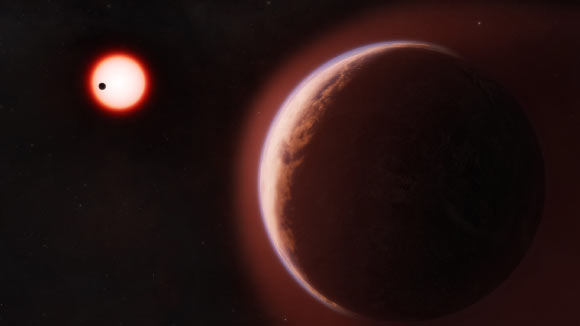
🔗 Artist's concept of LHS 1140 b and LHS 1140 c — https://cdn.sci.news/images/2026/07/image_14925-LHS-1140.jpg (Credit: Melissa Weiss/Harvard & Smithsonian's Center for Astrophysics, via Sci.News)
🔗 Original article with spectroscopic figures — https://www.science.org/doi/10.1126/science.aea9708 (Science / AAAS)
🔗 Coverage with image of the planetary system — https://www.sci.news/astronomy/atmosphere-habitable-zone-exoplanet-lhs-1140b-14925.html (Sci.News)
🔗 Helium escaping from the atmosphere of a nearby rocky exoplanet orbiting in a habitable zone — https://www.science.org/doi/10.1126/science.aea9708 (Science, artículo original, 16 jul. 2026)
🔗 Astronomers spot first atmosphere around a potentially habitable alien world — https://www.science.org/content/article/astronomers-spot-first-atmosphere-around-potentially-habitable-alien-world (Science / AAAS, noticia)
🔗 Potential Atmosphere Detected on Habitable-Zone Exoplanet LHS 1140b — https://www.sci.news/astronomy/atmosphere-habitable-zone-exoplanet-lhs-1140b-14925.html (Sci.News)
🔗 Astronomers detect first atmosphere on rocky 'super-Earth' — https://www.rt.com/news/643172-astronomers-superearth-atmosphere-helium/ (RT)
🔗 Nearby rocky planet may be replenishing helium from atmosphere, study finds — https://phys.org/news/2026-07-nearby-rocky-planet-replenishing-helium.html (Phys.org)
🔗 Astronomers Detect A Long-Lasting Atmosphere On A Planet That Could Resemble Earth — https://dailygalaxy.com/2026/07/astronomers-detect-atmosphere-on-a-planet/ (Daily Galaxy)
⚙️ SEO Optimization Block
Positioning data sheet for the publication of this blog article.
|
Meta title (≤60 car.)
|
LHS 1140 b: Atmosphere confirmed on habitable super-Earth
|
|
Meta description (≤160 car.)
|
Harvard astronomers detected helium escaping from LHS 1140 b, a super-Earth 49 light-years away. First confirmed atmosphere in habitable zone.
|
|
Suggested URL slug
|
/lhs-1140-b-atmosphere-super-earth-habitable-zone
|
|
Primary Keyword
|
atmosphere LHS 1140 b
|
|
Secondary keywords
|
Habitable zone exoplanet, super-Earth with atmosphere, helium exoplanet, world ocean exoplanet, James Webb LHS 1140, habitable red dwarf
|
|
Search intent
|
Informative / scientific dissemination (long-tail, Google Discover, Google News)
|
|
Used H1–H2 labels
|
H1: main title · H2: each section with icon (technical sheet, finding, study limits, cosmic coast, next steps, ocean world)
|
|
Suggested alt text (alt)
|
"Artist's concept of super-Earth LHS 1140 b and its neighbor LHS 1140 c orbiting a red dwarf"
|
|
Recommended structured data
|
Schema.org tipo NewsArticle o ScholarlyArticle: headline, datePublished, author, publisher, image, citation (DOI 10.1126/science.aea9708)
|
|
Suggested Internal Links
|
Previous articles on exoplanets in the habitable zone, guide on the James Webb telescope, glossary "cosmic coast"
|
|
External links (authority)
|
Science / AAAS (science.org), Harvard-Smithsonian Center for Astrophysics (cfa.harvard.edu), NASA Exoplanet Archive
|
|
Topic cluster
|
Rocky exoplanets, planetary atmospheres and the search for habitability
|
|
Featured snippet objetivo
|
Short definition of 40-50 words: "What is LHS 1140 b?" at the beginning of the article to dispute the featured snippet
|
|
E-E-A-T / authority
|
Cite DOIs, authors, and institutional affiliations; link to the original paper; Include Visible Publication and Update Date
|
|
Core Web Vitals
|
Images in WebP with lazy-loading, avoid CLS by reserving space for the featured image, compress the table as HTML not as a screenshot
|
|
Social media hashtags
|
#Exoplanetas #LHS1140b #Astronomía #Ciencia #ZonaHabitable #JamesWebb #NASA
|
Note: This coverage is based on the article published in Science (DOI 10.1126/science.aea9708) and the news coverage available at the time of writing; The exact nature of the atmosphere and the possible existence of liquid water remain under investigation.
🔭 SCIENCE · ASTRONOMY
An atmosphere in LHS 1140 b: the super-Earth that reignites the search for life beyond the Solar System is confirmed
A Harvard-led team detected helium escaping from this rocky world in the habitable zone of a red dwarf 49 light-years away, the first firm indication of a persistent atmosphere on such a planet.
✍️ Redacción de Ciencia 📅 July 17, 2026 🕒 Reading time: 7 minutes 📍 Source: Science magazine
An international team of astronomers led by Harvard University confirmed the presence of an atmosphere on LHS 1140 b, a rocky super-Earth orbiting within the habitable zone of a red dwarf located about 49 light-years from Earth, in the constellation of Cetus. The finding, published on July 16 in the journal Science, is based on the detection of helium escaping from the upper layers of the planet, a signal that, according to the authors themselves, opens more questions than it closes, but which constitutes the strongest evidence to date that a rocky world in the habitable zone can conserve air after billions of years.
|
Planet
|
LHS 1140 b (rocky super-Earth)
|
|
Distance to Earth
|
≈ 49 light-years (constellation Cetus)
|
|
Host Star
|
LHS 1140 (M-type red dwarf, also GJ 3053), 3 billion years >, inactive
|
|
Dough
|
5.60 ± 0.19 Earth masses
|
|
Radio
|
1.73 Terrestrial radios
|
|
Orbital period
|
24.7 days
|
|
Stellar irradiation received
|
42% of that which the Earth receives from the Sun
|
|
Equilibrium temperature
|
226 K (≈ −47 °C), within the liquid water zone
|
|
Key instrument
|
WINERED spectrograph on the Magellan Clay telescope (Las Campanas Observatory, Chile)
|
|
Publication
|
Science, 16 de julio de 2026 · DOI 10.1126/science.aea9708
|
🔭 The finding: how helium was detected
The team, led by astronomer Collin Cherubim, used the WINERED (Warm Infrared Echelle Spectrograph to Realize Extreme Dispersion) spectrograph, installed on the 6.5-meter Magellan Clay telescope at the Las Campanas Observatory in Chile. In September 2024, a rare alignment took place that allowed the transit of LHS 1140 b and the other rocky planet in the system, LHS 1140 c, to be observed in front of its star on the same night.
During the transit of LHS 1140 b, the spectrum showed clear helium absorption at high altitude, above the planet's solid radius; in the transit of LHS 1140 c, on the other hand, no equivalent signal was observed. The researchers interpret that difference as evidence that helium is actively escaping from LHS 1140b's upper atmosphere, heated by its star's extreme X-ray and ultraviolet radiation.
"My model predicted that helium was going to escape, and in large quantities." — Collin Cherubim, Harvard University
🌡️ A temperate world, but not confirmed as habitable
LHS 1140 b has a mass 5.6 times that of Earth and a radius 1.73 times greater, figures compatible with a rocky composition similar to that of Earth combined with a layer of low density, either a substantial atmosphere or a high proportion of water. Its equilibrium temperature of 226 kelvin (about −47 °C) puts it within the so-called liquid water zone, although that does not automatically imply that there are oceans on its surface.
The host star, LHS 1140, is an unusually quiet red dwarf for its kind, more than 3 billion years old and with low magnetic activity. That stellar calm could explain, according to the researchers, why the planet has managed to retain atmospheric gases for so long, instead of losing them completely as has happened with other rocky worlds observed in habitable zones of more active stars.
"We now know that at least one of them has managed to conserve an atmosphere." — Robin Wordsworth, professor at Harvard University
⚖️ What the study does not yet confirm
The authors themselves insist on qualifying the scope of the finding. The helium signal was clearly detected in the 2024 observations, but did not reappear in a second campaign conducted in 2025, which the researchers interpret as evidence of a time-varying gas leak, rather than a measurement error.
That variability leaves open a central question for the team: whether LHS 1140 b is actually a virtually bare rock that occasionally releases bursts of gas that escape immediately, or whether it maintains a stable atmosphere that, as on Earth, continuously loses and replenishes gases.
"Is it a bare rock that sometimes belches gas, or is there a stable atmosphere that renews itself?" — Jason Dittmann, University of Florida
At the moment, the exact composition of the lower atmosphere remains unknown. Previous studies with the James Webb Space Telescope had already ruled out a dense envelope of hydrogen around LHS 1140 b, leaving as the most likely hypothesis a thin atmosphere dominated by nitrogen or carbon dioxide, with inconclusive indications of water vapor.
🧭 LHS 1140 c and the concept of "cosmic coast"
The LHS 1140 system is also home to LHS 1140 c, a smaller planet much closer to the star, with an orbital period of just 3.78 days and a stellar irradiation about five times greater than that received by Earth. No sign of escaping helium was detected on this planet, suggesting that it lacks a comparable atmosphere.
The authors frame this contrast within the concept of the "cosmic shoreline": a theoretical boundary that would separate planets capable of retaining atmosphere for billions of years from those that lose it rapidly due to stellar radiation and stellar wind. LHS 1140 b and LHS 1140 c, despite orbiting the same star, would appear to be located on opposite sides of that boundary.
🔬 What's Next: The Role of the James Webb Telescope
The next step, according to the team, will depend on additional observations with the James Webb Space Telescope over the next four to five years, aimed at looking for the spectral signature of water in the planet's atmosphere. If those molecules appear consistently, the researchers believe it would be a strong indication that LHS 1140 b supports a stable and long-lasting atmosphere, and not a transient phenomenon.
"If there's water in the atmosphere, it's probably a stable atmosphere that's going to persist." — Jason Dittmann, University of Florida
🌊 A candidate for ocean world? A hypothesis to be confirmed
The idea that LHS 1140 b could host a temperate global ocean, covered by a layer of ice or directly exposed under a thick atmosphere, has been circulating for years among exoplanet specialists, supported by its density and its position within the habitable zone. However, both Cherubim's team and external specialists consulted by the journal Science stress that the current finding confirms the existence of gas in the upper atmosphere, not the presence of liquid water or habitable conditions on the surface.
Independent astronomers, such as René Doyon, from the University of Montreal, described the result as extraordinary if confirmed, although they stressed that it is a first step in a verification process that will still take years. In this sense, cataloging LHS 1140 b as "the most solid candidate" for ocean world reflects the legitimate enthusiasm of the scientific community, but it should be read as a working hypothesis and not as a confirmed fact.
🔎 Why this finding matters
Methodologically, this is the first case in which an atmosphere around a rocky planet in the habitable zone of another star has been clearly documented, among the more than 6,000 exoplanets catalogued so far. For years, whenever astronomers located a rocky world in the habitable zone, subsequent observations ended up revealing bare surfaces, with no trace of air. LHS 1140 b breaks, for now, that pattern.
For copyright reasons, the original images are not embedded in this document; The absolute links published by the media and the scientific journal are listed below.
🔗 Artist's concept of LHS 1140 b and LHS 1140 c — https://cdn.sci.news/images/2026/07/image_14925-LHS-1140.jpg (Credit: Melissa Weiss/Harvard & Smithsonian's Center for Astrophysics, via Sci.News)
🔗 Original article with spectroscopic figures — https://www.science.org/doi/10.1126/science.aea9708 (Science / AAAS)
🔗 Coverage with image of the planetary system — https://www.sci.news/astronomy/atmosphere-habitable-zone-exoplanet-lhs-1140b-14925.html (Sci.News)
🔗 Helium escaping from the atmosphere of a nearby rocky exoplanet orbiting in a habitable zone — https://www.science.org/doi/10.1126/science.aea9708 (Science, artículo original, 16 jul. 2026)
🔗 Astronomers spot first atmosphere around a potentially habitable alien world — https://www.science.org/content/article/astronomers-spot-first-atmosphere-around-potentially-habitable-alien-world (Science / AAAS, noticia)
🔗 Potential Atmosphere Detected on Habitable-Zone Exoplanet LHS 1140b — https://www.sci.news/astronomy/atmosphere-habitable-zone-exoplanet-lhs-1140b-14925.html (Sci.News)
🔗 Astronomers detect first atmosphere on rocky 'super-Earth' — https://www.rt.com/news/643172-astronomers-superearth-atmosphere-helium/ (RT)
🔗 Nearby rocky planet may be replenishing helium from atmosphere, study finds — https://phys.org/news/2026-07-nearby-rocky-planet-replenishing-helium.html (Phys.org)
🔗 Astronomers Detect A Long-Lasting Atmosphere On A Planet That Could Resemble Earth — https://dailygalaxy.com/2026/07/astronomers-detect-atmosphere-on-a-planet/ (Daily Galaxy)
⚙️ SEO Optimization Block
Positioning data sheet for the publication of this blog article.
|
Meta title (≤60 car.)
|
LHS 1140 b: Atmosphere confirmed on habitable super-Earth
|
|
Meta description (≤160 car.)
|
Harvard astronomers detected helium escaping from LHS 1140 b, a super-Earth 49 light-years away. First confirmed atmosphere in habitable zone.
|
|
Suggested URL slug
|
/lhs-1140-b-atmosphere-super-earth-habitable-zone
|
|
Primary Keyword
|
atmosphere LHS 1140 b
|
|
Secondary keywords
|
Habitable zone exoplanet, super-Earth with atmosphere, helium exoplanet, world ocean exoplanet, James Webb LHS 1140, habitable red dwarf
|
|
Search intent
|
Informative / scientific dissemination (long-tail, Google Discover, Google News)
|
|
Used H1–H2 labels
|
H1: main title · H2: each section with icon (technical sheet, finding, study limits, cosmic coast, next steps, ocean world)
|
|
Suggested alt text (alt)
|
"Artist's concept of super-Earth LHS 1140 b and its neighbor LHS 1140 c orbiting a red dwarf"
|
|
Recommended structured data
|
Schema.org tipo NewsArticle o ScholarlyArticle: headline, datePublished, author, publisher, image, citation (DOI 10.1126/science.aea9708)
|
|
Suggested Internal Links
|
Previous articles on exoplanets in the habitable zone, guide on the James Webb telescope, glossary "cosmic coast"
|
|
External links (authority)
|
Science / AAAS (science.org), Harvard-Smithsonian Center for Astrophysics (cfa.harvard.edu), NASA Exoplanet Archive
|
|
Topic cluster
|
Rocky exoplanets, planetary atmospheres and the search for habitability
|
|
Featured snippet objetivo
|
Short definition of 40-50 words: "What is LHS 1140 b?" at the beginning of the article to dispute the featured snippet
|
|
E-E-A-T / authority
|
Cite DOIs, authors, and institutional affiliations; link to the original paper; Include Visible Publication and Update Date
|
|
Core Web Vitals
|
Images in WebP with lazy-loading, avoid CLS by reserving space for the featured image, compress the table as HTML not as a screenshot
|
|
Social media hashtags
|
#Exoplanetas #LHS1140b #Astronomía #Ciencia #ZonaHabitable #JamesWebb #NASA
|
Note: This coverage is based on the article published in Science (DOI 10.1126/science.aea9708) and the news coverage available at the time of writing; The exact nature of the atmosphere and the possible existence of liquid water remain under investigation.
Close












 An atmosphere in LHS 1140 b: the super-Earth that reignites the search for life beyond the Solar System is confirmed - by
cronywell
An atmosphere in LHS 1140 b: the super-Earth that reignites the search for life beyond the Solar System is confirmed - by
cronywell