







News
 The Central Bank eliminated the cap on withdrawing cash abroad with a card.
- 10/04/2026 » 09:46 by cronywell
The Central Bank eliminated the cap on withdrawing cash abroad with a card.
- 10/04/2026 » 09:46 by cronywell
|
🏦 EXCHANGE RATE POLICY · EXCLUSIVE |
⏱ Estimated reading time: 5 minutes | 🗓 April 10, 2026 | ✍ Economic Writing
The Central Bank eliminated the cap on withdrawing cash abroad with a card: a new era for Argentine travelers
Through Communication "A" 8417, the BCRA annulled the limit of USD 50 per operation that was in force for cash advances at ATMs abroad. The measure is part of a broader package of exchange rate flexibilizations and does not introduce new ceilings: each bank will define its own thresholds.
|
USD 50 Previous limit bordering countries |
USD 200 Previous limit Non-bordering countries |
NO STOP New scheme BCRA Regulatory Framework |
"A" 8417 Communication BCRA · April 2026 |
📋 What did the Central Bank decide?
The Central Bank of the Argentine Republic (BCRA) formalized this Thursday a new round of exchange rate flexibilizations through Communication "A" 8417, approved by its board of directors and officially published. The most visible measure for the common citizen is the definitive elimination of the caps that were in force for cash advances made abroad through credit and purchase cards issued in the country.
Until the entry into force of this rule, those who traveled abroad and needed to withdraw money at an ATM with their Argentine credit card faced a limit of USD 50 per operation in neighboring countries and USD 200 in the rest of the world. These ceilings, enshrined in point 4.1 of the ordered text on Foreign Affairs and Exchanges, are expressly repealed.
In its statement, the agency was categorical: "To revoke the limits established in point 4.1. of the ordered text on Foreign Affairs and Changes for withdrawals abroad as cash advances to cardholders granted by financial institutions and other issuers of local credit and/or purchase cards." It is not a question of substitution for other values, but of the outright abolition of the quantitative restriction.
📊 Context: a trap that is dismantled in parts
The decision comes at a time of relative exchange rate calm. The official dollar has been within the floating band established by the BCRA since April 2025, when the government of Javier Milei announced the end of the clamp for individuals. Since then, restrictions for individuals have been gradually lifted, although the scheme for companies maintained greater rigidity.
The elimination of the PAIS Tax at the end of 2025, followed by the suppression of the 30% surcharge applied by ARCA as of January 2, 2026, were previous steps that brought the cost of the "card dollar" closer to that of financial quotes. Now, the removal of the cap on cash advances completes another aspect of the restrictive scheme that characterized the Argentine economy for years.
|
💡 KEY FACT The BCRA clarifies that the elimination of the cap will not generate significant pressure on the demand for foreign currency, given that cash advances are an expensive operation: commissions range between USD 14 and USD 19 per withdrawal, plus interest for cash advances and conversion to the official exchange rate. Argentines usually resort to this mechanism only in emergency situations during their trips. |
🔍 How the cash advance with a card works
The cash advance is the operation by which a credit card holder withdraws money in foreign currency from an ATM abroad, using the available credit quota of his plastic. Unlike commercial consumption, this modality involves an immediate financial charge and bank commissions that make it considerably more expensive.
With the previous rule, anyone who tried to withdraw more than USD 50 at an ATM abroad was simply rejected by the system, regardless of the limit that their bank had assigned them. From now on, this regulatory blockage disappears: it will be the commercial policy of each entity that determines how much its customer can extract.
It should be noted that the modification reaches exclusively cash advances and does not alter other aspects of the use of cards abroad, such as consumption in stores or digital platforms.
📦 The Complete Package: Beyond Cards
Communication "A" 8417 is not exhausted to the extent most widespread. The regulatory package includes a series of adjustments that affect both individuals and companies:
▸ Individual exporters: individuals who export goods are no longer obliged to settle the collections of these exports, provided that the funds enter through the exchange market within the established periods.
▸ Settlement terms for companies: for exports from companies with local headquarters to their subsidiaries abroad, the term goes from 60 to 180 days, and the ceiling is raised from USD 50 million to USD 200 million per year.
▸ Clothing, handbags and similar products: the deadline for entering and settling foreign currency in exports of these low-volume items is extended from six months to one year.
▸ Corporate debt payments: access to the foreign exchange market is facilitated to cancel intrafirm financial debt capital, with refinancing conditions of four years of average life and three years of grace.
▸ Foreign exchange hedges: companies with liabilities in currencies other than the dollar (such as the yuan) will now be able to access the market to hedge in dollars, an operation that was previously prohibited.
▸ Negotiable Obligations: banks may enable access to the foreign exchange market up to three business days before the maturity of securities for the payment of principal, equating the treatment of local bonds with those issued abroad.
|
⚠️ COUNTERPART: CROSS-CONSTRAINT IS EXTENDED The package of flexibilizations was accompanied by a punctual tightening: the cross-restriction that prevents access to the official market for 90 days to those who have operated financial dollars (MEP or CCL) to transfer them abroad was extended. The measure aims to avoid speculative arbitrage maneuvers between the official exchange rate and the financial rate. |
🗣 Voices from the market and the BCRA
|
" It is the most important announcement since the lifting of the clamp for human persons. This should lower the risk premium. I see it with optimism and that is also how they are interpreting it on the IMF Board. — Martin Fernandez Dubais, Asset Manager in the U.S. and Argentina |
|
" The Government is at an unbeatable moment for a much greater or total liberation. These measures are positive, but they could have gone further. — Foreign exchange market analyst (quoted by El Cronista) |
✈️ Practical impact for Argentine travelers
For those planning a trip abroad, the measure has a concrete but limited effect. Before, if the traveler ran out of cash and needed to withdraw money from an ATM, the system cut off access past the regulatory cap. Now that obstacle disappears from the regulatory side.
However, personal finance specialists warn that cash advances are still one of the most expensive ways to obtain foreign currency abroad. The bank fees for each withdrawal range between USD 14 and USD 19, to which are added the interest on the advance and, for those who pay the summary in pesos, the current tax collection.
The recommendation of the experts remains unchanged: pay the cards in your own dollars before closing, use accounts in foreign currency or resort to digital wallets that operate at the official exchange rate, strategies that allow you to avoid accessory surcharges.
📋 Comparative table: before and after Communication "A" 8417
|
Appearance |
Before |
After |
|
Extraction stop (bordering) |
$50 per trade |
No regulatory cap |
|
Extraction stop (not bordering) |
$200 per trade |
No regulatory cap |
|
Who sets the limit |
BCRA (regulatory) |
Each issuing bank |
|
Obligation to liquidate (exporting natural persons) |
Yes, mandatory |
Does not apply if funds enter |
|
Term of foreign exchange income (companies → subsidiaries) |
60 days / cap USD 50 M |
180 days / cap USD 200 M |
|
Access to currency hedging in currencies other than USD |
Forbidden |
Enabled |
🔎 Frequently Asked Questions (SEO)
What exactly did the BCRA change with Communication "A" 8417?
The Central Bank eliminated regulatory limits for cash advances at ATMs abroad with Argentine credit cards. Before, there was a cap of USD 50 in bordering countries and USD 200 in the rest of the world; Now each bank determines its own threshold.
Does this measure mean that the exchange clamp disappeared?
Not completely. Although the clamp for individuals was largely lifted since April 2025, restrictions remain for companies and some specific regulations, such as the cross-restriction that prevents access to the official market after operating financial dollars.
Is the dollar card still valid?
The 30% surcharge on account of Profits/Personal Assets was eliminated by ARCA in January 2026, which brought the cost of the card dollar closer to that of financial dollars. However, for those who cancel their summaries in pesos, the tax collection still applies. The best strategy is still to pay with your own dollars.
How much does it cost to withdraw cash abroad with an Argentine card?
The total cost includes: bank commission of between USD 14 and USD 19 per withdrawal, interest on cash advances (which are usually high), conversion to the official exchange rate and, in case of paying in pesos, the current tax collection. That is why experts advise against this modality except in emergencies.
📌 Conclusion: one more step in exchange rate normalization
The elimination of the cap on cash advances abroad is one more sign in the process of gradually dismantling the exchange clamp that the Government formally began in April 2025. Although its direct impact on the demand for foreign currency will probably be limited – given the high cost of the operation – the regulatory message is clear: the restrictive scheme continues to recede.
The context is propitious: the official dollar remains within the floating bands, the BCRA's reserves register a positive trend driven in part by the start of the heavy harvest, and the agreement with the IMF provides external support to the economic program. Market analysts agree that Argentina is slowly approaching full exchange rate normalization.
For Argentine travelers, the change is welcome although marginal in everyday life. For the financial market and international investors, it represents a sign that the government maintains its roadmap of exchange rate opening. The next step, according to several economists, could be the definitive elimination of the cross-restriction.
|
🏷 SEO Tags: Argentina exchange clamp · foreign credit card · BCRA Communication A 8417 · Effective foreign advance · Exchange Rate Easing 2026 · dollar card · monetary policy Argentina · Santiago Bausili · travel abroad Argentina · Official exchange rate 🔗 Sources: BCRA · Infobae · La Nación · El Cronista · iProfessional · Río Negro · Bloomberg Line · Profile |
 TENSE DAY FOR THE REFORM OF THE GLACIER LAW
- 08/04/2026 » 15:38 by cronywell
TENSE DAY FOR THE REFORM OF THE GLACIER LAW
- 08/04/2026 » 15:38 by cronywell
🌊 TENSE DAY FOR THE REFORM OF THE GLACIER LAW: THE RULING PARTY IMPOSES ITS NUMBER AMID PROTESTS AND A BESIEGED CONGRESS
The bill that modifies Law 26,639 is approved in the Chamber of Deputies with the support of mining provinces, while environmentalists and scientists warn of a "historic setback" in the protection of water resources.
📊 Reading time: 6 minutes
🏷️ Keywords: Glacier Law • Mining Reform • Javier Milei • Deputies • Environment Argentina
🧊 THE BACKGROUND OF THE CONFLICT: WHAT IS THE REFORM ABOUT?
Glacier Law 26,639, passed in 2010, was a pioneer worldwide in establishing that glaciers and the periglacial environment – areas of frozen soils that surround eternal ice – are "public goods" and "strategic water reserves". Argentina has approximately 17,000 ice bodies, essential for the water regulation of basins that supply millions of people in arid and semi-arid regions.
The reform promoted by the Executive and approved today modifies the heart of that protection. The new articles establish that only those glaciers and periglacial geoforms that fulfill an "effective and relevant water function" for the recharge of basins or human consumption will enjoy protection. In practice, this means that vast areas hitherto untouchable could be enabled for mining or hydrocarbon exploration and exploitation.
"The project distorts the spirit of the law and is not based on the latest advances in scientific knowledge about glaciers"
— Scientists from CONICET and the National University of Córdoba, in a letter sent to legislators
🗳️ THE NUMBERS OF POWER: HOW THE MAJORITY WAS BUILT
Today was the outcome of a legislative strategy that the ruling party has been weaving since February, when the Senate gave half sanction to the project with 40 votes in favor, 31 against and one abstention.
This afternoon, in the Chamber of Deputies, La Libertad Avanza consolidated a coalition that exceeded 130 votes, reaching – according to parliamentary sources – up to 140 votes. The arch of supports included:
- ✅ The PRO
- ✅ The Radical Civic Union (UCR)
- ✅ Federal Innovation
- ✅ A sector of Unión por la Patria (especially legislators from mining provinces such as San Juan, Catamarca and Mendoza)
- ✅ Provincial parties
The opposition bloc of Union for the Homeland, United Provinces and the Civic Coalition signed rejection opinions, warning that the measure violates the minimum environmental budgets established in Article 41 of the National Constitution.
📍 The Provincial Vote: Fracture of Peronism
A key factor was the pressure of the Andean governors. Governors such as Marcelo Orrego (San Juan), Raúl Jalil (Catamarca), Gustavo Sáenz (Salta) and Alfredo Cornejo (Mendoza) defended the reform as necessary to attract mining investments for billions of dollars in copper and lithium, under the RIGI (Incentive Regime for Large Investments).
"At no time did a governor propose modifying the glacier law and changing quality standards. It is not true that mining goes against the environment"
— Marcelo Orrego, governor of San Juan, during the plenary session of commissions
This position generated an internal fracture in Peronism: while the national leadership of Union for the Homeland rejected the project, deputies from San Juan and Catamarca voted in favor.
📢 THE STREET BURNS: PROTESTS, ESCALATIONS AND VIGILS
While the deputies deliberated, the Congress was transformed into an armored fortress.
⏰ 6:30 AM | Greenpeace scales the Monument to the Two Congresses
Greenpeace activists staged the first high-impact action of the day. Shortly after 6:30 a.m., two militants climbed the Monument to the Two Congresses and unfurled two giant banners that read from the avenue: "Deputies: do not betray the Argentines" and "The Glacier Law is not touched."
Nine people were delayed by the City Police, and firefighters from the Special Rescue Group intervened to lower the demonstrators who remained at height. All of them regained their freedom hours later, but with contraventional acts.
⏰ 13:00 HS | Rally of the Left Front
From noon, columns of the FIT (Left Front) began to arrive in the area of Avenida de Mayo and 9 de Julio. The slogan was clear: "No to the looting of the glaciers." Former deputy Juan Carlos Giordano denounced that "the government of Javier Milei intends to hand over the glaciers to the mining companies for 30 years."
⏰ 5:00 p.m. | Mass march and vigil until the vote
The call was extended to social organizations, environmentalists and unions. A crowd filled the Plaza del Congreso, where an artistic festival was held with musicians committed to the cause. The demonstrators announced that they would remain in place until the result of the vote was known.
⚖️ THE TECHNICAL KEYS: WHAT EXACTLY CHANGES?
|
Appearance |
Current Law (2010) |
Reform approved |
|
Glacier protection |
Absolute over every ice body |
It is maintained, but with the possibility of disaffiliation if it does not fulfill "water function" |
|
Periglacial environment |
Protected as a strategic water reserve |
Protection only if reliable water function is demonstrated |
|
National Inventory |
Binding for mining activity |
The provinces can review it and request modifications |
|
Powers |
Nation sets minimum budgets |
Provinces define which areas to protect according to their own criteria |
|
Mining activities |
Prohibited in protected areas |
Allowed in periglacial areas with no proven water function |
Source: Authors' elaboration based on the text of the project and journalistic coverage

🌎 THE ECONOMIC CONTEXT: MINING AS A WAY OUT
The government of Javier Milei is promoting this reform as part of a broader strategy to deregulate the economy and attract foreign investment. The mining sector sees the modification as an opportunity to develop copper megaprojects – such as El Pachón (US$ 9,500 million) and Agua Rica (US$ 4,000 million) – which today remain paralyzed by legal uncertainty.
In addition, in February 2026, Argentina and the United States signed an agreement to strengthen critical mineral supply chains, reinforcing the country's attractiveness to international capital.
"With this law there will be more lawsuits. The Supreme Court has already endorsed the current law and a new one will have to be submitted to the Court's gaze."
— Germán Martínez, head of the Union for the Homeland bloc
⚠️ SCIENTIFIC WARNINGS AND POSSIBLE LEGAL REMEDIES
More than a few scientists from CONICET and national universities sent a letter to legislators warning that the reform ignores the strategic value of glaciers as water reserves in a context of climate change.
"The reform proposed by the current administration sets a negative and dangerous precedent for Argentine environmental policy. By shifting power to the provinces, these important safeguards can be determined based on political expediency rather than collective environmental rights."
— Cristian Fernández, professor at the University of Buenos Aires and legal coordinator of FARN
Environmental organizations have already anticipated that they will resort to justice. The possible axes of challenge will be:
- The violation of Article 41 of the Constitution, which establishes that the Nation dictates the minimum environmental budgets, without the provinces being able to reduce them.
- The lack of a cumulative environmental impact assessment prior to the legal amendment.
📈 RESULTS OF THE VOTE (PROVISIONAL DATA)
|
Block |
Vote |
|
Freedom Advances |
✅ In favor |
|
PRO |
✅ In favor |
|
UCR |
✅ In favor (majority) |
|
Federal Innovation |
✅ In favor |
|
Union for the Homeland |
❌ Against (with exceptions) |
|
United Provinces |
❌ Against |
|
Civic Coalition |
❌ Against |
|
Left Front |
❌ Against |
Final estimate: between 135 and 140 votes in favor, 80 against.
🔮 WHAT'S NEXT
With the final sanction in the Chamber of Deputies, the reform becomes law. However, the conflict is far from resolved:
- Immediate judicialization: Amparos and judicial presentations by NGOs and opposition provincial governments.
- Conflicts between the Nation and the provinces: The law grants governors powers to reinterpret the Glacier Inventory, which will generate technical and political tensions.
- Impact on the international image: Argentina had been recognized for its leadership in glacier protection; this reform could affect environmental agreements and external financing.
📌 Executive Summary
The Chamber of Deputies turned into law the reform of the Glacier Law promoted by Javier Milei, with votes from the ruling party, the PRO, the UCR and Peronist governors of mining provinces. The regulation allows mining activity in periglacial areas without proven water function. The day was marked by Greenpeace's escalation of the Monument to the Two Congresses and a massive mobilization in front of Parliament. Environmentalists and scientists anticipate legal appeals.
Sources: Columbia Climate School, Telefe Noticias, Parlamentario, Letra P, Noticias Argentinas, Buenos Aires Times, La Gaceta, Diputados Bonaerenses, Rumbo Minero.
 The Government is moving forward with the largest road concession in the last decade
- 07/04/2026 » 20:16 by cronywell
The Government is moving forward with the largest road concession in the last decade
- 07/04/2026 » 20:16 by cronywell
🚗 The Government is moving forward with the largest road concession in the last decade: 12,000 kilometers of roads will pass into private hands from June
The Federal Concessions Network will eliminate state subsidies and will be financed exclusively with tolls, in a historic turn for Argentine infrastructure
📅 April 7, 2026 | ⏱️ Reading Time: 6 minutes
Buenos Aires — The Ministry of Economy, headed by Luis Caputo, confirmed this week the definitive schedule for the third and most ambitious stage of the Federal Road Concession Network. Starting in June 2026, the national government will tender 12,000 kilometers of national routes under an unprecedented scheme: zero financing from the Treasury, total private investment and exclusive remuneration through tolls.
The initiative, which completes the dismantling of the state-owned company Corredores Viales S.A. , seeks to progressively transform the country's main productive corridors into two-lane highways, improving road safety and logistics for cargo transport. The plan covers strategic sections in Buenos Aires, Santa Fe, Córdoba, San Luis, La Pampa, Entre Ríos, Corrientes, Chaco, Mendoza and Santiago del Estero, among other provinces.
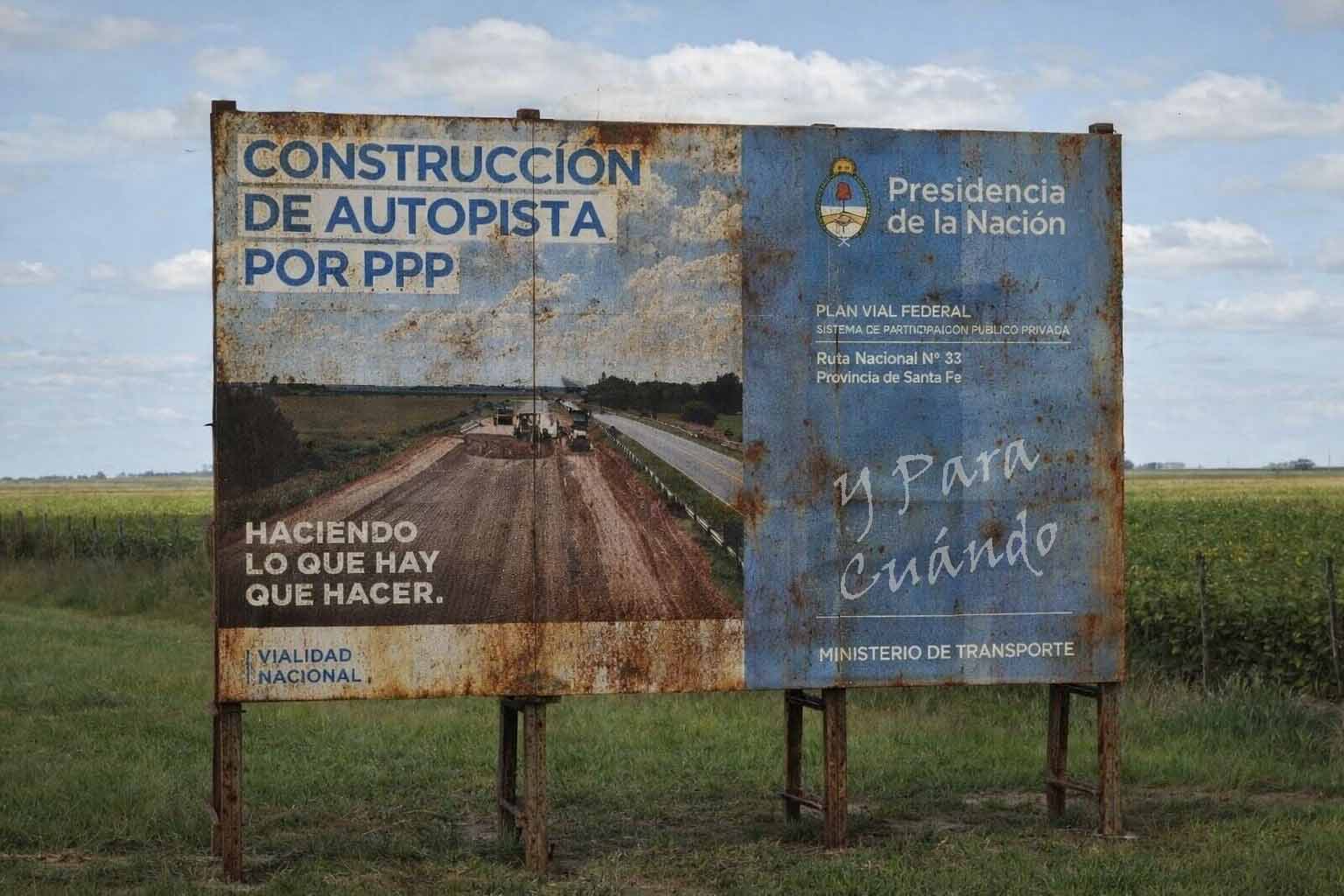
📋 A three-stage plan: this is how the concession is structured
The privatization of the Argentine road system was organized in progressive phases. Stage I, already awarded in January of this year, transferred the Mercosur Highway (routes 12 and 14) and the Rosario-Victoria Bridge to the private sector, with toll rates ranging from $1,000 to $1,900 for private vehicles.
Stage II – whose envelopes are scheduled to open in May – tenders more than 2,500 kilometers divided into four sections:
- Mediterranean Section: 672 km of routes 7 and 35 (Buenos Aires, Santa Fe, Córdoba)
- Puntano section: 720 km of routes 8, 36, 193 and A-005 (San Luis, Córdoba, Santa Fe, Buenos Aires)
- Southern Port Section: 637 km of routes 9 and 188 (Buenos Aires, La Pampa)
- North Port Section: 528 km including Rosario Beltway, Rosario-Buenos Aires Highway and National Route 33
Stage III, whose schedule was made official by Resolution 174/2026, adds an additional 3,900 kilometers in eight corridors: Cuyo, North Center, Northwest, Chaco-Santa Fe, Litoral, Northeast, Center and Mesopotamian. With this final phase, the concessioned network will total more than 9,000 kilometers – a figure that, added to the complementary sections and accesses, is close to the 12,000 kilometers projected by the Executive.
Key calendar: Bids for Stage III may be submitted until June 18, 2026 at 12:00 p.m. through the CONTRAT.AR platform. Consultations on the specifications will be enabled until May 4.
💰 Subsidy-free tolls: the new financing model
The scheme marks a break with the previous system. "This system will not have any subsidy from the public sector, which until now made contributions to sustain a deficit concession scheme," said sources from the National Highway Authority. Concessionaires must finance works, maintenance, operation and user services exclusively with the collection of tolls.
The maximum values established in the specifications for Stage II-B anticipate the new tariff scenario:
|
Section |
Current toll |
Cap rate |
Increase |
|
Mediterranean |
$1,300 |
$4,500 |
+246% |
|
Puntano |
$1,300 |
$4,100 |
+215% |
|
North Port |
$1,300 |
$4,705 |
+262% |
|
South Port |
$1,300 |
$3,400 |
+161% |
Values for category 2 (private car). Source: Bidding Documents
The award mechanism will prioritize the company that offers the lowest rate below the cap. In the event of a tie, it will be defined by the shortest concession term – the maximum stipulated is 20 years, extendable to 30.
The new tolls will incorporate automatic collection systems with license plate reading. Users who do not have TelePASE will pay double the rate.
🔧 Priority works: from Circunvalación to Route 33
Among the most urgent interventions that the new concessionaires will have to carry out are:
- Rosario Beltway Avenue: 30-kilometer comprehensive repair between La Florida and Belgrano Avenue. The route has destroyed roads, lack of lighting and poor signage, aggravated by the recent collapse of a pedestrian bridge.
- Rosario-Buenos Aires Highway: more than 50 kilometers on National Route 9, from the interprovincial border to the junction with the Circunvalación. Mayors of the region had complained for months about the progressive deterioration of the accesses.
- National Route 33: repaving and reconstruction of shoulders in the Rufino-General Villegas section. The work was demanded by the Justice, which on December 1, 2025 ordered the national government to repair the most critical sector between RN 178 and Chabás.
- New toll stations: the specifications propose five booths on RN 33 (Trenque Lauquen, Villegas, Rufino, Venado Tuerto and Casilda) and four on the Mediterranean Section (Chacabuco, Rufino, Laboulaye and Malena).
🏗️ Complementary businesses and state control
Concessionaires will be authorized to operate ancillary services that increase their profitability: inns, service stations, shopping centers, hotels, pharmacies, ATMs and telecommunications services.
The National Highway Ministry will maintain supervision and control functions of the contracts, while the Argentine Guarantee Fund (FOGAR) will provide guarantees for construction companies to access bank financing.
⚠️ The sector's warnings
The Minister of Public Works of Santa Fe, Lisandro Enrico, expressed reservations about the financial viability of the scheme: "The tolls are not economically and technically enough to repair. The proceeds will only be used for operating expenses – grass cutting, signage, lighting – but not for repaving long distances," he warned.
The official also confirmed that the province continues to negotiate with the Nation the transfer of jurisdiction of the A012 route in the access to the port terminals of Timbúes, a key node for agro-industrial exports.
🔍 Context: the end of Road Corridors
Road privatization is part of the Bases Law approved by Congress, which declared Corredores Viales S.A. "subject to privatization." According to official figures, 45% of the road network managed by the state-owned company was not in optimal conditions at the time of the transfer.
"The State leaves its role as a road builder and administrator to assume the functions of promoter and supervisor of what the private sector develops," Cabinet Chief Manuel Adorni had declared when announcing the process.
The market's response will be decisive. The first tenders attracted seven national and international bids, all below the planned tariff caps – a sign that the government interprets as validation of the model.
📎 Official documentation: The complete specifications can be consulted on CONTRAT.AR, the public procurement portal of the Nation.
📬 Press contact National Highway: prensa@vialidad.gob.ar
 Federal co-participation fell 11% in March
- 01/04/2026 » 13:46 by cronywell
Federal co-participation fell 11% in March
- 01/04/2026 » 13:46 by cronywell
Federal co-participation fell 11% in March: the provinces lost $1,151,000 million in the first quarter 📉
📅 April 1, 2026 | ⏱️ Reading Time: 7 minutes
📉 The collapse of resources
In a new blow to subnational finances, automatic transfers by Federal Co-participation registered a real drop of 11.3% in March compared to February, according to private estimates based on official data. This setback is not an isolated event, but consolidates a negative trend during the first quarter of 2026, generating an accumulated loss for the provinces and the Autonomous City of Buenos Aires (CABA) that amounts to $1,151,000 million in real terms.
The report by the consulting firm Politikon Chaco, prepared based on data from the National Directorate of Provincial Affairs (DNAP) and INDEC, details that during March remittances totaled $5.05 billion, showing a decrease of –4.3% year-on-year and –9.9% in the monthly comparison. This volume is the lowest in nominal terms since April 2025, which sets off alarms in local governments.
🖼️ Monthly Evolution Real Federal Co-participation
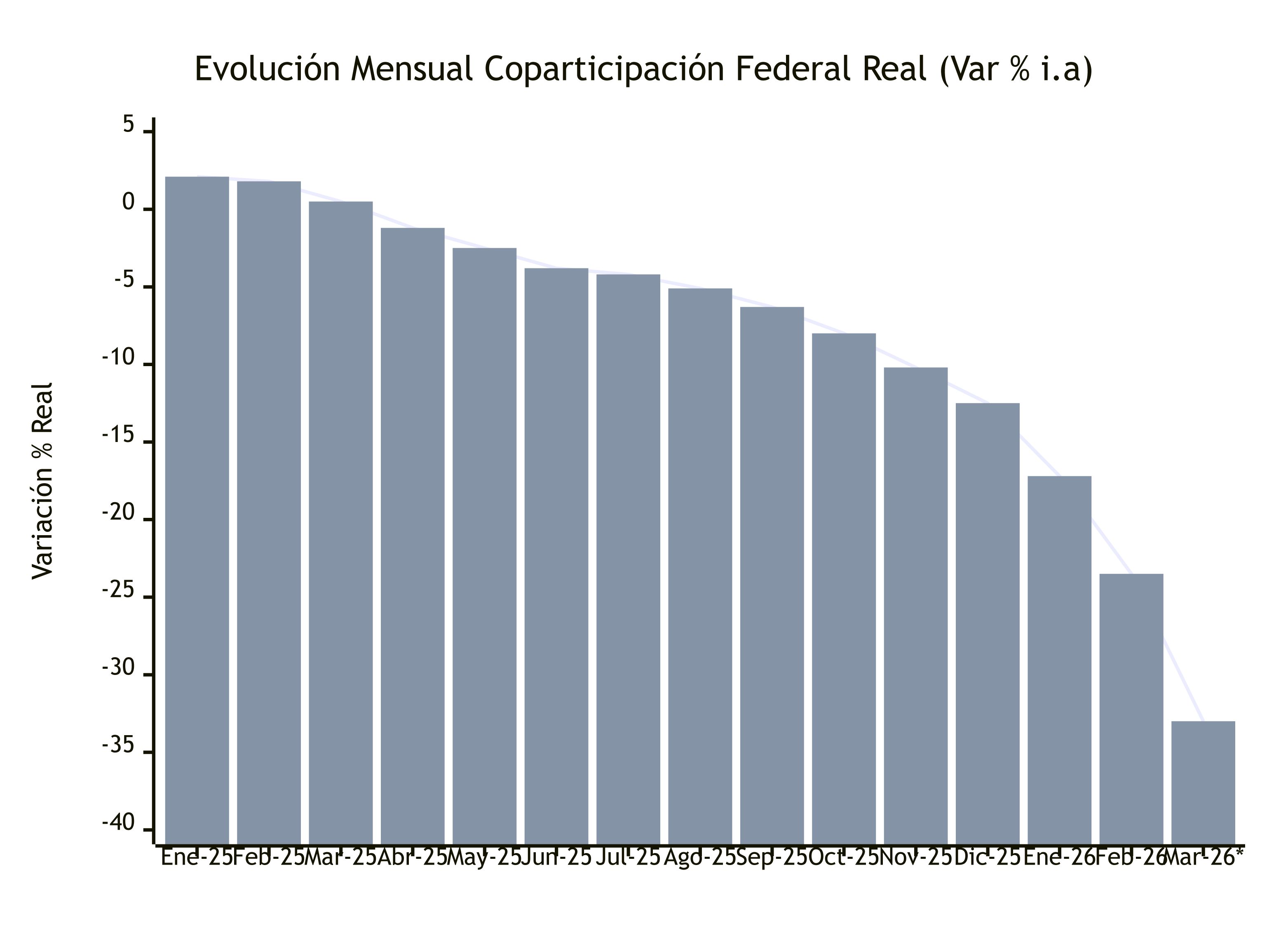
Source: Prepared by the authors based on data from the National Directorate of Provincial Affairs (DNAP), INDEC and the consulting firm Politikon Chaco.
** March 2026: provisional data. *
💰 The weight of collection: VAT and Profits in decline
The main co-participation taxes, the Value Added Tax (VAT) and the Income Tax, explain much of this deterioration. The collection of both taxes has shown a negative performance in the first months of the year, reflecting the slowdown in economic activity and the impact of administrative measures such as the restitution of exclusion certificates in customs VAT.
According to economist Nadin Argañaraz, of the IARAF, national revenue registered a real drop of $3.3 billion in the first two months. VAT contributed the largest drop ($1,680,000 million), followed by withholdings and personal contributions. Thus, while the Nation reduced its revenues by 9.3% real year-on-year, the provinces suffered a 7.6% decrease in their transfers during the same period.
🌎 Regional impact: millionaire losses and adjustments
The magnitude of the loss affects the entire provincial spectrum, with variations in absolute terms, but with a common denominator: financial stress.
📊 Main provinces affected (loss in the first quarter of 2026)
|
Province |
Loss (in millions of pesos) |
|
Buenos Aires |
$204,499 |
|
Santa Fe |
$82,957 |
|
Cordoba |
$81,028 |
|
Chaco |
MX$57,111 |
|
Quests |
$38,000 |
Source: Estimated data based on reports from Politikon Chaco and Infobae.
In the case of Chaco, the loss totaled $57,111 million, with a fall of 6.9% in real terms in the quarterly cumulative, while Misiones lost about $38,000 million in the same period, a decline of 6.5% in real terms. Buenos Aires, the most populous province governed by Axel Kicillof, heads the list of the most affected in absolute terms, with a reduction of more than $204,499 million in the first two months of the year alone.
⚖️ Political tension and fiscal federalism
The drain of funds has revived the dispute over fiscal federalism. The governors, who mostly accompanied President Javier Milei at the recent Argentina Week in New York in search of investments, now face a scenario of forced adjustment in their jurisdictions.
The conflict escalated this week when 25 mayors, grouped in the Federal Council of Mayors (Cofein), came out to the intersection of the Minister of Economy, Luis Caputo, who had pointed out against municipal taxes for considering them an obstacle to the reduction of prices. In a document entitled "The municipalities sustain what the Nation abandons," the community leaders warned that the rates represent only 3% of the total tax burden, against the 75% that remains in the hands of the Nation.
"The Nation collects resources from everyone, but does not distribute them according to real responsibilities," said the mayors, demanding a reform in the distribution of the fuel tax and the execution of the withheld National Treasury Contributions (ATN).
🚧 Consequences: works stopped and debt increase
The lack of liquidity is already having concrete consequences in the territory. A governor of northern Argentina described the scenario starkly:
"The month closed very badly. We have to try to lower expenses and that increases our debt. The execution of works is slower and others are eliminated directly."
During 2025, the provinces had increased their spending at a faster rate than revenues, largely due to the electoral calendar. This gap left seven jurisdictions, including Buenos Aires, Santa Cruz and Chubut, with a negative financial balance. Now, with the fall in co-participating resources, the margins for maneuver have been reduced to zero.
🖼️ PUBLIC WORKS PARALYZED
🔮 Perspectives: a new fiscal pact?
Against this backdrop, calls for structural reform are growing. The president of IDEA, Santiago Mignone, recalled that the constitutional mandate of 1994 to sanction a new co-participation regime is still pending after 30 years of extensions. He warned that dependence on uncertain transfers leads the provinces to create distortionary taxes that make production more expensive.
In the same vein, the mayor of La Plata, Julio Alak, formally called for "a new Fiscal Pact" to reverse the "brutal" fall in co-participation that affects neighbors, requesting that the spirit of the May Pact signed in 2024 be resumed.
Meanwhile, Minister Luis Caputo maintains that the solution is not to raise taxes, but to deepen labor and fiscal reforms to encourage economic growth, warning that credit and private investment are the ways to recover revenue.
If there is no change in the economic trend or a political agreement, the second quarter of the year is presented as a new minefield for provincial finances, with the latent risk of new tensions in Congress and the loss of purchasing power of subnational states.