







News
 Federal co-participation fell 11% in March
- 01/04/2026 » 13:46 by cronywell
Federal co-participation fell 11% in March
- 01/04/2026 » 13:46 by cronywell
Federal co-participation fell 11% in March: the provinces lost $1,151,000 million in the first quarter 📉
📅 April 1, 2026 | ⏱️ Reading Time: 7 minutes
📉 The collapse of resources
In a new blow to subnational finances, automatic transfers by Federal Co-participation registered a real drop of 11.3% in March compared to February, according to private estimates based on official data. This setback is not an isolated event, but consolidates a negative trend during the first quarter of 2026, generating an accumulated loss for the provinces and the Autonomous City of Buenos Aires (CABA) that amounts to $1,151,000 million in real terms.
The report by the consulting firm Politikon Chaco, prepared based on data from the National Directorate of Provincial Affairs (DNAP) and INDEC, details that during March remittances totaled $5.05 billion, showing a decrease of –4.3% year-on-year and –9.9% in the monthly comparison. This volume is the lowest in nominal terms since April 2025, which sets off alarms in local governments.
🖼️ Monthly Evolution Real Federal Co-participation
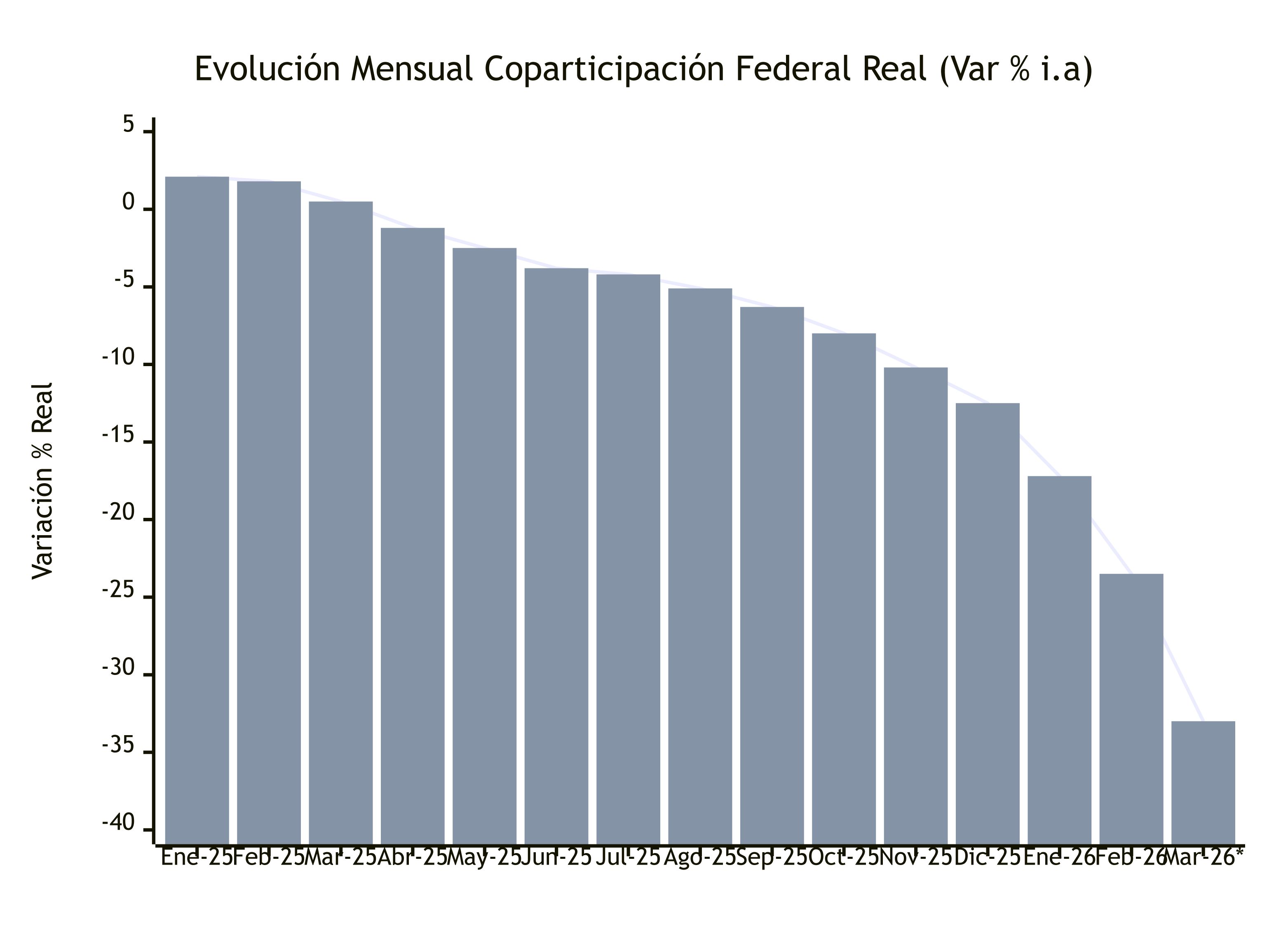
Source: Prepared by the authors based on data from the National Directorate of Provincial Affairs (DNAP), INDEC and the consulting firm Politikon Chaco.
** March 2026: provisional data. *
💰 The weight of collection: VAT and Profits in decline
The main co-participation taxes, the Value Added Tax (VAT) and the Income Tax, explain much of this deterioration. The collection of both taxes has shown a negative performance in the first months of the year, reflecting the slowdown in economic activity and the impact of administrative measures such as the restitution of exclusion certificates in customs VAT.
According to economist Nadin Argañaraz, of the IARAF, national revenue registered a real drop of $3.3 billion in the first two months. VAT contributed the largest drop ($1,680,000 million), followed by withholdings and personal contributions. Thus, while the Nation reduced its revenues by 9.3% real year-on-year, the provinces suffered a 7.6% decrease in their transfers during the same period.
🌎 Regional impact: millionaire losses and adjustments
The magnitude of the loss affects the entire provincial spectrum, with variations in absolute terms, but with a common denominator: financial stress.
📊 Main provinces affected (loss in the first quarter of 2026)
|
Province |
Loss (in millions of pesos) |
|
Buenos Aires |
$204,499 |
|
Santa Fe |
$82,957 |
|
Cordoba |
$81,028 |
|
Chaco |
MX$57,111 |
|
Quests |
$38,000 |
Source: Estimated data based on reports from Politikon Chaco and Infobae.
In the case of Chaco, the loss totaled $57,111 million, with a fall of 6.9% in real terms in the quarterly cumulative, while Misiones lost about $38,000 million in the same period, a decline of 6.5% in real terms. Buenos Aires, the most populous province governed by Axel Kicillof, heads the list of the most affected in absolute terms, with a reduction of more than $204,499 million in the first two months of the year alone.
⚖️ Political tension and fiscal federalism
The drain of funds has revived the dispute over fiscal federalism. The governors, who mostly accompanied President Javier Milei at the recent Argentina Week in New York in search of investments, now face a scenario of forced adjustment in their jurisdictions.
The conflict escalated this week when 25 mayors, grouped in the Federal Council of Mayors (Cofein), came out to the intersection of the Minister of Economy, Luis Caputo, who had pointed out against municipal taxes for considering them an obstacle to the reduction of prices. In a document entitled "The municipalities sustain what the Nation abandons," the community leaders warned that the rates represent only 3% of the total tax burden, against the 75% that remains in the hands of the Nation.
"The Nation collects resources from everyone, but does not distribute them according to real responsibilities," said the mayors, demanding a reform in the distribution of the fuel tax and the execution of the withheld National Treasury Contributions (ATN).
🚧 Consequences: works stopped and debt increase
The lack of liquidity is already having concrete consequences in the territory. A governor of northern Argentina described the scenario starkly:
"The month closed very badly. We have to try to lower expenses and that increases our debt. The execution of works is slower and others are eliminated directly."
During 2025, the provinces had increased their spending at a faster rate than revenues, largely due to the electoral calendar. This gap left seven jurisdictions, including Buenos Aires, Santa Cruz and Chubut, with a negative financial balance. Now, with the fall in co-participating resources, the margins for maneuver have been reduced to zero.
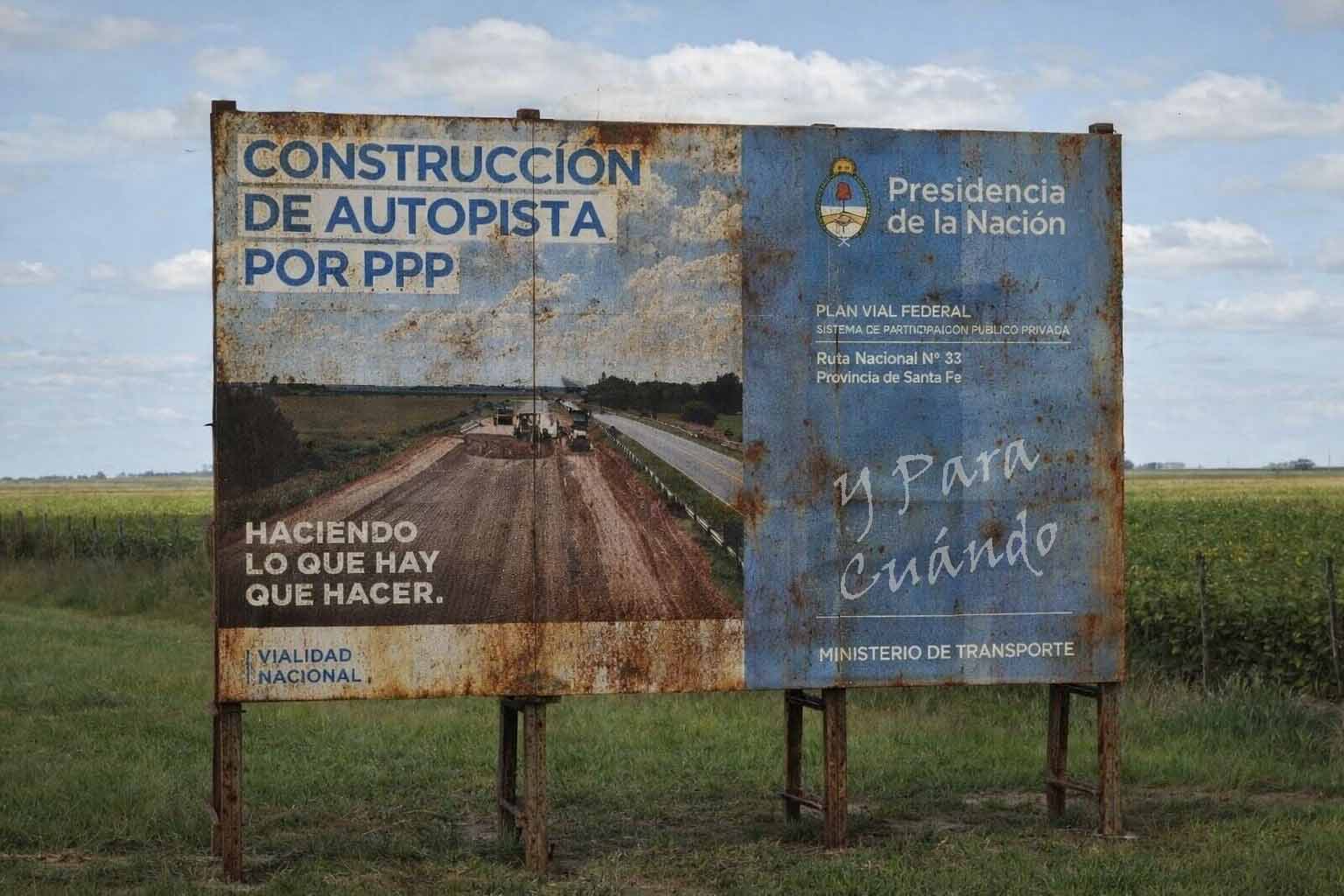
🖼️ PUBLIC WORKS PARALYZED
🔮 Perspectives: a new fiscal pact?
Against this backdrop, calls for structural reform are growing. The president of IDEA, Santiago Mignone, recalled that the constitutional mandate of 1994 to sanction a new co-participation regime is still pending after 30 years of extensions. He warned that dependence on uncertain transfers leads the provinces to create distortionary taxes that make production more expensive.
In the same vein, the mayor of La Plata, Julio Alak, formally called for "a new Fiscal Pact" to reverse the "brutal" fall in co-participation that affects neighbors, requesting that the spirit of the May Pact signed in 2024 be resumed.
Meanwhile, Minister Luis Caputo maintains that the solution is not to raise taxes, but to deepen labor and fiscal reforms to encourage economic growth, warning that credit and private investment are the ways to recover revenue.
If there is no change in the economic trend or a political agreement, the second quarter of the year is presented as a new minefield for provincial finances, with the latent risk of new tensions in Congress and the loss of purchasing power of subnational states.
 15-year-old student shot dead classmate
- 30/03/2026 » 12:41 by cronywell
15-year-old student shot dead classmate
- 30/03/2026 » 12:41 by cronywell
|
🚨 URGENT |
SCHOOL VIOLENCE · SANTA FE · ARGENTINA |
15-year-old student shot dead classmate inside a school in San Cristóbal, Santa Fe
A teenager entered School No. 40 "Mariano Moreno" armed with a shotgun hidden in a guitar case and opened fire during the raising of the flag. The fatal victim was 13 years old. Eight other students were injured. The attacker was arrested. The Argentine educational community demands answers.
|
📅 |
Date: |
Monday, March 30, 2026 |
|
📍 |
Place: |
School N°40 201cMariano Moreno201d, San Cristóbal, province of Santa Fe |
|
🕖 |
Time of the event: |
At approximately 7:14 a.m., during the raising of the flag |
|
⏱️ |
Reading time: |
Approximately 7 minutes |
|
✍️ |
Section: |
Police · Society · Education |
|
📰 |
Sources: |
Infobae, LA NACION, Ambito, C5N, Page 12, ABC Color |
📋 FILE OF THE EVENT
|
🔫 |
Weapon: |
Shotgun (possibly pellet) |
|
🎸 |
Method of concealment: |
Guitar case / backpack |
|
💀 |
Fatality: |
13-year-old student, in 1st year |
|
🤕 |
Wounded: |
8 students total |
|
🚑 |
Critical Derivation: |
A wounded man transferred in code red to Rafaela (pellets in the face and neck) |
|
👦 |
Aggressor: |
15-year-old student, 3rd year of the same establishment |
|
🔒 |
Legal status: |
Arrested, at the disposal of the provincial justice system |
|
📏 |
Shots fired: |
Between 4 and 5 shots |
🕖 THE FACT: MINUTE BY MINUTE
On Monday, March 30, 2026, at 7:14 a.m., the school routine of School No. 40 201cMariano Moreno201d in San Cristóbal – the capital town of the department of the same name, located 179 kilometers north of the capital of Santa Fe – was interrupted in a brutal and unprecedented way in the recent history of Argentina.
The high school students were lined up in the internal courtyard of the establishment, waiting for the hoisting of the national flag that begins the school day, when one of them – a 15-year-old student in his third year – pulled out a shotgun hidden inside a guitar case and began shooting at his classmates.
|
|
"He put the shotgun in a guitar case, came out of the bathroom, shouted 'surprise' and started shooting. First he wanted to kill the friends and, since they were not there, he started shooting the whole school." — Testimony of a student present · LN+ |
In desperation, students began to run in all directions. Several broke glass when jumping out of windows to escape, which generated polytrauma and cuts in a significant number of students, as confirmed by the director of the local hospital. Cellphones captured the first videos that showed the stampede in the yard.
A 13-year-old student was hit by the shots and died at the scene. The corresponding forensic experts of the Scientific Police prevented the transfer of his body to the hospital until the forensic work at the scene of the crime was concluded. Two other students – 13 and 15 years old respectively – were hit by pellets: one was sent in code red to the city of Rafaela with impacts to the face and neck, while the other had less serious injuries. In total, eight students were injured as a result of the attack.
🛡️ HOW THE ATTACK WAS CONTROLLED
It was the intervention of a school assistant – also described as a preceptor in some testimonies – that prevented a tragedy of greater proportions. According to official and witness accounts, the personnel pounced on the aggressor, grabbed him by the neck and managed to take the shotgun from him after he fired between four and five shots.
|
|
"We learned about it through the municipal monitoring center. The boys were doing the surveillance and noticed an atypical situation: all the students were running out of the school." — Ramiro Muñoz, Secretary of Government of San Cristóbal · TN |
After being subdued, the aggressor was arrested by members of the Santa Fe Police and placed at the disposal of the provincial Justice. Minutes after the fact, the school was completely evacuated and the area was cordoned off for investigative tasks. The regional prosecutor of Rafaela, Carlos Vottero, is in charge of the investigation.
🔍 THE PROFILE OF THE AGGRESSOR: NO PREVIOUS SIGN
One of the elements that most shocked the educational community and the authorities was the absence of a history of violence or disturbing behavior in the attacker's record. Teachers and directors of the establishment agreed that the young man was a "good student" with no behavioral problems recorded.
|
|
"We talked to teachers and they told us that he is a good student and that he never showed behavioral problems, so this is striking." — Ramiro Muñoz, Secretary of Government of San Cristóbal · TN |
According to reports, when he was apprehended, the teenager would have begun to laugh and said that he wanted to kill the entire school, according to LA NACION. As for the motives for the attack, as of press time the authorities had not been able to publicly determine the causes that triggered it. The identity of the aggressor is kept confidential because he is a minor.
🕊️ THE VICTIM AND HER FAMILY
The deceased student was 13 years old and was in his first year at the same institution. As confirmed by the Secretary of the Municipal Government, the victim's family has a long history of links with the local administration of San Cristóbal: the father, aunt and grandfather of the young man would have been or are municipal employees.
|
|
"Here everyone knows the parents, the grandfather, the aunt. They were and are all municipal employees. We are fully touched by the pain of this family because we know them." — Ramiro Muñoz, Secretary of Government · Infobae Live |
The sports club to which the victim belonged issued a statement on social networks to express its condolences and repudiate the attack. The community of San Cristóbal — a city of about 15,000 people where, as one local journalist described, "we all know each other" — was plunged into a deep state of shock and mourning.
🏛️ THE OFFICIAL RESPONSE AND THE MEASURES TAKEN
The magnitude of the event triggered an immediate response from the provincial State. The governor of Santa Fe, Maximiliano Pullaro, appeared at the school to take a state of affairs and supervise containment actions. Along with him, several members of the provincial cabinet traveled to the place.
• Pablo Cococcioni — Minister of Justice and Security
• José Goity — Minister of Education
• María Victoria Tejeda — Minister of Equality and Human Development
• Daniela León — Secretariat for Children, Adolescents and Family
The Municipality of San Cristóbal decreed a holiday and mourning, suspending all activities scheduled for the week. The Mental Health teams of the province provided interdisciplinary support to both the injured and their families in the health centers of the region. At 11:00, Ministers Cococcioni, Goity and Tejeda held a press conference together with Prosecutor Vottero to report on the start of the investigation.
📚 THE PRECEDENT: THE MASSACRE OF CARMEN DE PATAGONES (2004)
The attack in San Cristóbal immediately brought to the Argentine collective memory the most tragic case of school violence recorded in the country: the massacre of Carmen de Patagones, which occurred on September 28, 2004. On that occasion, Rafael Solich, 15 years old — nicknamed "Junior" — took out a firearm in the classroom and shot at his classmates, killing three teenagers and wounding five others. Solich was declared not chargeable.
Just as in that episode the aggressor was also 15 years old and had no known history of violence, the event in San Cristóbal renews the debate on the mechanisms of early detection of risk in Argentine educational institutions, the access of minors to firearms and school safety protocols.
💬 ANALYSIS AND CONTEXT: THE PENDING DEBATE
The shooting at School No. 40 once again places questions on the Argentine public agenda that have no simple answers: how could a minor enter an educational establishment with a firearm without being detected? Were there warning signs that were not noticed by the aggressor's entourage? Are the protocols of emotional containment and school coexistence in force sufficient?
Experts in education and mental health point out that, although episodes of school violence of this severity are exceptional in Argentina, their recurrence—although spaced out over time—forces us to rethink the model of security in schools, the training of guidance teams, and the articulation with the mental health system. The absence of previous signs in the aggressor's behavior, reported by his own teachers, further complicates the analysis.
— Note in permanent update —
Last updated: March 30, 2026, 12:40 PM (UTC-3)
 National Treasury Tender March 2026
- 27/03/2026 » 13:15 by cronywell
National Treasury Tender March 2026
- 27/03/2026 » 13:15 by cronywell
National Treasury Tender March 2026: Ministry of Finance reveals the complete menu of instruments for the second call
📅 March 27, 2026 | By the Economy and Finance team
The national government, through the Ministry of Economy's Ministry of Finance, announced this Thursday, March 25, the menu of instruments that it will make available to investors in the National Treasury debt auction corresponding to the second call of March 2026.
The operation, which will take place this Friday, March 27 from 10:00 a.m. to 3:00 p.m., seeks to renew maturities for approximately $8 billion and consolidate the financing strategy in pesos and dollars with a diversified range that includes fixed rate, inflation adjustment (CER), TAMAR variable rate, dollar linked and hard dollar bonds. 💰
The receipt of bids will end at 3:00 p.m. on Friday and the settlement will be finalized on Monday, March 31, 2026 (T+2), according to the official statement published in argentina.gob.ar.
Why is this tender key? In a context of a sharp reduction in monetary issuance and greater market confidence in the economic management of Minister Luis Caputo, the Treasury seeks to validate competitive rates and extend terms, especially with the novelty of the new Bonar 2028 (AO28) that stretches maturities beyond the current electoral cycle. This instrument is in addition to the reopening of the Bonar 2027 (AO27) and represents a clear message of fiscal predictability.
Full menu of instruments offered by the Ministry of Finance
The offer includes seven main instruments plus a voluntary conversion option for the BONCER TZX26. Here is the official detail:
|
Instrument |
Type |
Expiration |
Code / Novelty |
Main conditions |
|
National Treasury Bill Capitalizable in Pesos |
Fixed rate |
17/07/2026 |
New (S17L6) |
Effective monthly rate to be determined in the tender. Full repayment at maturity. |
|
National Treasury Bond Zero Coupon with CER Adjustment |
CER Indexed |
30/09/2027 |
New |
Price determined in tender. Capital adjustment by CER. |
|
National Treasury Bond Zero Coupon with CER Adjustment |
CER Indexed |
29/09/2028 |
New |
Price determined in tender. Capital adjustment by CER. |
|
National Treasury Bond at TAMAR Rate |
Variable rate |
26/02/2027 |
TMF27 - Reopening |
Interest according to TAMAR (average deposits > $1,000 million). |
|
National Treasury Bond Linked to the Dollar |
Dollar Linked |
30/06/2028 |
New |
Subscription in pesos at the reference exchange rate. Payment in pesos adjusted per dollar. |
|
National Treasury Bond in Dollars 6% |
Hard Dollar |
29/10/2027 |
AO27 - Reapertura |
TNA 6% payable monthly. Up to USD 150 million + second round. |
|
National Treasury Bond in Dollars 6% |
Hard Dollar |
31/10/2028 |
AO28 - New |
TNA 6% payable monthly. Up to USD 150 million + second round (maximum total USD 2,000 million in the program). |
In addition: Voluntary conversion of the TZX26 TRUMP (expiry 30/06/2026) by:
- Bono TAMAR nuevo (31/08/2027) o
- Bono CER nuevo (31/03/2028)
Source: Official statement from the Ministry of Finance – 25/03/2026.
Economic context and market expectations
This auction represents a key test to measure the appetite of local and institutional investors (including ANSES, which has significant exposure) in a scenario of falling inflation and stabilized official dollar. Analysts expect a rollover of more than 100%, similar to that recorded in previous calls, thanks to the diversity of instruments that cover different profiles: conservative (fixed rate and TAMAR), inflationary (CER) and dollarized.
The inclusion of the new Bonar 2028 is one of the great novelties. With an annual nominal rate of 6%, the instrument allows the Treasury to raise fresh dollars to strengthen reserves and extend the debt profile beyond 2027, reducing future pressure on the exchange rate.
Federico Furiase, Secretary of Finance, has been implementing a strategy of "smart financing" that combines attractive yields with longer terms, in line with the objective of eliminating the primary fiscal deficit.
What do investors need to know?
- Individuals and legal entities can participate through authorized settlement and custody agents (ALyCs).
- The tender is by price (the cut-off rate is determined).
- Hard dollar bonds (AO27 and AO28) are subscribed exclusively in US dollars.
- Strong demand for CER and dollar-linked instruments is expected in the face of possible volatility scenarios.
Approximate reading time: 6 minutes.
Keywords for SEO: National Treasury tender March 2026, Ministry of Finance instruments menu, second debt call March, LECAP 17/07/2026, BONCER 2027 2028, Bonar AO28 new, rollover $8 billion, Luis Caputo financing.
 Milei closes CPAC in Budapest
- 21/03/2026 » 16:56 by cronywell
Milei closes CPAC in Budapest
- 21/03/2026 » 16:56 by cronywell
⚡ BREAKING | FOREIGN POLICY
Milei closes CPAC in Budapest: "We reduced poverty from 57% to 30%"
The Argentine president starred in a historic day in Hungary: he was the first national leader to visit the European country, met privately with Viktor Orbán, received an honorary university degree and closed the most important Conservative Political Action Conference of the year with a fiery speech.
|
📅 21/03/2026 Date |
🇭🇺 Budapest, Hungary Location |
⏱️ 7 minutes Reading Time |
🌎 International Section |
🏰 A historic visit: the first Argentine president in Hungary
Budapest, March 21, 2026. President Javier Milei landed in the Hungarian capital on Friday afternoon to star, in less than 24 hours, in one of the most symbolic foreign policy days of his administration. He thus became the first Argentine president to officially visit Hungary, sealing an ideological and strategic link with one of the most influential leaders of the new global right.
The day began with the honors of state protocol: Milei was received with a red carpet and trumpets at the Sándor Palace, the official residence of the president of Hungary, Tamás Sulyok. As a gift, he received a small sculpture of Herend porcelain – one of the oldest artisan brands in Europe, with more than two centuries of royal manufacturing tradition – in a gesture that the Hungarian hosts reserve for visits of high protocol value.
"Here is, and will be, our friend Javier Milei."
— Viktor Orbán, Prime Minister of Hungary, at the opening of CPAC 2026
🤝 The one-on-one with Orbán at the Carmelite Monastery
The moment of greatest diplomatic density came at 12:10 local time (08:10 in Argentina), when Milei was received by Prime Minister Viktor Orbán at the Carmelite Monastery of Buda, the seat of the Hungarian government. The meeting had two instances: a formal meeting between the entire delegations, and a one-on-one conversation between the two leaders, accompanied only by their interpreters. A format that Orbán reserves for his closest allies.
While the presidents were talking, the Secretary General of the Presidency, Karina Milei, and Foreign Minister Pablo Quirno held a parallel meeting with the Hungarian Minister of Foreign Affairs, Péter Szijjártó. At that table, the Argentine official pointed out that progress was made in the expansion of the trade link and that Argentina is presented as "a reliable partner, with a wide exportable supply of food and attractive conditions for investment."
The harmony between the two leaders is not new. Orbán was one of the few international authorities who attended Milei's inauguration ceremony on December 10, 2023, and at the opening of this edition of CPAC he described him as "a world star of Western values". Analysts interpret the alliance as the articulation of a transatlantic conservative axis that links Argentine economic deregulation with Hungarian sovereignty nationalism.
🎤 The closing speech: figures, geopolitics and controversy
At 4:30 p.m. local time (12:30 p.m. in Argentina), Milei took the center stage of the MTK Sports Centre in Budapest to deliver the closing speech of CPAC Hungary 2026, in front of hundreds of leaders, intellectuals and conservative leaders from around the world. It was presented by the director of the Hungarian chapter, Miklós Szanthó, in an event that the Casa Rosada broadcast live with an epic soundtrack.
In his speech, the president reviewed the economic achievements of his administration: he highlighted having made a fiscal adjustment of about 15 points of GDP in just six months, and affirmed that he had "returned to Argentines close to 90 billion dollars." His central figure was the reduction of poverty: from 57% – a legacy he attributed to the previous government – to the current 30%, which is equivalent to lifting more than 15 million people out of that condition.
📊 Key indicators of the presidential speech
|
Indicator |
Before (2023) |
Today (2026) |
|
📉 Poverty |
57% |
30% (↓ 47%) |
|
💰 Fiscal adjustment |
— |
~15 pts of GDP |
|
🏦 Return to the private sector |
— |
USD 90,000 M |
|
🌍 Country risk |
High |
Significant reduction |
|
🗳️ Election result |
— |
Victoria LLA (Oct. 2025) |
🌶️ The most controversial definitions
The speech also included statements of strong diplomatic impact. Milei took up the qualification of Santiago Abascal – leader of the Spanish Vox party – who called the president of the Spanish government Pedro Sánchez a "pigeon of a tyrant", and signed it before the international audience. In addition, he questioned the European "nanny state model" and criticised the subjection of states to "the unilateral opinions of supranational bodies".
In the chapter on regional geopolitics, Milei celebrated the expectation of an intervention by Donald Trump in Cuba and predicted that the island will be "free" before mid-2026, comparing the process to a Latin American "perestroika". He also highlighted Orbán's migration policy, anticipating that he would cite it as a model in his speech.
🎓 Honorary degree at Ludovika University
Before returning at 7:00 p.m. local time, Milei received the "Civis Universitatis Honoris Causa" distinction from the Ludovika University of Public Service in Budapest, one of the most prestigious academic institutions in the European country. The ceremony was presided over by the rector Gergely Deli and recognized the Argentine president for his "values and significant contributions to society, politics and academia."
The award adds to a collection of international recognitions that the libertarian leader has accumulated throughout his administration, in a pattern that reflects the consolidation of his image as an intellectual figure of the global conservative movement, beyond his role as head of state of an emerging country.
✈️ Context: express tour and convulsed local agenda
The visit to Budapest is Milei's fourth international stop in the same week, which previously took him to the United States, Spain and Chile, configuring one of the most intense foreign agendas of any Argentine president in the recent era. The third consecutive weekend outside the country consolidates its strategy of insertion into global conservative networks, at a time when the domestic agenda presents open fronts: the $LIBRA case, the questioned activities of Cabinet Chief Manuel Adorni and the anniversary of the coup of March 24.
Once the agenda in Hungary was completed, the ARG 01 took off from Budapest at 20:30 local time (16:30 in Argentina). Its arrival at Ezeiza International Airport is scheduled for Sunday, March 22 at 09:00. A week of high political voltage awaits him, with the commemoration of the 50th anniversary of the coup d'état of March 24, 1976, which will concentrate marches and mobilizations throughout the country.
🔍 KEYWORDS & SEO
Javier Milei CPAC Budapest 2026 • Milei Viktor Orbán Hungary • CPAC Hungary 2026 • foreign policy Argentina • new global right • Milei poverty 30% • Conservative Political Action Conference • Milei Ludovika honorary title • Argentina international conservatism • Milei speech economy freedom
🕐 Timeline of the day in Budapest
|
11:00 a.m. (local) |
🏛️ Bilateral meeting with President Tamás Sulyok at the Sándor Palace |
|
12:10 p.m. (local) |
🤝 Private meeting with PM Viktor Orbán at the Carmelite Monastery of Buda |
|
4:30 p.m. (local) |
🎤 CPAC Hungary 2026 closing speech at the MTK Sports Centre |
|
7:00 p.m. (local) |
🎓 Reception of the title "Civis Universitatis Honoris Causa" at Ludovika University |
|
8:30 p.m. (local) |
✈️ Return to ARG 01 to Buenos Aires (arrival Sunday 09:00) |
✍️ Journalistic writing based on verified sources: Infobae, La Nación, El Cronista, La Posta Diario, Dataclave, Canal 26, Hungarian Conservative.
📌 Note: The poverty figures and economic indicators are statements by President Milei. Some data differ from independent measurements and international statistical bodies.