
News
 Google Willow: The Quantum Chip Revolutionizing Computing
- 09/12/2025 » 11:50 by cronywell
Google Willow: The Quantum Chip Revolutionizing Computing
- 09/12/2025 » 11:50 by cronywell
Google Willow: The Quantum Chip Revolutionizing Computing
The Google Willow quantum chip, presented on December 9, 2025, constitutes a scientific milestone by demonstrating quantum error correction below threshold and achieving quantum supremacy with 105 qubits. Its architecture allows errors to be exponentially reduced as the number of qubits increases, solving a three-decade challenge in quantum computing.
White Paper: Google Willow
1. Context and relevance
- Date of filing: December 9, 2025.
- Institution: Google Quantum AI.
- Scientific publication: Nature, where the experimental results are documented.
- Impact: Willow represents a decisive step towards building useful and scalable quantum computers capable of solving practical problems with commercial relevance.
2. Willow chip architecture
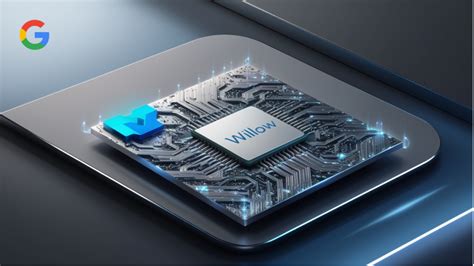
- Number of qubits: 105 superconducting qubits.
- Base technology: transmon qubits, cooled to temperatures close to absolute zero to maintain quantum coherence.
- Bug fixes:
- It implements quantum surface codes, which distribute logical information across multiple physical qubits.
- It was shown that by increasing the number of qubits, the error rate decreases exponentially, confirming that the system operates under the quantum error correction threshold.
- This result experimentally validates a theoretical principle proposed almost 30 years ago, considered essential for scalability.
- It implements quantum surface codes, which distribute logical information across multiple physical qubits.
3. Quantum supremacy
- Benchmark performed: A standard quantum sampling reference task.
- Runtime: less than five minutes.
- Comparison: The Frontier supercomputer would need approximately 10²⁵ years to complete the same calculation.
- Conclusion: Willow confirms quantum supremacy, demonstrating that certain problems are intractable for classical computing.
Featured Comparison
|
Aspect |
Google Willow |
Frontier |
|
Technology |
Quantum computing with error correction |
High-performance classical computing |
|
Speed in benchmark |
5 minutes |
10 septillion years |
|
Qubits / Processing |
105 superconducting qubits |
1.1 exaflops (≈10^18 operations/second) |
|
Potential Applications |
Medicine, energy, AI, crypto |
Scientific simulations, climate, nuclear physics |
|
Impact |
It marks a leap towards quantum supremacy |
Leader in classical supercomputing |
4. Key scientific breakthroughs
- Bug fixes under threshold:
- It allows logical qubits to be more reliable than physical qubits.
- It opens the door to scalable and stable quantum systems.
- It allows logical qubits to be more reliable than physical qubits.
- Scalability:
- Reducing errors with more qubits indicates that the technology can grow into thousands or millions of useful qubits.
- Reducing errors with more qubits indicates that the technology can grow into thousands or millions of useful qubits.
- Experimental validation:
- It is confirmed that the theoretical principles of quantum computing are applicable in real hardware.
- It is confirmed that the theoretical principles of quantum computing are applicable in real hardware.
5. Potential applications
- Pharmacology: Simulation of complex molecules for drug discovery.
- Energy: Advanced battery design and nuclear fusion modeling.
- Artificial intelligence: optimization of deep learning algorithms.
- Cybersecurity: development of systems resistant to quantum attacks.
6. Conclusion
The Google Willow chip not only confirms quantum supremacy, but solves the historical problem of quantum error correction under threshold. This breakthrough places Google at the forefront of quantum computing and paves the way for practical applications with an impact on science, industry, and society.