Federal co-participation fell 11% in March: the provinces lost $1,151,000 million in the first quarter 📉
📅 April 1, 2026 | ⏱️ Reading Time: 7 minutes
📉 The collapse of resources
In a new blow to subnational finances, automatic transfers by Federal Co-participation registered a real drop of 11.3% in March compared to February, according to private estimates based on official data. This setback is not an isolated event, but consolidates a negative trend during the first quarter of 2026, generating an accumulated loss for the provinces and the Autonomous City of Buenos Aires (CABA) that amounts to $1,151,000 million in real terms.
The report by the consulting firm Politikon Chaco, prepared based on data from the National Directorate of Provincial Affairs (DNAP) and INDEC, details that during March remittances totaled $5.05 billion, showing a decrease of –4.3% year-on-year and –9.9% in the monthly comparison. This volume is the lowest in nominal terms since April 2025, which sets off alarms in local governments.
🖼️ Monthly Evolution Real Federal Co-participation
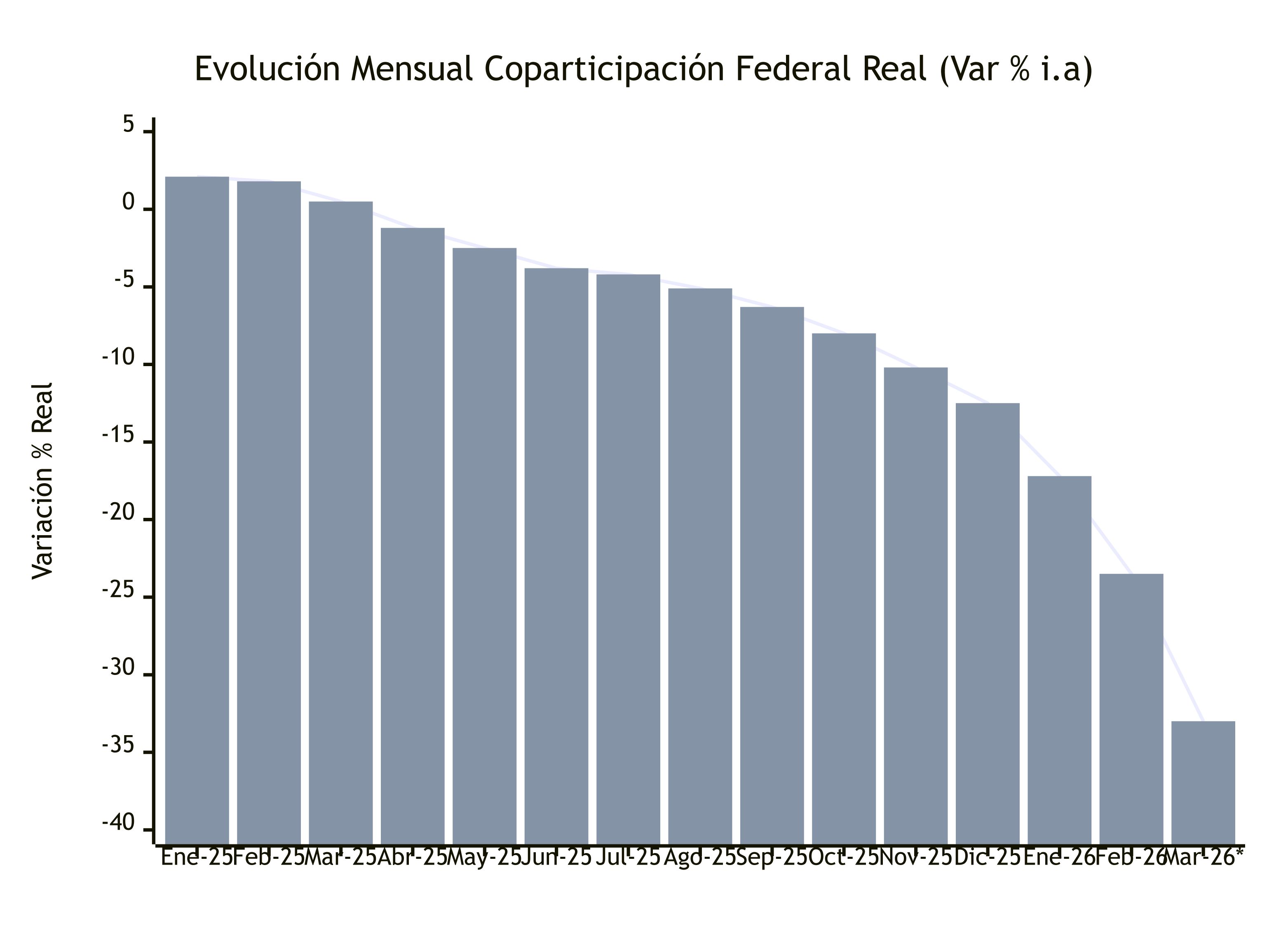
Source: Prepared by the authors based on data from the National Directorate of Provincial Affairs (DNAP), INDEC and the consulting firm Politikon Chaco.
** March 2026: provisional data. *
💰 The weight of collection: VAT and Profits in decline
The main co-participation taxes, the Value Added Tax (VAT) and the Income Tax, explain much of this deterioration. The collection of both taxes has shown a negative performance in the first months of the year, reflecting the slowdown in economic activity and the impact of administrative measures such as the restitution of exclusion certificates in customs VAT.
According to economist Nadin Argañaraz, of the IARAF, national revenue registered a real drop of $3.3 billion in the first two months. VAT contributed the largest drop ($1,680,000 million), followed by withholdings and personal contributions. Thus, while the Nation reduced its revenues by 9.3% real year-on-year, the provinces suffered a 7.6% decrease in their transfers during the same period.
🌎 Regional impact: millionaire losses and adjustments
The magnitude of the loss affects the entire provincial spectrum, with variations in absolute terms, but with a common denominator: financial stress.
📊 Main provinces affected (loss in the first quarter of 2026)
|
Province
|
Loss (in millions of pesos)
|
|
Buenos Aires
|
$204,499
|
|
Santa Fe
|
$82,957
|
|
Cordoba
|
$81,028
|
|
Chaco
|
MX$57,111
|
|
Quests
|
$38,000
|
Source: Estimated data based on reports from Politikon Chaco and Infobae.
In the case of Chaco, the loss totaled $57,111 million, with a fall of 6.9% in real terms in the quarterly cumulative, while Misiones lost about $38,000 million in the same period, a decline of 6.5% in real terms. Buenos Aires, the most populous province governed by Axel Kicillof, heads the list of the most affected in absolute terms, with a reduction of more than $204,499 million in the first two months of the year alone.
⚖️ Political tension and fiscal federalism
The drain of funds has revived the dispute over fiscal federalism. The governors, who mostly accompanied President Javier Milei at the recent Argentina Week in New York in search of investments, now face a scenario of forced adjustment in their jurisdictions.
The conflict escalated this week when 25 mayors, grouped in the Federal Council of Mayors (Cofein), came out to the intersection of the Minister of Economy, Luis Caputo, who had pointed out against municipal taxes for considering them an obstacle to the reduction of prices. In a document entitled "The municipalities sustain what the Nation abandons," the community leaders warned that the rates represent only 3% of the total tax burden, against the 75% that remains in the hands of the Nation.
"The Nation collects resources from everyone, but does not distribute them according to real responsibilities," said the mayors, demanding a reform in the distribution of the fuel tax and the execution of the withheld National Treasury Contributions (ATN).
🚧 Consequences: works stopped and debt increase
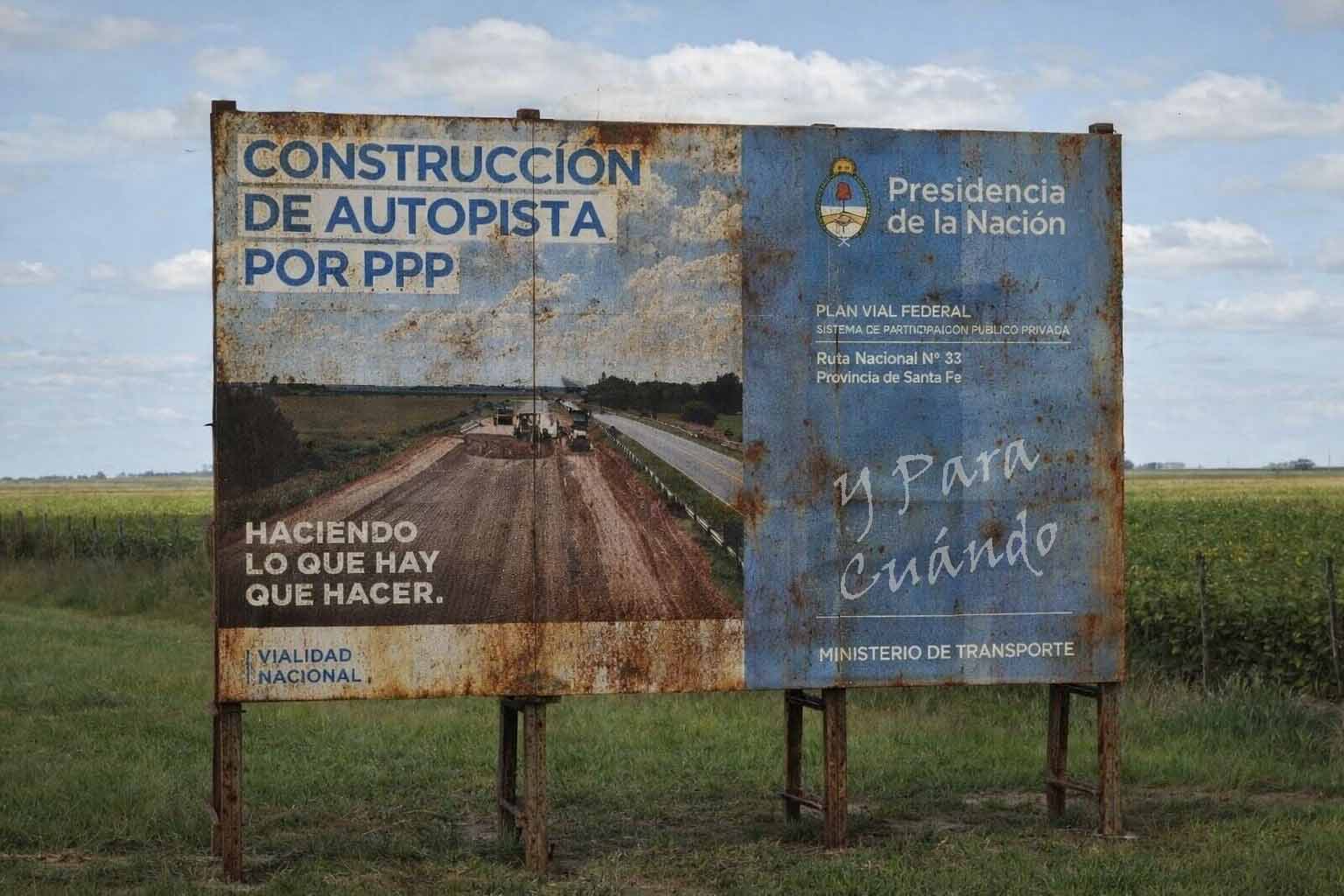
The lack of liquidity is already having concrete consequences in the territory. A governor of northern Argentina described the scenario starkly:
"The month closed very badly. We have to try to lower expenses and that increases our debt. The execution of works is slower and others are eliminated directly."
During 2025, the provinces had increased their spending at a faster rate than revenues, largely due to the electoral calendar. This gap left seven jurisdictions, including Buenos Aires, Santa Cruz and Chubut, with a negative financial balance. Now, with the fall in co-participating resources, the margins for maneuver have been reduced to zero.
🖼️ PUBLIC WORKS PARALYZED
🔮 Perspectives: a new fiscal pact?
Against this backdrop, calls for structural reform are growing. The president of IDEA, Santiago Mignone, recalled that the constitutional mandate of 1994 to sanction a new co-participation regime is still pending after 30 years of extensions. He warned that dependence on uncertain transfers leads the provinces to create distortionary taxes that make production more expensive.
In the same vein, the mayor of La Plata, Julio Alak, formally called for "a new Fiscal Pact" to reverse the "brutal" fall in co-participation that affects neighbors, requesting that the spirit of the May Pact signed in 2024 be resumed.
Meanwhile, Minister Luis Caputo maintains that the solution is not to raise taxes, but to deepen labor and fiscal reforms to encourage economic growth, warning that credit and private investment are the ways to recover revenue.
If there is no change in the economic trend or a political agreement, the second quarter of the year is presented as a new minefield for provincial finances, with the latent risk of new tensions in Congress and the loss of purchasing power of subnational states.
📌 TECHNICAL SHEET AND SEO APPLIED
|
Component
|
Detail
|
|
Primary Keyword
|
Federal co-participation
|
|
Secondary keywords
|
fall in co-participation March 2026, loss of provinces first quarter, fiscal conflict Nation provinces, Luis Caputo co-participation
|
|
Meta Description
|
The federal co-participation fell 11% in March 2026, generating a loss of $1,151,000 million for the provinces in the first quarter. Learn about the impact by province, Caputo's statements and the reactions of the governors.
|
|
Tags
|
co-participation, provinces, Javier Milei, Luis Caputo, fiscal federalism, VAT, Profits, collection, governors, Argentina 2026
|
|
Header Structure
|
H1 (title), H2 (main sections), H3 (sub-theme within Regional Impact)
|
|
Responsive format
|
One column, legible typography, visual icons, adaptive tables
|
✅ PRE-PUBLICATION CHECKLIST
- Monserrat typeface installed or configured in the document
- Built-in images based on suggestions
- Table of losses by province verified with sources
- Updated Release Date
Read more...
Federal co-participation fell 11% in March: the provinces lost $1,151,000 million in the first quarter 📉
📅 April 1, 2026 | ⏱️ Reading Time: 7 minutes
📉 The collapse of resources
In a new blow to subnational finances, automatic transfers by Federal Co-participation registered a real drop of 11.3% in March compared to February, according to private estimates based on official data. This setback is not an isolated event, but consolidates a negative trend during the first quarter of 2026, generating an accumulated loss for the provinces and the Autonomous City of Buenos Aires (CABA) that amounts to $1,151,000 million in real terms.
The report by the consulting firm Politikon Chaco, prepared based on data from the National Directorate of Provincial Affairs (DNAP) and INDEC, details that during March remittances totaled $5.05 billion, showing a decrease of –4.3% year-on-year and –9.9% in the monthly comparison. This volume is the lowest in nominal terms since April 2025, which sets off alarms in local governments.
🖼️ Monthly Evolution Real Federal Co-participation
Source: Prepared by the authors based on data from the National Directorate of Provincial Affairs (DNAP), INDEC and the consulting firm Politikon Chaco.
** March 2026: provisional data. *
💰 The weight of collection: VAT and Profits in decline
The main co-participation taxes, the Value Added Tax (VAT) and the Income Tax, explain much of this deterioration. The collection of both taxes has shown a negative performance in the first months of the year, reflecting the slowdown in economic activity and the impact of administrative measures such as the restitution of exclusion certificates in customs VAT.
According to economist Nadin Argañaraz, of the IARAF, national revenue registered a real drop of $3.3 billion in the first two months. VAT contributed the largest drop ($1,680,000 million), followed by withholdings and personal contributions. Thus, while the Nation reduced its revenues by 9.3% real year-on-year, the provinces suffered a 7.6% decrease in their transfers during the same period.
🌎 Regional impact: millionaire losses and adjustments
The magnitude of the loss affects the entire provincial spectrum, with variations in absolute terms, but with a common denominator: financial stress.
📊 Main provinces affected (loss in the first quarter of 2026)
|
Province
|
Loss (in millions of pesos)
|
|
Buenos Aires
|
$204,499
|
|
Santa Fe
|
$82,957
|
|
Cordoba
|
$81,028
|
|
Chaco
|
MX$57,111
|
|
Quests
|
$38,000
|
Source: Estimated data based on reports from Politikon Chaco and Infobae.
In the case of Chaco, the loss totaled $57,111 million, with a fall of 6.9% in real terms in the quarterly cumulative, while Misiones lost about $38,000 million in the same period, a decline of 6.5% in real terms. Buenos Aires, the most populous province governed by Axel Kicillof, heads the list of the most affected in absolute terms, with a reduction of more than $204,499 million in the first two months of the year alone.
⚖️ Political tension and fiscal federalism
The drain of funds has revived the dispute over fiscal federalism. The governors, who mostly accompanied President Javier Milei at the recent Argentina Week in New York in search of investments, now face a scenario of forced adjustment in their jurisdictions.
The conflict escalated this week when 25 mayors, grouped in the Federal Council of Mayors (Cofein), came out to the intersection of the Minister of Economy, Luis Caputo, who had pointed out against municipal taxes for considering them an obstacle to the reduction of prices. In a document entitled "The municipalities sustain what the Nation abandons," the community leaders warned that the rates represent only 3% of the total tax burden, against the 75% that remains in the hands of the Nation.
"The Nation collects resources from everyone, but does not distribute them according to real responsibilities," said the mayors, demanding a reform in the distribution of the fuel tax and the execution of the withheld National Treasury Contributions (ATN).
🚧 Consequences: works stopped and debt increase
The lack of liquidity is already having concrete consequences in the territory. A governor of northern Argentina described the scenario starkly:
"The month closed very badly. We have to try to lower expenses and that increases our debt. The execution of works is slower and others are eliminated directly."
During 2025, the provinces had increased their spending at a faster rate than revenues, largely due to the electoral calendar. This gap left seven jurisdictions, including Buenos Aires, Santa Cruz and Chubut, with a negative financial balance. Now, with the fall in co-participating resources, the margins for maneuver have been reduced to zero.
🖼️ PUBLIC WORKS PARALYZED
🔮 Perspectives: a new fiscal pact?
Against this backdrop, calls for structural reform are growing. The president of IDEA, Santiago Mignone, recalled that the constitutional mandate of 1994 to sanction a new co-participation regime is still pending after 30 years of extensions. He warned that dependence on uncertain transfers leads the provinces to create distortionary taxes that make production more expensive.
In the same vein, the mayor of La Plata, Julio Alak, formally called for "a new Fiscal Pact" to reverse the "brutal" fall in co-participation that affects neighbors, requesting that the spirit of the May Pact signed in 2024 be resumed.
Meanwhile, Minister Luis Caputo maintains that the solution is not to raise taxes, but to deepen labor and fiscal reforms to encourage economic growth, warning that credit and private investment are the ways to recover revenue.
If there is no change in the economic trend or a political agreement, the second quarter of the year is presented as a new minefield for provincial finances, with the latent risk of new tensions in Congress and the loss of purchasing power of subnational states.
📌 TECHNICAL SHEET AND SEO APPLIED
|
Component
|
Detail
|
|
Primary Keyword
|
Federal co-participation
|
|
Secondary keywords
|
fall in co-participation March 2026, loss of provinces first quarter, fiscal conflict Nation provinces, Luis Caputo co-participation
|
|
Meta Description
|
The federal co-participation fell 11% in March 2026, generating a loss of $1,151,000 million for the provinces in the first quarter. Learn about the impact by province, Caputo's statements and the reactions of the governors.
|
|
Tags
|
co-participation, provinces, Javier Milei, Luis Caputo, fiscal federalism, VAT, Profits, collection, governors, Argentina 2026
|
|
Header Structure
|
H1 (title), H2 (main sections), H3 (sub-theme within Regional Impact)
|
|
Responsive format
|
One column, legible typography, visual icons, adaptive tables
|
✅ PRE-PUBLICATION CHECKLIST
- Monserrat typeface installed or configured in the document
- Built-in images based on suggestions
- Table of losses by province verified with sources
- Updated Release Date
Close








 Federal co-participation fell 11% in March
- 01/04/2026 » 13:46 by cronywell
Federal co-participation fell 11% in March
- 01/04/2026 » 13:46 by cronywell