📚 EDUCATION • OECD REPORT
PISA 2025: Argentina suffers its worst educational drop in almost two decades and regresses in the three subjects evaluated
The country obtained its lowest scores since 2006 and fell, for the first time simultaneously, in Science, Reading and Mathematics. Eight out of ten students do not reach the expected basic level in Mathematics.
📅 September 8, 2026 🏷️ Society / Education ⏱️ Reading time: 6 min ✍️ Writing
The results of the PISA 2025 tests, released Tuesday by the Organization for Economic Cooperation and Development (OECD), confirmed a sharp setback in the Argentine education system. For the first time since there is a comparable series, the country fell simultaneously in the three areas evaluated – Science, Reading and Mathematics – and registered its worst performance in almost twenty years. The collapse occurs in the midst of an educational deterioration that is hitting much of the world, although Argentina is among the countries that regressed the most in Latin America.
📉 An unprecedented collapse: the numbers of the fall
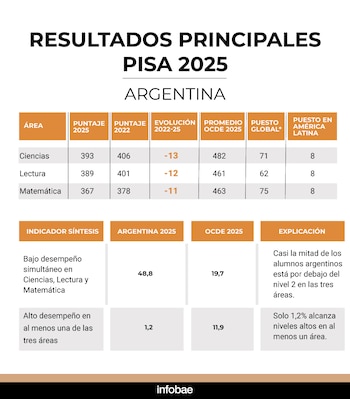
In the 2025 edition, the ninth since this international assessment was taken, Argentina obtained 393 points in Science, 389 in Reading and 367 in Mathematics. The three results were below those of PISA 2022 and you have to go back to 2006 to find lower figures in Science and Reading. In Mathematics, on the other hand, the country scored the worst score in its entire comparable historical series.
The drop was 13 points in Science (from 406 to 393), 12 points in Reading (from 401 to 389) and 11 points in Mathematics (from 378 to 367). In the ranking of the 91 participating education systems, Argentina was ranked 71st in Science, 62nd in Reading and 75th in Mathematics.
🔻 393 points in Science (-13 compared to 2022) — 71st place out of 91
🔻 389 points in Reading (-12 compared to 2022) — 62nd place out of 91
🔻 367 points in Mathematics (-11 compared to 2022) — 75th place out of 91, the worst in the historical series
Behind the general averages, an even more worrying picture appears when observing performance levels. In Mathematics, only 24% of Argentine students reached the basic level (level 2) or higher, compared to 65% of the OECD average; that is, three out of four adolescents fail to solve the minimum problems expected for their age. In Reading, 40% reached the basic level and in Science 41%, compared to 69% and 74% in the OECD respectively.
The most eloquent indicator combines the three subjects: 48.8% of Argentine 15-year-old students perform poorly in Science, Reading and Mathematics at the same time, almost triple the 19.7% observed in the OECD average. At the other extreme, only 1.2% of Argentine students achieve the highest levels of performance in any of the three areas, compared to 11.9% of the countries of the organization.
🌎 Argentina, eighth in the Latin American ranking
Compared to the rest of the region, Argentina remains in the bottom half of the table. Among the 13 Latin American countries that participated in PISA 2025, the country ranked eighth in the three subjects evaluated. Uruguay and Chile lead almost all the regional rankings, followed by Costa Rica, Colombia, Mexico, Brazil and Peru, which generally surpass Argentina.
|
Country
|
Science
|
Reading
|
Mathematics
|
|
Uruguay
|
445
|
423
|
405
|
|
Chile
|
442
|
436
|
403
|
|
Costa Rica
|
424
|
416
|
387
|
|
Mexico
|
414
|
408
|
388
|
|
Colombia
|
414
|
399
|
381
|
|
Brazil
|
409
|
408
|
377
|
|
Peru
|
406
|
390
|
382
|
|
Argentina
|
393
|
389
|
367
|
|
Ecuador
|
393
|
s/d
|
366
|
PISA 2025 scores by country in Latin America. Source: OECD / Argentines for Education.
Beyond the relative position, what worries specialists most is the speed of the setback: although most countries in the region stagnated or fell slightly between 2022 and 2025, Argentina is among those that worsened the most. In Mathematics, in fact, it registered the largest drop in the entire regional bloc, with 11 points less than in the previous edition. Only Costa Rica and El Salvador managed to avoid setbacks in the three areas evaluated.
🧮 Mathematics, the most critical area
Mathematics has been, for several editions, the weakest point of the Argentine education system, and in 2025 it deepened its deterioration. The proportion of students who reach at least the basic level has been falling steadily: it was 31% in 2018, fell to 27% in 2022 and now stands at 24%. At the highest levels of the scale (5 and 6) the Argentine presence is practically nil, while in the OECD it reaches 8% of students.
● 2018 → 31% of students reached the basic level
● 2022 → 27% reached the basic level
● 2025 → 24% reached the basic level (76% do not)
PISA 2025 also incorporated a computational problem-solving test, which measures the ability to use digital programming and modeling tools to solve new situations. Argentina obtained 403 points, well below the OECD average of 500, and was ninth among the 13 Latin American countries evaluated in this new competition.
📱 Cell phones, noise and digital distraction in the classroom
The complementary questionnaires that accompany the test allow us to reconstruct the climate inside the classroom, and there Argentina exhibits several indicators above the international average. 55% of students said that their classmates are distracted by cell phones or other devices during most science classes, compared to 28% in the OECD; and only 37% attend schools where the use of cell phones is prohibited throughout the establishment, compared to 49% in the countries of the organization.
The disorder inside the classroom is also more marked: 58% of Argentine students said that noise interrupts most or all of the science classes, almost double the 31% recorded in the OECD, and 47% said that their classmates do not listen to the teacher. Unpunctuality was added to the list of problems: 66% of adolescents were late to school at least once in the two weeks prior to the test, ten points higher than the international average.
In the midst of this panorama, a favorable fact appears: the assessment of teachers by the students themselves. 78% of Argentine students consider that their science teacher is interested in everyone's learning, 73% that they continue to explain until the course understands and 79% that they offer extra help when necessary; all three percentages exceed the OECD average.
🗣️ The voices of the education sector
"The results of PISA 2025 confirm a trend that we cannot ignore," said Víctor Volman, executive director of Argentinos por la Educación, who remarked that the recent improvement in some indicators of Learning is not enough if there is not a sustained strategy throughout the school career, with a special focus on Mathematics.
— Víctor Volman, executive director of Argentines for Education
From a regional perspective, specialists in educational evaluation point out that reading is today the area that is regressing the most globally, and that Latin America faces this trend from already low learning levels, which deepens the gap with the best-performing education systems.
🌐 A global phenomenon: the OECD also hits its historic low
Argentina's collapse does not occur in isolation. The OECD report points out that PISA 2025 recorded the lowest average scores since the beginning of assessment in Science, Reading and Mathematics, although the behavior was not the same in the three subjects: while Science remained relatively stable in most education systems, the fall in Reading and Mathematics continued and deepened.
East Asian education systems were once again at the top of the ranking. Chinese provinces grouped as B-S-J-Z (Beijing, Shanghai, Jiangsu and Zhejiang) and Singapore topped the combined results of the three subjects, followed by Estonia, Japan, South Korea, Macau, Taipei and the United Kingdom.
Among the factors that the OECD itself mentions to explain the global deterioration are the decrease in reading for pleasure, changes in the digital habits of adolescents, persistent problems with school attendance and less family interaction around school life. The organization insists that learning loss is a long-term process that cannot be explained only by school closures during the pandemic.
🔎 How the Study Was Done
PISA evaluates 15-year-old students in Science, Reading and Mathematics every three years, with a focus on the ability to apply knowledge to new situations and not on the mastery of specific curricular content. More than 760,000 students from 91 countries and economies participated in this edition, representing some 33 million adolescents worldwide. In Argentina, the sample included 11,093 students from 412 schools, representative of about 609,100 15-year-olds, and the test was administered in digital format, as in 2022.
📊 Historical evolution of Argentina's scores (2006–2025)
|
Subject matter
|
2006
|
2009
|
2012
|
2018
|
2022
|
2025
|
|
Science
|
391
|
401
|
406
|
404
|
406
|
393
|
|
Reading
|
374
|
s/d
|
s/d
|
402
|
401
|
389
|
|
Mathematics
|
s/d
|
s/d
|
s/d
|
s/d
|
378
|
367
|
n.d.: No representative data available in this comparison. Source: OECD / Argentines for Education, report "How did Argentina fare in PISA 2025?".
📰 Sources consulted
🔗 La Nación — PISA 2025 tests: Argentina falls again in all subjects
🔗 Infobae — Argentina fell in reading, math and science: worst results since 2006
🔗 Minute One — Argentina obtained the worst result in 20 years
🔗 360 More News — Argentina fell again in all subjects
🔗 RosarioMix — The worst data since 2006
🔗 Mi Periódico — Argentina falls in all areas
🖼️ Reference images (absolute links)
As they are copyrighted material of each medium, the photographs are not embedded in this document; their source links are listed for consultation or licensing.
🔗 Student taking an exam in a classroom (Infobae)
🔗 Infographic: Argentina fell in the three areas evaluated (Infobae)
🔗 Public high school (Infobae)
📈 SEO datasheet for web publishing
SEO title (title tag, ≈60 car.): PISA 2025: Argentina falls in all subjects, the worst in 20 years
Meta description (≈155 car.): Argentina fell in Science, Reading and Mathematics in PISA 2025, its worst result in almost 20 years. Figures, regional comparison and complete context.
Suggested slug URL: /educacion/pisa-2025-argentina-cae-todas-las-materia
Focus keyword: PISA 2025 Argentina
Secondary/long-tail keywords:
●PISA 2025 Argentina results
●educational fall Argentina 2025
●Mathematics Level Argentine Students
●PISA Latin America 2025 ranking
●OECD education Argentina
Header structure (H1–H2 semantic hierarchy) already applied:
●H1: main title of the note
●H2: An unprecedented collapse / Latin American ranking / Mathematics / Digital distraction / Voices from the sector / Global phenomenon / Methodology
Suggested alt text (alt) for images:
●"Student taking the PISA 2025 test in an Argentine classroom"
●"Graph: evolution of Argentina's scores in PISA 2006-2025"
●"Public high school classroom in Argentina"
Suggested internal linking: previous notes on Learning 2025, reports by Argentines for Education and coverage of PISA 2022, to reinforce thematic authority (topic cluster).
External link of authority: official report of the OECD and the report of Argentines for Education (see Sources).
Recommended structured data (JSON-LD, schema.org/NewsArticle):
{ "@context": "https://schema.org", "@type": "NewsArticle", "headline": "PISA 2025: Argentina cae en todas las materias", "datePublished": "2026-09-08", "articleSection": "Educación", "keywords": "PISA 2025, Argentina, OCDE, educación" }
Core Web Vitals / performance: use images in WebP/AVIF with width/height and loading="lazy" attributes (except the main image), and compress the total weight of the note below 1.5 MB to optimize the LCP on mobile.
Social media — copy's suggestion: "Argentina fell again in the three subjects of PISA 2025 and scored its worst result in almost 20 years. The numbers, here 👇"
Read more...
📚 EDUCATION • OECD REPORT
PISA 2025: Argentina suffers its worst educational drop in almost two decades and regresses in the three subjects evaluated
The country obtained its lowest scores since 2006 and fell, for the first time simultaneously, in Science, Reading and Mathematics. Eight out of ten students do not reach the expected basic level in Mathematics.
📅 September 8, 2026 🏷️ Society / Education ⏱️ Reading time: 6 min ✍️ Writing
The results of the PISA 2025 tests, released Tuesday by the Organization for Economic Cooperation and Development (OECD), confirmed a sharp setback in the Argentine education system. For the first time since there is a comparable series, the country fell simultaneously in the three areas evaluated – Science, Reading and Mathematics – and registered its worst performance in almost twenty years. The collapse occurs in the midst of an educational deterioration that is hitting much of the world, although Argentina is among the countries that regressed the most in Latin America.
📉 An unprecedented collapse: the numbers of the fall
In the 2025 edition, the ninth since this international assessment was taken, Argentina obtained 393 points in Science, 389 in Reading and 367 in Mathematics. The three results were below those of PISA 2022 and you have to go back to 2006 to find lower figures in Science and Reading. In Mathematics, on the other hand, the country scored the worst score in its entire comparable historical series.
The drop was 13 points in Science (from 406 to 393), 12 points in Reading (from 401 to 389) and 11 points in Mathematics (from 378 to 367). In the ranking of the 91 participating education systems, Argentina was ranked 71st in Science, 62nd in Reading and 75th in Mathematics.
🔻 393 points in Science (-13 compared to 2022) — 71st place out of 91
🔻 389 points in Reading (-12 compared to 2022) — 62nd place out of 91
🔻 367 points in Mathematics (-11 compared to 2022) — 75th place out of 91, the worst in the historical series
Behind the general averages, an even more worrying picture appears when observing performance levels. In Mathematics, only 24% of Argentine students reached the basic level (level 2) or higher, compared to 65% of the OECD average; that is, three out of four adolescents fail to solve the minimum problems expected for their age. In Reading, 40% reached the basic level and in Science 41%, compared to 69% and 74% in the OECD respectively.
The most eloquent indicator combines the three subjects: 48.8% of Argentine 15-year-old students perform poorly in Science, Reading and Mathematics at the same time, almost triple the 19.7% observed in the OECD average. At the other extreme, only 1.2% of Argentine students achieve the highest levels of performance in any of the three areas, compared to 11.9% of the countries of the organization.
🌎 Argentina, eighth in the Latin American ranking
Compared to the rest of the region, Argentina remains in the bottom half of the table. Among the 13 Latin American countries that participated in PISA 2025, the country ranked eighth in the three subjects evaluated. Uruguay and Chile lead almost all the regional rankings, followed by Costa Rica, Colombia, Mexico, Brazil and Peru, which generally surpass Argentina.
|
Country
|
Science
|
Reading
|
Mathematics
|
|
Uruguay
|
445
|
423
|
405
|
|
Chile
|
442
|
436
|
403
|
|
Costa Rica
|
424
|
416
|
387
|
|
Mexico
|
414
|
408
|
388
|
|
Colombia
|
414
|
399
|
381
|
|
Brazil
|
409
|
408
|
377
|
|
Peru
|
406
|
390
|
382
|
|
Argentina
|
393
|
389
|
367
|
|
Ecuador
|
393
|
s/d
|
366
|
PISA 2025 scores by country in Latin America. Source: OECD / Argentines for Education.
Beyond the relative position, what worries specialists most is the speed of the setback: although most countries in the region stagnated or fell slightly between 2022 and 2025, Argentina is among those that worsened the most. In Mathematics, in fact, it registered the largest drop in the entire regional bloc, with 11 points less than in the previous edition. Only Costa Rica and El Salvador managed to avoid setbacks in the three areas evaluated.
🧮 Mathematics, the most critical area
Mathematics has been, for several editions, the weakest point of the Argentine education system, and in 2025 it deepened its deterioration. The proportion of students who reach at least the basic level has been falling steadily: it was 31% in 2018, fell to 27% in 2022 and now stands at 24%. At the highest levels of the scale (5 and 6) the Argentine presence is practically nil, while in the OECD it reaches 8% of students.
● 2018 → 31% of students reached the basic level
● 2022 → 27% reached the basic level
● 2025 → 24% reached the basic level (76% do not)
PISA 2025 also incorporated a computational problem-solving test, which measures the ability to use digital programming and modeling tools to solve new situations. Argentina obtained 403 points, well below the OECD average of 500, and was ninth among the 13 Latin American countries evaluated in this new competition.
📱 Cell phones, noise and digital distraction in the classroom
The complementary questionnaires that accompany the test allow us to reconstruct the climate inside the classroom, and there Argentina exhibits several indicators above the international average. 55% of students said that their classmates are distracted by cell phones or other devices during most science classes, compared to 28% in the OECD; and only 37% attend schools where the use of cell phones is prohibited throughout the establishment, compared to 49% in the countries of the organization.
The disorder inside the classroom is also more marked: 58% of Argentine students said that noise interrupts most or all of the science classes, almost double the 31% recorded in the OECD, and 47% said that their classmates do not listen to the teacher. Unpunctuality was added to the list of problems: 66% of adolescents were late to school at least once in the two weeks prior to the test, ten points higher than the international average.
In the midst of this panorama, a favorable fact appears: the assessment of teachers by the students themselves. 78% of Argentine students consider that their science teacher is interested in everyone's learning, 73% that they continue to explain until the course understands and 79% that they offer extra help when necessary; all three percentages exceed the OECD average.
🗣️ The voices of the education sector
"The results of PISA 2025 confirm a trend that we cannot ignore," said Víctor Volman, executive director of Argentinos por la Educación, who remarked that the recent improvement in some indicators of Learning is not enough if there is not a sustained strategy throughout the school career, with a special focus on Mathematics.
— Víctor Volman, executive director of Argentines for Education
From a regional perspective, specialists in educational evaluation point out that reading is today the area that is regressing the most globally, and that Latin America faces this trend from already low learning levels, which deepens the gap with the best-performing education systems.
🌐 A global phenomenon: the OECD also hits its historic low
Argentina's collapse does not occur in isolation. The OECD report points out that PISA 2025 recorded the lowest average scores since the beginning of assessment in Science, Reading and Mathematics, although the behavior was not the same in the three subjects: while Science remained relatively stable in most education systems, the fall in Reading and Mathematics continued and deepened.
East Asian education systems were once again at the top of the ranking. Chinese provinces grouped as B-S-J-Z (Beijing, Shanghai, Jiangsu and Zhejiang) and Singapore topped the combined results of the three subjects, followed by Estonia, Japan, South Korea, Macau, Taipei and the United Kingdom.
Among the factors that the OECD itself mentions to explain the global deterioration are the decrease in reading for pleasure, changes in the digital habits of adolescents, persistent problems with school attendance and less family interaction around school life. The organization insists that learning loss is a long-term process that cannot be explained only by school closures during the pandemic.
🔎 How the Study Was Done
PISA evaluates 15-year-old students in Science, Reading and Mathematics every three years, with a focus on the ability to apply knowledge to new situations and not on the mastery of specific curricular content. More than 760,000 students from 91 countries and economies participated in this edition, representing some 33 million adolescents worldwide. In Argentina, the sample included 11,093 students from 412 schools, representative of about 609,100 15-year-olds, and the test was administered in digital format, as in 2022.
📊 Historical evolution of Argentina's scores (2006–2025)
|
Subject matter
|
2006
|
2009
|
2012
|
2018
|
2022
|
2025
|
|
Science
|
391
|
401
|
406
|
404
|
406
|
393
|
|
Reading
|
374
|
s/d
|
s/d
|
402
|
401
|
389
|
|
Mathematics
|
s/d
|
s/d
|
s/d
|
s/d
|
378
|
367
|
n.d.: No representative data available in this comparison. Source: OECD / Argentines for Education, report "How did Argentina fare in PISA 2025?".
📰 Sources consulted
🔗 La Nación — PISA 2025 tests: Argentina falls again in all subjects
🔗 Infobae — Argentina fell in reading, math and science: worst results since 2006
🔗 Minute One — Argentina obtained the worst result in 20 years
🔗 360 More News — Argentina fell again in all subjects
🔗 RosarioMix — The worst data since 2006
🔗 Mi Periódico — Argentina falls in all areas
🖼️ Reference images (absolute links)
As they are copyrighted material of each medium, the photographs are not embedded in this document; their source links are listed for consultation or licensing.
🔗 Student taking an exam in a classroom (Infobae)
🔗 Infographic: Argentina fell in the three areas evaluated (Infobae)
🔗 Public high school (Infobae)
📈 SEO datasheet for web publishing
SEO title (title tag, ≈60 car.): PISA 2025: Argentina falls in all subjects, the worst in 20 years
Meta description (≈155 car.): Argentina fell in Science, Reading and Mathematics in PISA 2025, its worst result in almost 20 years. Figures, regional comparison and complete context.
Suggested slug URL: /educacion/pisa-2025-argentina-cae-todas-las-materia
Focus keyword: PISA 2025 Argentina
Secondary/long-tail keywords:
●PISA 2025 Argentina results
●educational fall Argentina 2025
●Mathematics Level Argentine Students
●PISA Latin America 2025 ranking
●OECD education Argentina
Header structure (H1–H2 semantic hierarchy) already applied:
●H1: main title of the note
●H2: An unprecedented collapse / Latin American ranking / Mathematics / Digital distraction / Voices from the sector / Global phenomenon / Methodology
Suggested alt text (alt) for images:
●"Student taking the PISA 2025 test in an Argentine classroom"
●"Graph: evolution of Argentina's scores in PISA 2006-2025"
●"Public high school classroom in Argentina"
Suggested internal linking: previous notes on Learning 2025, reports by Argentines for Education and coverage of PISA 2022, to reinforce thematic authority (topic cluster).
External link of authority: official report of the OECD and the report of Argentines for Education (see Sources).
Recommended structured data (JSON-LD, schema.org/NewsArticle):
{ "@context": "https://schema.org", "@type": "NewsArticle", "headline": "PISA 2025: Argentina cae en todas las materias", "datePublished": "2026-09-08", "articleSection": "Educación", "keywords": "PISA 2025, Argentina, OCDE, educación" }
Core Web Vitals / performance: use images in WebP/AVIF with width/height and loading="lazy" attributes (except the main image), and compress the total weight of the note below 1.5 MB to optimize the LCP on mobile.
Social media — copy's suggestion: "Argentina fell again in the three subjects of PISA 2025 and scored its worst result in almost 20 years. The numbers, here 👇"
Close








 PISA 2025: Argentina suffers its worst educational drop in almost two decades and regresses in the three subjects evaluated
- 08/09/2026 » 21:03 by cronywell
PISA 2025: Argentina suffers its worst educational drop in almost two decades and regresses in the three subjects evaluated
- 08/09/2026 » 21:03 by cronywell