ECONOMY · WHOLESALE INFLATION
Wholesale inflation jumped to 2.1% in August and reopens the political debate after official celebrations for its slowdown
The IPIM measured by INDEC accelerated 1.3 percentage points compared to July, surpassed retail inflation and revived the discussion on the direction of prices, just a month after the Government celebrated the slowdown of the indicator.
|
📅 September 17, 2026
|
⏱️ Reading: 5 minutes
|
✍️ Economy Editorial Team
|
Wholesale prices accelerated again in August. According to INDEC, the Internal Wholesale Price Index (IPIM) rose 2.1% compared to July, when it had marked only 0.8%. The rebound, of 1.3 percentage points, placed the indicator above the retail CPI and returned to the center of the scene a discussion that the Government itself had taken for granted a month earlier.
📊 The data that set the agenda
The general level of the IPIM registered a monthly increase of 2.1% in August, with a year-on-year variation of 29.8% and a cumulative 19.1% in the first eight months of 2026. The result was 0.4 points above the Consumer Price Index of the same month, which was 1.7%, which anticipates a possible pressure on retail prices in the coming months, given that wholesale costs tend to be passed on to the shelves with a lag.
The rise was explained by an increase of 2.1% in products of national origin and 2.9% in imports, the latter driven by the behavior of the exchange rate and dollarized inputs. Within the index, primary products climbed 4.6%, while manufactured products and electricity advanced at a more moderate pace, of 1.3%.
⛽ The items that pushed the index the most
Among the divisions with the greatest positive impact was "Crude oil and gas", which contributed 0.71 percentage points to the general result. It was followed by "Agricultural products" (0.25 p.p.), "Food and beverages" (0.17 p.p.), "Refined petroleum products" (0.14 p.p.) and "Motor vehicles, bodies and spare parts" (0.10 p.p.).
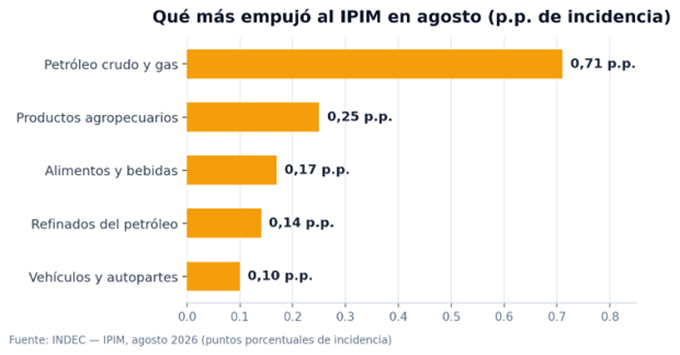
Graph: Authors' elaboration based on INDEC — IPIM data, August 2026. Incidence in percentage points.
📈 A series with ups and downs during 2026
The performance of the IPIM had strong ups and downs throughout the year. After a jump of 5.2% in April, the index began a sustained slowdown: 2.5% in May, 1.1% in June and 0.8% in July, the lowest record of the year and which the economic management had publicly highlighted as a sign of the success of the stabilization plan. August ended this downward streak and returned the indicator to an area above 2% per month, although still far from the peaks of April and May.
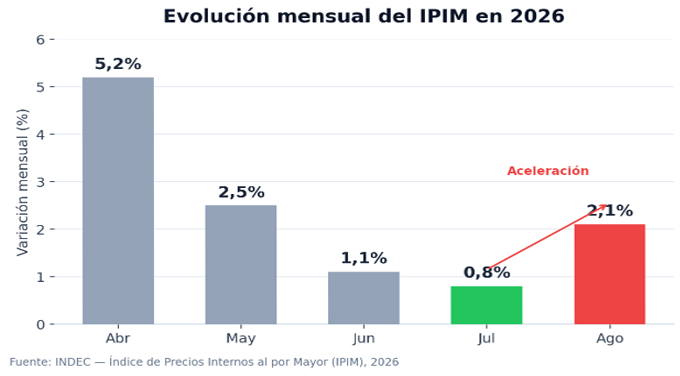
Graph: Authors' elaboration based on INDEC data — Monthly variation of the IPIM, April-August 2026.
🏛️ From official celebration to the blow of acceleration
The August data comes just weeks after national officials celebrated the slowdown in July as a confirmation of the economic course. The Minister of Economy, Luis Caputo, had maintained in different public appearances that inflation could pierce 1% per month during the second half of the year, and President Javier Milei himself repeatedly set the objective of bringing the index closer to values close to zero by August.
The August result contrasted with those expectations and revived criticism from the opposition, which had questioned the official reading of the slowdown in previous months as premature or partial. On his social networks, Caputo attributed the rise to the evolution of domestic and imported products, in a message that replicated, without delving into the root causes, the figure released by INDEC.
🗣️ An indicator that anticipates forward pressure
Economic analysts closely follow the IPIM because its behavior tends to anticipate subsequent movements in retail prices: when production and import costs rise, that pressure tends to be transferred – with lag – to the prices paid by the final consumer. For this reason, the acceleration in August generated caution among those who project retail inflation for the coming months, in particular due to the weight of energy and fuels within the cost structure.
INDEC's System of Wholesale Price Indexes also released two other complementary measurements: the Basic Domestic Wholesale Price Index (IPIB), which rose 2.3% (2.2% in domestic products and 3% in imports), and the Basic Producer Price Index (PPI), which advanced 2.3%, with a rise of 4.6% in primary products and 1.3% in manufactured goods and energy.
🔮 What to watch from here on out
The economic team itself had insisted that convergence to low-single-digit inflation, or even close to zero, would depend on maintaining control of monetary issuance and fiscal balance. The upturn in August does not modify that declared roadmap, but it does force the government to explain a figure that departs from the narrative of linear deceleration that it had installed in previous months, in a year also marked by the electoral agenda.
✅ Key points
✔ The IPIM rose 2.1% in August, 1.3 points more than in July (0.8%).
✔ The year-on-year increase was 29.8% and the accumulated increase in 2026 reached 19.1%.
✔ The IPIM was 0.4 points above the CPI for August (1.7%).
✔ Imported products (+2.9%) rose more than domestic products (+2.1%).
✔ "Crude oil and gas" was the item with the highest incidence, with 0.71 p.p.
✔ The data interrupted three consecutive months of slowdown in the index.
📚 Sources consulted
🔗 INDEC — Wholesale Price Index System (MPI), August 2026
🔗 INDEC — Official Statistics Portal
🔗 Infobae — Wholesale inflation accelerated to 2.1% in August
🔗 El Cronista — Against the retail industry: wholesale inflation accelerated to 2.1%
🔗 Río Negro — Wholesale inflation rebounded in August 2026
🖼️ Reference image — INDEC headquarters (external source, illustrative use)
Note on images: the two graphics included in this note are our own elaborations based on official INDEC data. For copyright reasons, photographs of third parties are not reproduced; it is suggested that the editorial staff incorporate a royalty-free cover image (own or Argentina.gob.ar image bank) before publication.
TECHNICAL SHEET FOR PUBLICATION
🔍 SEO and Publishing Checklist
Reference block for the web editing team, with metadata, keywords and recommended elements for positioning in search engines and networks.
|
Meta title (≤60 car.)
|
Wholesale inflation August 2026: up 2.1% and revives the political debate
|
|
Meta description (≤155 car.)
|
INDEC's IPIM accelerated to 2.1% in August, outperformed the CPI and cut three months of decline. Keys, charts and political reactions.
|
|
Suggested URL/slug
|
/economy/wholesale-inflation-August-2026-ipim-2-1-percent-
|
|
Keyword principal
|
Wholesale inflation August 2026
|
|
Keywords secundarias
|
IPIM INDEC, wholesale inflation Argentina, IPIM August 2.1%, wholesale inflation vs CPI, Caputo inflation August
|
|
Relevant entities (NLP/Semantic SEO)
|
INDEC, IPIM, IPC, Luis Caputo, Javier Milei, Central Bank, crude oil and gas
|
|
Search intent
|
Informative / news (long-tail, "data + month + year" format)
|
|
H1 suggested
|
Wholesale inflation jumped to 2.1% in August and reopens the political debate
|
|
Alt-text image 1
|
Bar graph showing the monthly evolution of the IPIM in Argentina, April to August 2026
|
|
Alt-text image 2
|
Graph of incidence by item in the IPIM of August 2026, according to INDEC
|
|
Structured Data (schema.org)
|
NewsArticle + FAQPage; incluir datePublished, dateModified, author, publisher.logo
|
|
Suggested internal linking
|
Previous notes on monthly CPI, evolution of the dollar and country risk, economic analysis column
|
|
External Linking (Authority)
|
Official report of INDEC (indec.gob.ar) as a primary source
|
|
Core Web Vitals / Technical
|
Compress images to WebP, lazy-load graphics, serve in AMP or light version for mobile
|
|
Featured snippet objetivo
|
Question: "How much did wholesale inflation go up in August 2026?" → Short answer of 40-50 words at the beginning
|
|
Copy for X / Twitter
|
📊 Wholesale inflation rose 2.1% in August and cut three months of decline. It was above the CPI. We tell you what explained 👇 it
|
|
Copy para LinkedIn
|
The IPIM accelerated in August and reopened the debate on the direction of prices in Argentina. An analysis of INDEC data and its implications.
|
|
Hashtags
|
#Inflación #Economía #INDEC #Argentina #IPIM
|
|
Estimated reading time
|
5 minutes (≈ 950 words, 200 ppm)
|
❓ Frequently asked questions (for FAQ schema and "people also ask")
Q: How much did wholesale inflation rise in August 2026? — A: INDEC's IPIM rose 2.1% compared to July.
Q: How was the year-on-year wholesale inflation? — A: It accumulated a 29.8% increase in the last twelve months.
Q: Did wholesale inflation exceed retail inflation? — A: Yes, it was 0.4 points above the CPI for August (1.7%).
Q: Which products increased the most? — A: Imports (+2.9%), above domestic products (+2.1%).
Q: Which item explained the increase the most? — A: "Crude oil and gas", with 0.71 percentage points of incidence.
Read more...
ECONOMY · WHOLESALE INFLATION
Wholesale inflation jumped to 2.1% in August and reopens the political debate after official celebrations for its slowdown
The IPIM measured by INDEC accelerated 1.3 percentage points compared to July, surpassed retail inflation and revived the discussion on the direction of prices, just a month after the Government celebrated the slowdown of the indicator.
|
📅 September 17, 2026
|
⏱️ Reading: 5 minutes
|
✍️ Economy Editorial Team
|
Wholesale prices accelerated again in August. According to INDEC, the Internal Wholesale Price Index (IPIM) rose 2.1% compared to July, when it had marked only 0.8%. The rebound, of 1.3 percentage points, placed the indicator above the retail CPI and returned to the center of the scene a discussion that the Government itself had taken for granted a month earlier.
📊 The data that set the agenda
The general level of the IPIM registered a monthly increase of 2.1% in August, with a year-on-year variation of 29.8% and a cumulative 19.1% in the first eight months of 2026. The result was 0.4 points above the Consumer Price Index of the same month, which was 1.7%, which anticipates a possible pressure on retail prices in the coming months, given that wholesale costs tend to be passed on to the shelves with a lag.
The rise was explained by an increase of 2.1% in products of national origin and 2.9% in imports, the latter driven by the behavior of the exchange rate and dollarized inputs. Within the index, primary products climbed 4.6%, while manufactured products and electricity advanced at a more moderate pace, of 1.3%.
⛽ The items that pushed the index the most
Among the divisions with the greatest positive impact was "Crude oil and gas", which contributed 0.71 percentage points to the general result. It was followed by "Agricultural products" (0.25 p.p.), "Food and beverages" (0.17 p.p.), "Refined petroleum products" (0.14 p.p.) and "Motor vehicles, bodies and spare parts" (0.10 p.p.).
Graph: Authors' elaboration based on INDEC — IPIM data, August 2026. Incidence in percentage points.
📈 A series with ups and downs during 2026
The performance of the IPIM had strong ups and downs throughout the year. After a jump of 5.2% in April, the index began a sustained slowdown: 2.5% in May, 1.1% in June and 0.8% in July, the lowest record of the year and which the economic management had publicly highlighted as a sign of the success of the stabilization plan. August ended this downward streak and returned the indicator to an area above 2% per month, although still far from the peaks of April and May.
Graph: Authors' elaboration based on INDEC data — Monthly variation of the IPIM, April-August 2026.
🏛️ From official celebration to the blow of acceleration
The August data comes just weeks after national officials celebrated the slowdown in July as a confirmation of the economic course. The Minister of Economy, Luis Caputo, had maintained in different public appearances that inflation could pierce 1% per month during the second half of the year, and President Javier Milei himself repeatedly set the objective of bringing the index closer to values close to zero by August.
The August result contrasted with those expectations and revived criticism from the opposition, which had questioned the official reading of the slowdown in previous months as premature or partial. On his social networks, Caputo attributed the rise to the evolution of domestic and imported products, in a message that replicated, without delving into the root causes, the figure released by INDEC.
🗣️ An indicator that anticipates forward pressure
Economic analysts closely follow the IPIM because its behavior tends to anticipate subsequent movements in retail prices: when production and import costs rise, that pressure tends to be transferred – with lag – to the prices paid by the final consumer. For this reason, the acceleration in August generated caution among those who project retail inflation for the coming months, in particular due to the weight of energy and fuels within the cost structure.
INDEC's System of Wholesale Price Indexes also released two other complementary measurements: the Basic Domestic Wholesale Price Index (IPIB), which rose 2.3% (2.2% in domestic products and 3% in imports), and the Basic Producer Price Index (PPI), which advanced 2.3%, with a rise of 4.6% in primary products and 1.3% in manufactured goods and energy.
🔮 What to watch from here on out
The economic team itself had insisted that convergence to low-single-digit inflation, or even close to zero, would depend on maintaining control of monetary issuance and fiscal balance. The upturn in August does not modify that declared roadmap, but it does force the government to explain a figure that departs from the narrative of linear deceleration that it had installed in previous months, in a year also marked by the electoral agenda.
✅ Key points
✔ The IPIM rose 2.1% in August, 1.3 points more than in July (0.8%).
✔ The year-on-year increase was 29.8% and the accumulated increase in 2026 reached 19.1%.
✔ The IPIM was 0.4 points above the CPI for August (1.7%).
✔ Imported products (+2.9%) rose more than domestic products (+2.1%).
✔ "Crude oil and gas" was the item with the highest incidence, with 0.71 p.p.
✔ The data interrupted three consecutive months of slowdown in the index.
📚 Sources consulted
🔗 INDEC — Wholesale Price Index System (MPI), August 2026
🔗 INDEC — Official Statistics Portal
🔗 Infobae — Wholesale inflation accelerated to 2.1% in August
🔗 El Cronista — Against the retail industry: wholesale inflation accelerated to 2.1%
🔗 Río Negro — Wholesale inflation rebounded in August 2026
🖼️ Reference image — INDEC headquarters (external source, illustrative use)
Note on images: the two graphics included in this note are our own elaborations based on official INDEC data. For copyright reasons, photographs of third parties are not reproduced; it is suggested that the editorial staff incorporate a royalty-free cover image (own or Argentina.gob.ar image bank) before publication.
TECHNICAL SHEET FOR PUBLICATION
🔍 SEO and Publishing Checklist
Reference block for the web editing team, with metadata, keywords and recommended elements for positioning in search engines and networks.
|
Meta title (≤60 car.)
|
Wholesale inflation August 2026: up 2.1% and revives the political debate
|
|
Meta description (≤155 car.)
|
INDEC's IPIM accelerated to 2.1% in August, outperformed the CPI and cut three months of decline. Keys, charts and political reactions.
|
|
Suggested URL/slug
|
/economy/wholesale-inflation-August-2026-ipim-2-1-percent-
|
|
Keyword principal
|
Wholesale inflation August 2026
|
|
Keywords secundarias
|
IPIM INDEC, wholesale inflation Argentina, IPIM August 2.1%, wholesale inflation vs CPI, Caputo inflation August
|
|
Relevant entities (NLP/Semantic SEO)
|
INDEC, IPIM, IPC, Luis Caputo, Javier Milei, Central Bank, crude oil and gas
|
|
Search intent
|
Informative / news (long-tail, "data + month + year" format)
|
|
H1 suggested
|
Wholesale inflation jumped to 2.1% in August and reopens the political debate
|
|
Alt-text image 1
|
Bar graph showing the monthly evolution of the IPIM in Argentina, April to August 2026
|
|
Alt-text image 2
|
Graph of incidence by item in the IPIM of August 2026, according to INDEC
|
|
Structured Data (schema.org)
|
NewsArticle + FAQPage; incluir datePublished, dateModified, author, publisher.logo
|
|
Suggested internal linking
|
Previous notes on monthly CPI, evolution of the dollar and country risk, economic analysis column
|
|
External Linking (Authority)
|
Official report of INDEC (indec.gob.ar) as a primary source
|
|
Core Web Vitals / Technical
|
Compress images to WebP, lazy-load graphics, serve in AMP or light version for mobile
|
|
Featured snippet objetivo
|
Question: "How much did wholesale inflation go up in August 2026?" → Short answer of 40-50 words at the beginning
|
|
Copy for X / Twitter
|
📊 Wholesale inflation rose 2.1% in August and cut three months of decline. It was above the CPI. We tell you what explained 👇 it
|
|
Copy para LinkedIn
|
The IPIM accelerated in August and reopened the debate on the direction of prices in Argentina. An analysis of INDEC data and its implications.
|
|
Hashtags
|
#Inflación #Economía #INDEC #Argentina #IPIM
|
|
Estimated reading time
|
5 minutes (≈ 950 words, 200 ppm)
|
❓ Frequently asked questions (for FAQ schema and "people also ask")
Q: How much did wholesale inflation rise in August 2026? — A: INDEC's IPIM rose 2.1% compared to July.
Q: How was the year-on-year wholesale inflation? — A: It accumulated a 29.8% increase in the last twelve months.
Q: Did wholesale inflation exceed retail inflation? — A: Yes, it was 0.4 points above the CPI for August (1.7%).
Q: Which products increased the most? — A: Imports (+2.9%), above domestic products (+2.1%).
Q: Which item explained the increase the most? — A: "Crude oil and gas", with 0.71 percentage points of incidence.
Close