ECONOMY · INDEC · ARGENTINA
🚨 Poverty in Argentina climbed to 32.3% in the first half of the year and already affects 15.5 million people
INDEC reported a jump of 4.1 percentage points compared to the second half of 2025 and broke three consecutive periods of decline. Indigence also rose, to 7.5%. The mismatch between income and the cost of the baskets explains the deterioration.
🗓️ Updated: September 25, 2026 ⏱️ Reading Time: 5 minutes 📍 Buenos Aires, Argentina
Poverty rose again in Argentina. According to the report released Thursday by the National Institute of Statistics and Census (INDEC), the indicator reached 32.3% of the population during the first half of 2026, that is, 4.1 percentage points more than in the second half of 2025, when it had marked 28.2%. When projecting the data of the 31 urban agglomerations surveyed to the country as a whole, the figure is equivalent to about 15.5 million people below the poverty line. Indigence, meanwhile, climbed to 7.5%, some 3.6 million Argentines who are unable to cover even the basic food basket.
The figure marks a break: it is the first increase after three consecutive semesters of decline. In terms of households, poverty affected 24.4% and indigence, 5.6%. Compared to the first half of 2025 – when the index had been 31.6% – the current level is also higher.
📈 A BREAK IN THE TREND
The trajectory of the last two years had been downward: poverty went from 52.9% in the first half of 2024 to 38.9% by the end of that year, and continued to fall to 31.6% and 28.2% in the two semesters of 2025. The jump to 32.3% in the first six months of 2026 interrupts this dynamic and returns the indicator to values similar to those of the beginning of 2025.
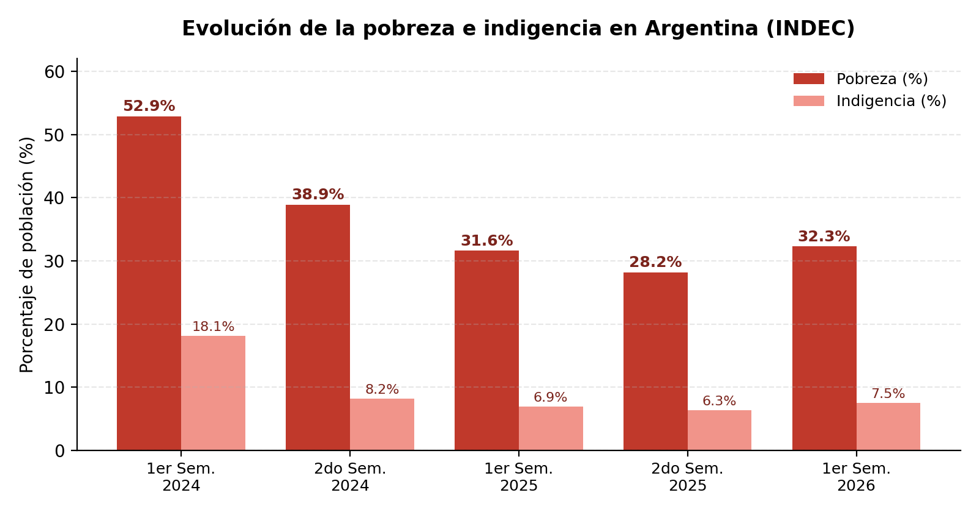
Graph: Authors' elaboration based on INDEC data
👶 CHILDREN, THE HARDEST HIT SECTOR
The deterioration had a particularly strong impact on the youngest. According to the statistical agency's age breakdown, child poverty went from 41.3% at the end of 2025 to 44.5% in the current measurement, well above the general average. The gap between generations once again puts the spotlight on a structural phenomenon in Argentina: children systematically concentrate the highest levels of poverty in the country.
🗺️ AN UNEVEN MAP: POVERTY BY REGION
The regional differences are marked. The Northeast (NEA) led the ranking with an incidence of 41.5%, followed by Cuyo with 36.7%. In Greater Buenos Aires, poverty reached 32.1%, although with a very wide gap internally: 13.9% in the City of Buenos Aires compared to 36.9% in the suburban districts. Further behind were the Northwest (31.5%), the Pampas region (30.3%) and, with the best record in the country, Patagonia (28.4%). Indigence was also higher in the NEA (10.5%) and in the GBA (8.4%).
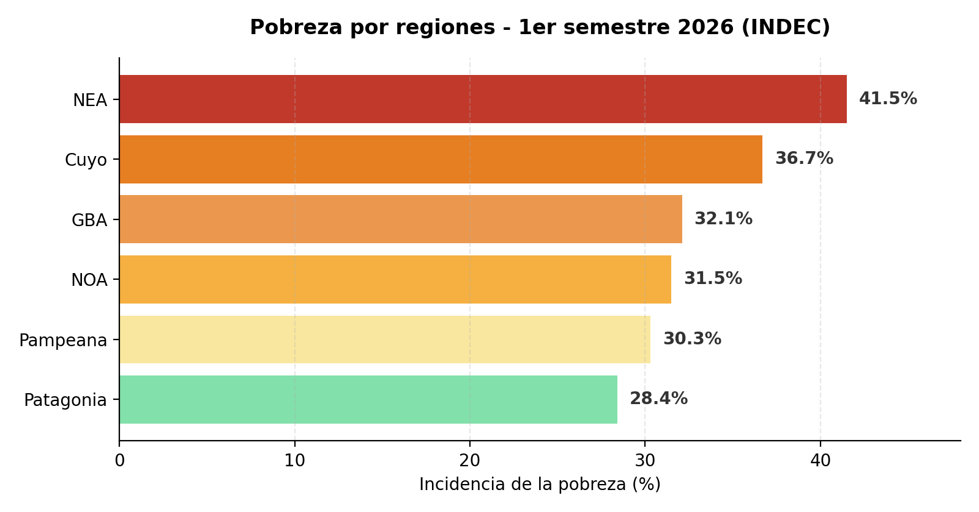
Graph: Authors' elaboration based on INDEC data
💸 INCOME THAT DOES NOT COVER THE BASKET
INDEC itself explained the deterioration based on the mismatch between household income and the cost of the reference baskets. During the first half of the year, the average family per capita income rose 11.5%, well below the 21.4% increase in the Basic Food Basket (CBA, which measures indigence) and the 19.6% increase in the Total Basic Basket (CBT, which measures poverty). This difference is also reflected in the so-called poverty gap – the distance between the income of poor households and the amount needed to overcome it – which in the first half of the year stood at 35.9%.
▪ Family per capita income: +11.5%
▪ Basic Food Basket (indigence): +21.4%
▪ Total Basic Basket (poverty): +19.6%
▪ Poverty gap: 35.9%
🏛️ THE GOVERNMENT'S READING
The economic team relativized the specific data and emphasized the longer-term comparison. The Minister of Economy, Luis Caputo, remarked through his social networks that, despite the rise compared to the previous semester, both poverty and indigence show a pronounced drop compared to the first half of 2024, when the indicators had reached 52.9% and 18.1% respectively. In the ruling party, they maintain that the rebound in the semester responds to specific factors and they hope that the trend will be reversed again in the next reports.
🔎 WHAT TO WATCH FROM HERE ON OUT
The new data reopens the debate on the social impact of the economic program and on the sustainability of the recovery of income in the face of the cost of living. Some social programs — such as Progresar, Acompañamiento Social and Volver al Trabajo — lost coverage in the period analyzed, a factor that economists and social organizations point to as part of the explanation. The next measurement, corresponding to the second half of 2026, will be key to confirming whether the jump was temporary or the beginning of a new trend.
🧩 SEO FILE OF THE NOTE
|
SEO Title
|
Poverty in Argentina 2026: rose to 32.3% and affects 15.5 million
|
|
Meta Description
|
INDEC confirmed that poverty reached 32.3% in the first half of 2026, with 15.5 million people affected. Figures, causes and map by region.
|
|
Suggested URL/Slug
|
/economy/poverty-argentina-32-3-first-semester-2026
|
|
Focus keywords
|
poverty Argentina 2026, INDEC poverty, indigence Argentina, child poverty, total basic basket
|
|
Secondary keywords
|
poverty first semester 2026, poverty by region Argentina, Luis Caputo poverty, EPH INDEC
|
|
H1 Label
|
Poverty in Argentina climbed to 32.3% and affects 15.5 million people
|
|
Alt text images
|
Graph evolution poverty and indigence Argentina INDEC 2024-2026 · Graph poverty by region Argentina 2026
|
|
Suggested structured data
|
schema.org/NewsArticle with datePublished, dateModified, author (Organization), and speakable for voice assistants
|
|
Internal Linking
|
Link with previous INDEC notes, basic basket and labor market to reinforce topical authority
|
🔗 Clarín — https://www.clarin.com/
🔗 TN — All News — https://tn.com.ar/
🔗 Infobae — Coverage of the INDEC report — https://www.infobae.com/economia/2026/09/24/la-pobreza-subio-al-323-en-el-primer-semestre-de-ano-y-afecto-a-155-millones-de-personas/
🔗 La Nación — Official data from INDEC — https://www.lanacion.com.ar/economia/la-pobreza-crecio-a-323-en-el-primer-semestre-segun-el-indec-nid24092026/
🔗 Chain 3 — Report Detail — https://www.cadena3.com/noticia/sociedad/pobreza-en-argentina-subio-al-323-y-ya-alcanza-a-mas-de-15-millones-de-personas_597478
Note prepared with official data from INDEC (Permanent Household Survey). The graphs are prepared by the authors.
Read more...
ECONOMY · INDEC · ARGENTINA
🚨 Poverty in Argentina climbed to 32.3% in the first half of the year and already affects 15.5 million people
INDEC reported a jump of 4.1 percentage points compared to the second half of 2025 and broke three consecutive periods of decline. Indigence also rose, to 7.5%. The mismatch between income and the cost of the baskets explains the deterioration.
🗓️ Updated: September 25, 2026 ⏱️ Reading Time: 5 minutes 📍 Buenos Aires, Argentina
Poverty rose again in Argentina. According to the report released Thursday by the National Institute of Statistics and Census (INDEC), the indicator reached 32.3% of the population during the first half of 2026, that is, 4.1 percentage points more than in the second half of 2025, when it had marked 28.2%. When projecting the data of the 31 urban agglomerations surveyed to the country as a whole, the figure is equivalent to about 15.5 million people below the poverty line. Indigence, meanwhile, climbed to 7.5%, some 3.6 million Argentines who are unable to cover even the basic food basket.
The figure marks a break: it is the first increase after three consecutive semesters of decline. In terms of households, poverty affected 24.4% and indigence, 5.6%. Compared to the first half of 2025 – when the index had been 31.6% – the current level is also higher.
📈 A BREAK IN THE TREND
The trajectory of the last two years had been downward: poverty went from 52.9% in the first half of 2024 to 38.9% by the end of that year, and continued to fall to 31.6% and 28.2% in the two semesters of 2025. The jump to 32.3% in the first six months of 2026 interrupts this dynamic and returns the indicator to values similar to those of the beginning of 2025.
Graph: Authors' elaboration based on INDEC data
👶 CHILDREN, THE HARDEST HIT SECTOR
The deterioration had a particularly strong impact on the youngest. According to the statistical agency's age breakdown, child poverty went from 41.3% at the end of 2025 to 44.5% in the current measurement, well above the general average. The gap between generations once again puts the spotlight on a structural phenomenon in Argentina: children systematically concentrate the highest levels of poverty in the country.
🗺️ AN UNEVEN MAP: POVERTY BY REGION
The regional differences are marked. The Northeast (NEA) led the ranking with an incidence of 41.5%, followed by Cuyo with 36.7%. In Greater Buenos Aires, poverty reached 32.1%, although with a very wide gap internally: 13.9% in the City of Buenos Aires compared to 36.9% in the suburban districts. Further behind were the Northwest (31.5%), the Pampas region (30.3%) and, with the best record in the country, Patagonia (28.4%). Indigence was also higher in the NEA (10.5%) and in the GBA (8.4%).
Graph: Authors' elaboration based on INDEC data
💸 INCOME THAT DOES NOT COVER THE BASKET
INDEC itself explained the deterioration based on the mismatch between household income and the cost of the reference baskets. During the first half of the year, the average family per capita income rose 11.5%, well below the 21.4% increase in the Basic Food Basket (CBA, which measures indigence) and the 19.6% increase in the Total Basic Basket (CBT, which measures poverty). This difference is also reflected in the so-called poverty gap – the distance between the income of poor households and the amount needed to overcome it – which in the first half of the year stood at 35.9%.
▪ Family per capita income: +11.5%
▪ Basic Food Basket (indigence): +21.4%
▪ Total Basic Basket (poverty): +19.6%
▪ Poverty gap: 35.9%
🏛️ THE GOVERNMENT'S READING
The economic team relativized the specific data and emphasized the longer-term comparison. The Minister of Economy, Luis Caputo, remarked through his social networks that, despite the rise compared to the previous semester, both poverty and indigence show a pronounced drop compared to the first half of 2024, when the indicators had reached 52.9% and 18.1% respectively. In the ruling party, they maintain that the rebound in the semester responds to specific factors and they hope that the trend will be reversed again in the next reports.
🔎 WHAT TO WATCH FROM HERE ON OUT
The new data reopens the debate on the social impact of the economic program and on the sustainability of the recovery of income in the face of the cost of living. Some social programs — such as Progresar, Acompañamiento Social and Volver al Trabajo — lost coverage in the period analyzed, a factor that economists and social organizations point to as part of the explanation. The next measurement, corresponding to the second half of 2026, will be key to confirming whether the jump was temporary or the beginning of a new trend.
🧩 SEO FILE OF THE NOTE
|
SEO Title
|
Poverty in Argentina 2026: rose to 32.3% and affects 15.5 million
|
|
Meta Description
|
INDEC confirmed that poverty reached 32.3% in the first half of 2026, with 15.5 million people affected. Figures, causes and map by region.
|
|
Suggested URL/Slug
|
/economy/poverty-argentina-32-3-first-semester-2026
|
|
Focus keywords
|
poverty Argentina 2026, INDEC poverty, indigence Argentina, child poverty, total basic basket
|
|
Secondary keywords
|
poverty first semester 2026, poverty by region Argentina, Luis Caputo poverty, EPH INDEC
|
|
H1 Label
|
Poverty in Argentina climbed to 32.3% and affects 15.5 million people
|
|
Alt text images
|
Graph evolution poverty and indigence Argentina INDEC 2024-2026 · Graph poverty by region Argentina 2026
|
|
Suggested structured data
|
schema.org/NewsArticle with datePublished, dateModified, author (Organization), and speakable for voice assistants
|
|
Internal Linking
|
Link with previous INDEC notes, basic basket and labor market to reinforce topical authority
|
🔗 Clarín — https://www.clarin.com/
🔗 TN — All News — https://tn.com.ar/
🔗 Infobae — Coverage of the INDEC report — https://www.infobae.com/economia/2026/09/24/la-pobreza-subio-al-323-en-el-primer-semestre-de-ano-y-afecto-a-155-millones-de-personas/
🔗 La Nación — Official data from INDEC — https://www.lanacion.com.ar/economia/la-pobreza-crecio-a-323-en-el-primer-semestre-segun-el-indec-nid24092026/
🔗 Chain 3 — Report Detail — https://www.cadena3.com/noticia/sociedad/pobreza-en-argentina-subio-al-323-y-ya-alcanza-a-mas-de-15-millones-de-personas_597478
Note prepared with official data from INDEC (Permanent Household Survey). The graphs are prepared by the authors.
Close








 🚨 Poverty in Argentina climbed to 32.3%
- 25/09/2026 » 08:56 by cronywell
🚨 Poverty in Argentina climbed to 32.3%
- 25/09/2026 » 08:56 by cronywell