










Blog - Politics
 How does the state control itself? - by
How does the state control itself?
Institutions, Comparative Evidence, and the False Dilemma Between Left and Right
The State does not control itself as if it were a single subject, but through a system of institutions that limit and control each other. This principle, typical of the constitutional and democratic rule of law, is based on the idea that all power requires limits to avoid its concentration and arbitrary exercise.
The division of powers, oversight bodies, judicial independence, accountability, transparency and citizen control are mechanisms designed to ensure that the exercise of power remains subject to the Constitution and the law. Its purpose is not to hinder the action of the State, but to preserve the public interest, protect the rights of individuals and prevent corruption.
From a philosophical and republican perspective, corruption does not depend exclusively on the size of the State, but on the quality of its institutions and the effectiveness of its control mechanisms. A small state can be as corrupt as a large one if it lacks transparency, institutional independence and effective sanctions. Similarly, a state with broad functions can manage public resources with integrity when there are strong controls and a true culture of public accountability.
Therefore, the solution to corruption is not simply to shrink or enlarge the State, but to strengthen institutions, guarantee the independence of control bodies, promote transparency and ensure that all exercise of power is subject to limits, supervision and accountability. In a republic, the problem is not how much power the state has, but how controlled, responsible and transparent its exercise is.
Comparative evidence: institutions, corruption and well-being
These statements cease to be a philosophical intuition when they are contrasted with data. The Corruption Perceptions Index (CPI) published annually by Transparency International measures, on a scale of 0 to 100, how experts and businessmen perceive the level of corruption in the public sector in 182 countries. The 2025 edition shows a global average of just 42 points, the lowest in more than a decade, with 122 out of 182 countries below 50 points.
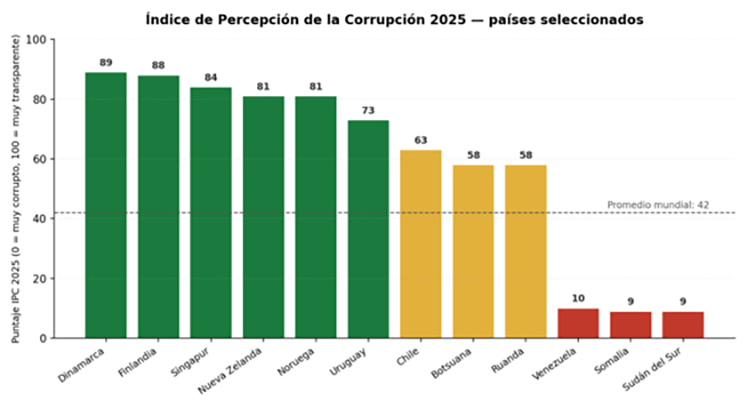
Figure 1. Score of the 2025 Corruption Perceptions Index in selected countries. Source: Authors' elaboration with data from Transparency International, CPI 2025.
The graph above does not order countries by ideology or by the size of their state, but by the quality of their control institutions. Denmark, Finland, Singapore, New Zealand, and Norway—with very different state and economic traditions—share something more relevant than their political orientation: independent judiciaries, a free press, a professionalized civil service, and effective accountability mechanisms.
Why this matters for the well-being of the population
Institutional quality is not an abstract discussion: it has measurable effects on people's daily lives. Economic research on the CPI has found an association between higher index scores and higher long-term economic growth, with estimates placing the effect at around an additional 1.7 percentage points of GDP growth for each point of improvement in the index, in addition to a greater attraction of foreign investment.
Transparency International also documents links between corruption and very specific areas of well-being: countries with lower levels of corruption generally show better access to and affordability of justice for their citizens; there is a relationship between health service coverage – as measured by the World Health Organization's Universal Health Coverage Index – and levels of corruption; and more than ninety percent of journalists killed in recent years for covering corruption cases died in countries with CPI scores below 50.
These data allow us to trace the causal mechanism that underlies the first section of this document: when judicial controls, a free press and accountability are lacking, the resources allocated to hospitals, schools, infrastructure and social protection are diverted or mismanaged, and it is the people with lower incomes who pay the highest cost, because corruption works as a regressive tax that falls more heavily on poor households.
Specific cases in the world
The following table summarizes examples from different regions and models of state. The objective is not to present a ranking of "good" or "bad" countries, but to show that the variable that explains the result is not the size of the State or its ideological orientation, but the strength of its control mechanisms.
|
Country |
State model |
CPI 2025 |
Key institutional factor |
|
Denmark |
Broad welfare state |
89 |
Professional civil service, free press, budget transparency |
|
Singapore |
Reduced state, highly regulatory |
84 |
Independent judiciary, severe and consistent sanctions against corruption |
|
New Zealand |
Mid-sized status |
81 |
Transparent political financing, low concentration of power |
|
Estonia |
Digitized Administration |
76 |
E-government that reduces discretionary contact between officials and citizens |
|
Uruguay |
Social State, Latin America |
73 |
Stable democratic alternation, high social mobility and judicial independence |
|
Botswana |
African state, natural resources |
58 |
Transparent management of diamond income and parliamentary control |
|
Rwanda |
State in post-conflict reconstruction |
58 |
Administrative reform and low formal tolerance for minor corruption |
|
Venezuela |
State with captured institutions |
10 |
Collapse of judicial independence and public oversight |
|
Somalia / South Sudan |
Fragile or conflict-ridden state |
9 |
Absence of control institutions and the rule of law |
Table 1. Comparative cases of institutional control and perception of corruption. Source: Authors' elaboration with data from Transparency International, CPI 2025.
The case of Botswana is particularly illustrative: it is one of the few diamond-rich countries that avoided the so-called "curse of natural resources" thanks to the fact that, since its independence, it subjected mining income to parliamentary controls and public audits, in contrast to Venezuela, where the capture of control institutions coincided with economic and social collapse despite having the largest oil reserves in the world. Rwanda, for its part, built a public administration with a low formal tolerance for minor corruption after a devastating conflict, which allowed it to achieve levels of control comparable to those of much richer countries.
At the other extreme, Somalia and South Sudan show what happens when there are practically no institutions of control: there is no state to supervise itself because the basic functions of justice, security and public administration have collapsed, with severe humanitarian consequences.
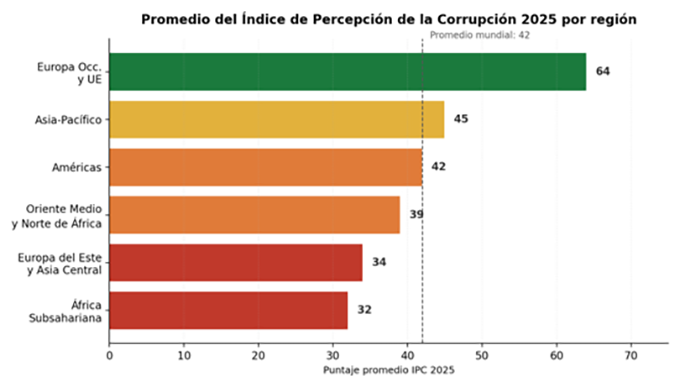
Figure 2. Regional average of the Corruption Perceptions Index 2025. Source: Authors' elaboration with data from Transparency International, CPI 2025.
The regional average confirms the pattern: no region in the world is exempt from the problem—even Western Europe, the highest-scoring region, has been declining faster than any other in the past decade—but the differences between regions mostly reflect differences in the strength of their control institutions, not a single economic model.
Beyond the false dilemma between left and right
One of the biggest obstacles to discussing anti-corruption policies effectively is the trap of reducing the debate to whether the state should be bigger or smaller, more left-wing or more right-wing. The comparative data show that such discussion, while legitimate for other purposes, does not predict the level of corruption in a country.
● Denmark and Finland have large welfare states, with high tax burdens and strong public intervention, and are among the least corrupt countries in the world.
● Singapore and New Zealand combine comparatively smaller or more market-oriented states with similarly high levels of transparency.
● Uruguay, with a consolidated social state, leads the Latin American region in controlling corruption, while countries with states of similar size in the same region occupy much lower positions.
● Venezuela shows that a State with enormous resources and broad powers can collapse in terms of integrity when judicial independence and oversight disappear.
What distinguishes the best-evaluated countries is not their place on the left-right spectrum, but a common set of institutional conditions: independence of the judiciary, freedom of the press, protection of civic space for social organizations and journalists, transparent political financing, and public procurement systems open to scrutiny. In fact, Transparency International warns that, in recent decades, the restriction of civic space – that is, limitations on the press, non-governmental organizations and social protest, promoted indistinctly by governments of different political persuasions – systematically coincides with falls in corruption control scores.
Discussing public policies under the slogan of "more State" or "less State" diverts attention from the real problem and makes it easier for actors of any political orientation to evade accountability. The relevant question for policy-making is not how much state is needed, but what controls, what institutional independence, and what transparency accompany public decisions, no matter who governs.
Conclusion
The state controls itself through a network of mutually limiting institutions, and international evidence confirms that the quality of these institutions—not their size or political color—determines whether power is exercised in the public interest or diverted to private gain. Strengthening judicial independence, transparency, freedom of the press and citizen control is not an ideological preference: it is the condition common to all countries, large or small, left or right, that manage to translate the power of the State into effective well-being for their population.
Sources: Transparency International, Corruption Perceptions Index 2025 (published on 10 February 2026); World Health Organization, Universal Health Services Coverage Index; Committee to Protect Journalists (CPJ).
Nobody gave a comment yet.
Be the first to do so!