







News of Friends -
Portal regional del sudeste de Córdoba: noticias, clima, recetas, fotos, foros y recursos exclusivos de Bell Ville y alrededores. ¡Sumate a MiDire!
🏛️ POLITICS · 🎓 EDUCATION · ⚖️ JUSTICE
University financing: the Government will appeal the daily fine of $100,000 for failing to comply with the precautionary measure
The Casa Rosada confirmed that it will appeal the sanction ordered by federal judge Martín Cormick against the Chief of Staff. He questioned the magistrate, while the CIN celebrated the measure and the universities return to the streets today.
✍️ Newsroom · 📅 Thursday, October 15, 2026 · ⏱️ Reading time: 6 min
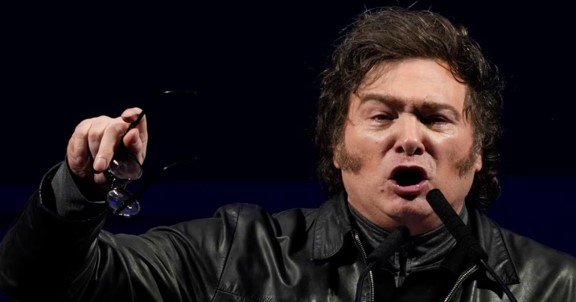
🖼️ Cover image of the original coverage. Credit: Diario Huarpe
The national government confirmed on Wednesday, October 14, that it will appeal the daily fine of $100,000 imposed by the Justice for not complying with the precautionary measure linked to the University Financing Law. The sanction, ordered by Federal Judge Martín Cormick, falls on the head of the Chief of Cabinet – according to different media reports, Diego Santilli – and opens a new instance in a conflict that is settled both in the courts and in the streets.
📌 IN 30 SECONDS
💸 The fine: $100,000 for each day of non-compliance, addressed to the head of the Chief of Staff.
⚖️ The reason: Judge Cormick considered the non-compliance with a firm precautionary measure on salaries and scholarships (Articles 5 and 6 of Law 27,795) verified.
🏛️ The official reaction: the government will appeal and questioned the magistrate; sources from Casa Rosada linked him to La Cámpora.
🎓 The universities: the CIN valued the sanction as a precedent and demands that the law be complied with.
🚶 Today: fifth Federal University March throughout the country.
🧭 In this article
• ⚖️ The judge's decision: $100,000 per day
• 🏛️ The Government's response: appeal and criticism of the magistrate
• 🎓 The view of universities
• 📜 What does Law 27,795 establish and why is it in dispute?
• 🗓️ Timeline of the conflict
• 🚶 Federal March and Measures of Force
• ❓ Frequently Asked Questions
• 🔮 What can happen now
⚖️ The judge's decision: $100,000 per day
In his resolution, Cormick – head of the Federal Administrative Court No. 11 – understood that there is a "verified non-compliance" with the precautionary measure and resolved to make effective the warning he had ordered on September 30, 2026. Consequently, he applied daily astreintes to the official of the Chief of the Cabinet of Ministers.
The astreintes are injunction economic sanctions: they do not seek to compensate, but to pressure the obligor to comply with what a judge ordered. The magistrate stated that the precautionary measure "continues to be active, firm and mandatory" and warned that the amount and the officials reached could be modified if the non-compliance persists.
The measure orders the recomposition and updating of the salaries of teaching and non-teaching staff of public universities and to guarantee the funds allocated to student scholarships. The case is processed under file 39.475/2025 and was promoted by the National Interuniversity Council (CIN) and other parties against the National State.
🏛️ The Government's response: appeal and criticism of the magistrate
The Executive announced that it will appeal the decision with the aim of annulling the sanction. As reported, its proposal maintains that there was no deliberate omission; in addition, the Government has maintained for weeks that, with the increases applied, it is advancing in compliance with the precautionary measure.
Along with the appeal, the Casa Rosada harshly questioned the judge. Official sources affirmed that he is a magistrate who repeatedly rules against the management of Javier Milei, who "has a past and friends in La Cámpora" and recalled that he had tried to declare the anti-picketing protocol null and void. They also described him as former head of the General Inspectorate of Justice and former general syndic of PAMI during the administration of Luana Volnovich.
Important: these are statements by government spokesmen. In the coverage consulted, no evidence was disseminated to support them or a response from the magistrate.
🎓 The view of universities
The president of the CIN, Franco Bartolacci, welcomed the resolution. He explained that the body had notified the judge of the expiration of the deadline without complying with the precautionary measure and that, therefore, it had requested the application of fines. For the leader, the relevant thing is not only that a daily sanction be set, but that specific responsibilities be established.
Bartolacci warned that the conflict is not yet resolved because the judicial process continues, but described the decision as "a very important step that we value." For the CIN, the fine ratifies that the law is not being complied with.
📜 What does Law 27,795 establish and why is it in dispute?
The Law on the Financing of University Education and Recomposition of Teacher Salary was approved by Congress in 2025 and ratified by both chambers after President Milei's veto. The Executive enacted it through decree 759/2025, but conditioned its application on Congress determining the sources of financing and incorporating the items into the budget.
The judicial discussion focuses on articles 5 and 6: the first contemplates the salary update of teachers and non-teachers (with the recomposition period ranging from December 2023 to September 2025) and the second, the recomposition of student scholarship programs. The Government argues that applying it without first defining its financing would affect the fiscal balance; the Justice dismissed this proposal in the previous instances.
🗓️ Timeline of the conflict
• December 2025: Cormick issues the injunction at the request of the CIN and the universities.
• March 2026: The Federal Administrative Court confirms the precautionary measure and rejects the official appeal.
• June 25, 2026: The Supreme Court rejects the Executive's extraordinary appeal for not being directed against a final judgment; the precautionary measure remains final.
• September 22: The judge orders the State to comply within five days, under threat of applying astreintes.
• End of September: the Government appeals the summons; on September 30 the warning is ordered.
• October 14: The fine of $100,000 per day becomes effective and the Government confirms that it will appeal.
• October 15: Fifth Federal University March.
🚶 Federal March and Measures of Force
The news coincides with the fifth Federal University March, called for this Thursday, October 15. The executive committee of the CIN met in the Cabildo of Buenos Aires to demand compliance with the law and call for mobilization, with replicas in different cities of the country, such as Santa Fe and Posadas.
At the union level, the University Trade Union Front denounced that, in the face of a salary demand of 31.2%, the Government proposed a 3% increase, and carried out a strike in unity throughout the system. In Rosario, the Coad union decided to stop on the 15th and will take to Conadu the motion for a strike for an indefinite period of time.
❓ Frequently Asked Questions
How much is the fine and how long does it run?
It is $100,000 for each day of non-compliance. The judge warned that the amount and the officials reached could be modified if the delay continues.
Who must pay it?
The sanction is aimed at the official of the Chief of the Cabinet of Ministers, a position that, according to the media consulted, is occupied by Diego Santilli.
Why is the Government appealing?
He seeks to annul the astreintes. He maintains that there was no deliberate omission and that he advances in compliance with the increases applied, and questions the impartiality of the judge.
What exactly does the precautionary measure require?
Recompose and update the salaries of university teachers and non-professors and guarantee funds for student scholarships (Articles 5 and 6 of Law 27,795).
Does the appeal stop the fine?
The notes consulted do not specify whether the appeal suspends the sanction. That will depend on what the judge himself or the Court of Appeals resolves.
🔮 What can happen now
• The conflict will continue in the judicial sphere with the processing of the appeal announced by the Executive; no deadlines for its resolution were reported.
• If the non-compliance persists, the judge could adjust the amount of the astreintes or increase the number of officials reached.
• Meanwhile, the universities maintain the demand for the updating of funds and salaries, with marches and industrial action underway.
🔗 Sources consulted
1. LV12 — University financing: the Government will appeal the fine imposed by the Justice
2. Diario Huarpe — The Government will appeal the fine for failing to comply with the University Financing Law
3. The Intransigent — The Government of Javier Milei seeks to get rid of the fine
4. Examedia — The government will appeal the university ruling and took aim at the judge
5. Examedia — The government was fined $100,000 per day and will appeal
6. Enterate Noticias — Criticism from Casa Rosada and Grounds for the Appeal
7. Diario Pampero — The Government will appeal the fine for university funds
8. Facundo Quiroga — The Government Rejected the Ruling and Prepares an Appeal
9. Profile — Judge Cormick indicts the government over college funding law
10. NQN News — The Government appealed the summons of the Justice
11. NQN News — The Justice ratified that the Government must apply the law
12. Tiempo Argentino — We strike because we can't stand any more silence or provocations
13. Misiones Online — Call for a new Federal University March
⚖️ Supreme Court reinstates the law that limits the sale of land to foreigners
The Court suspended the decree that eliminated restrictions and referred a precautionary measure to the Federal Court of Bariloche
Reading Time: 5 minutes
📌 SEO SUMMARY: The Supreme Court of Justice of the Nation provisionally suspended the effects of article 154 of DNU 70/2023 and reinstated the limits on the purchase of rural land by foreigners while the Federal Court of Bariloche analyzes the merits of the claim.
📰 Development of the news
The Supreme Court of Justice of the Nation issued an interim precautionary measure that puts back into force the restrictions provided for by Law 26,737 on the acquisition of rural land by foreign citizens and companies. The decision provisionally suspends the effects of Article 154 of DNU 70/2023, promoted by the national government, which had repealed that regulation.
The ruling was signed by Horacio Rosatti, Ricardo Lorenzetti and co-judges Diego Barroetaveña and Juan Ignacio Pérez Curci. Carlos Rosenkrantz voted in partial dissent. The resolution does not settle the discussion on the constitutionality of the decree, but seeks to preserve effective judicial protection until pending issues are resolved.
The case was promoted by the environmental association Árbol de Pie, native communities and the leader of Río Negro Magdalena Odarda. The plaintiffs maintain that the repeal of the Land Law could affect collective and territorial environmental rights.
As an immediate consequence, the limits established by the legislation are once again applied, including the cap on foreign participation on rural land and restrictions on sensitive areas from the environmental, water and border point of view.
The Court returned the file to the Federal Court of Bariloche, which must determine the legitimacy of the plaintiffs and analyze the precautionary measure requested. Until then, the restrictions will remain in force provisionally.
📊 Keys to the ruling
Temporarily reinstates the Rural Land Law.
It suspends the effects of article 154 of DNU 70/2023.
The decision is precautionary and not final.
The file returns to the Federal Court of Bariloche.
Restrictions on the purchase of land by foreigners remain in place while the process continues.
🖼️ Suggested image
🗞️ POLITICS · 💼 TRADE UNIONS · 📈 ECONOMY · 🇦🇷 ARGENTINA
The CGT marches for the national industry and increases tension in Congress over the Land Law and DNU 70
The labor federation has been concentrating since 3 p.m. on Diagonal Sur and Perú towards the former Ministry of Industry, with no general strike in sight. At the same time, the ruling party and the opposition are measuring forces in the Chamber of Deputies ahead of the special session on October 15.
✍️ By Redacción Política | 📍 Buenos Aires | 📅 Thursday, October 8, 2026
⏱️ Reading time: 10 min | 📝 1,895 words | 🔄 Note in development
|
⚡ IN BRIEF • 🚶 The march: the CGT concentrates from 3 p.m. on Diagonal Sur and Peru and advances towards the former Ministry of Industry, today the Ministry of Industry. • 🛑 No strike for now: the union postpones the general strike and maintains a staggered plan of action initiated in July. • 🏭 The hard fact: according to the UIA, industrial activity fell 5.7% year-on-year in August. • ⚖️ The trigger: the Court's ruling of September 29 reactivated the repeal of the Land Law provided for by DNU 70/2023. • 🏛️ Congress: the opposition called a special session on October 15; the ruling party seeks to deactivate it and proposes to hold a session on the 21st. |
|
🖼️ IMAGE 1 · Cover · Federal march and mobilizations in October Alt text (alt): Column of protesters marching in downtown Buenos Aires with Argentine flags and banners 🔗 Absolute link: Open original image (infobae.com) Credit: Infobae (file photo of the Federal University March) |

BUENOS AIRES.— The General Confederation of Labor (CGT) returned to the streets on Thursday, October 8, with a mobilization through downtown Buenos Aires, in rejection of the economic course of the Government of Javier Milei and in demand of a policy of productive development. The column concentrates from 3 p.m. on Diagonal Sur and Peru and advances towards the building of the former Ministry of Industry, current headquarters of the Secretariat of Industry.
The protest comes in a week of high political temperature: in Congress, the ruling party and the dialogue blocs are negotiating how to shield DNU 70/2023 in the face of the special session that the opposition called for October 15, with the Land Law as the axis of the conflict.
🚶 The march: what the CGT is demanding and how it is organized
The labor federation called under the slogan "The Malvinas are Argentine, so is the national industry," a phrase that takes up the aesthetics of the August 6 mobilization, when the government withdrew the chapters on land and fire management from the project of Inviolability of Private Property. The declared axis is the defense of production, employment and development.
The collegiate leadership of the CGT is made up of Jorge Sola (Insurance), Octavio Argüello (Truckers) and Cristian Jerónimo (Glass). From the central they maintain that industry means work, sovereignty and future, and warn about the closure of SMEs and the loss of registered employment. Sola also called for a tax reform that alleviates the burden on production and work, and stated that local industry competes at a disadvantage against products manufactured under other working conditions and cost structures.
📌 A "solo" march
Unlike other days, this mobilization is exclusively cegetista: it is not accompanied by other unions or social movements. These sectors will converge on Thursday, October 15 in the Federal University March, which the CGT will join. The decision was made at a meeting of the leadership at the headquarters of the UOCRA, where it was also decided to postpone a national strike.
Today's is the fourth action of a plan initiated in July, which included marches for retirees (July 22), San Cayetano (August 7) and for the indebted (August 20), the latter coordinated with the two CTAs and the UTEP.
Asked about the general strike, Jerónimo explained that the measure will be taken when the union considers that it is the right time and that, today, a strike would harm the workers represented. Even so, he described a social picture of deterioration and described it as "the worst scenario."
🏭 Industry in the crosshairs: the numbers behind the claim
The union's proposal is supported by the latest report from the Center for Studies of the Argentine Industrial Union (UIA): manufacturing activity fell 0.3% in August compared to July and 5.7% in the year-on-year comparison. In the first eight months of 2026, it accumulated a 3% drop and is 11% below the volumes of 2022 and 2023.
The coverage also circulates figures attributed to the SIPA and the UIA that speak of more than 100,000 formal jobs lost and more than 4,000 factories closed since the end of 2023. These are data that should be contrasted with the official series before taking them as definitive figures.
⚖️ The trigger: the Court's ruling and the Land Law
The political conflict accelerated after the resolution signed on September 29 by Horacio Rosatti, Carlos Rosenkrantz and Ricardo Lorenzetti. The Court annulled a ruling of the Federal Court of La Plata that had declared Article 154 of DNU 70/2023 unconstitutional, considering that the Malvinas Islands of La Plata Veterans Center (CECIM) lacked standing to promote a collective action.
As a consequence, the repeal of Law 26,737, which set a 15% cap on foreign ownership of rural land, limited the participation of the same nationality within that quota to 30%, and restricted the purchase of real estate with relevant bodies of water or in border security zones, took effect again. The court clarified that it did not rule on the substantive constitutionality of the article and that other persons or organizations may file new precautionary measures.
|
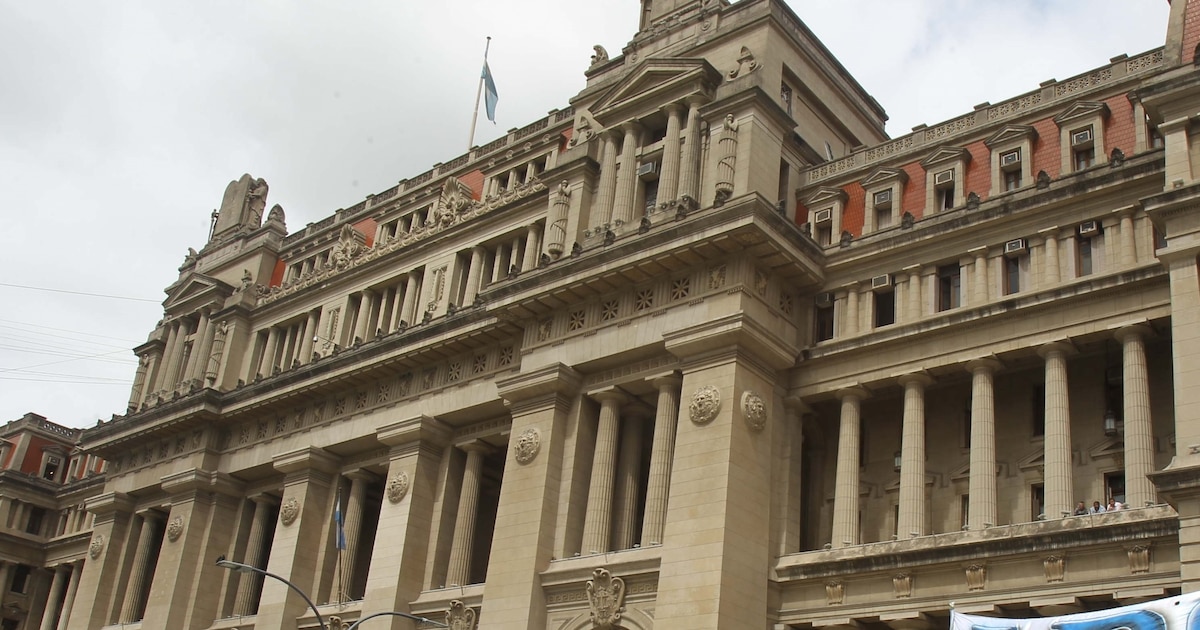
🖼️ IMAGE 2 · Rally in front of the Palace of Courts (October 6) Alternative text (alt): Social and trade union organizations in front of the Courts against the Court's ruling on the Land Law 🔗 Absolute link: Open original image (infobae.com) Credit: Infobae |

Deputies Miguel Ángel Pichetto and Nicolás Massot presented an injunction to suspend Article 154 again while Congress defines its fate. At the same time, the highest court advanced in the call of co-judges for a new debate based on a proposal by the Árbol de Pie association, a movement that the ruling party is following closely.
|
📖 GLOSSARY · What is DNU 70/2023? It is the decree "Bases for the Reconstruction of the Argentine Economy", signed by Javier Milei on December 20, 2023. Original of 366 articles, it modified rules on rents, commerce, health, transportation, public companies, labor market and more. The Senate rejected it on March 14, 2024 (42 votes to 25 and 4 abstentions), but since the lower house never dealt with it, the decree remains in force. |
🏛️ The legislative chessboard: two sessions, one dispute
🗓️ The opposition session on October 15
The opposition blocs called a special session in the Chamber of Deputies for Thursday 15 at 2 p.m. The agenda includes the rejection of DNU 70/2023, a bill on indebtedness and delinquency of families and the extension of the disability emergency until December 31, 2027. To open the chamber, 129 legislators are needed. If the lower house also rejects the decree, as the Senate has already done, the rule would be repealed going forward.
In Union for the Homeland they admit that the prospects of reaching a quorum are complicated as the date approaches, but they maintain that they will go to the venue anyway to make it clear who supports the repeal and who does not.
🧩 The government's counteroffensive
La Libertad Avanza tries to leave the opposition session without a quorum and, at the same time, offers the dialoguists to open the chamber on October 21 with another agenda: Defense of National Sovereignty, disability and family over-indebtedness. In a meeting held on Wednesday in the Hall of Honor, with the presence of the Secretary of Finance, Carlos Guberman, the allies insisted on what the government will do with the Land Law and did not get a conclusive answer.
The alternative that today appears to be stronger is to reintroduce restrictions on the purchase and sale of rural land within the Law of Inviolability of Private Property, which came with half the approval of the Senate. The idea would be to rescue the Land Law by another means to protect the rest of DNU 70, considered the cornerstone of the official economic program. A decision has not yet been made.
The negotiation also includes the 2027 Budget, whose debate begins on Tuesday 13 with the official goal of ruling before the visit of Pope Leo XIV, and changes to the project for the Defense of National Sovereignty: the allies ask to eliminate Article 111, which provides for prison sentences for actions of disinformation or destabilization carried out on behalf of foreign entities. The opposition questions it for its possible impact on journalistic work and legitimate criticism.
|
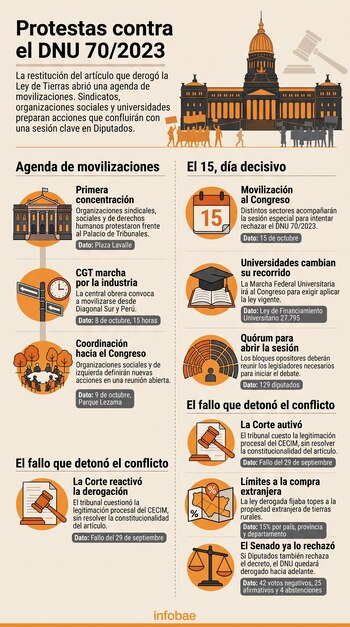
🖼️ IMAGE 3 · Infographic · Calendar of protests against DNU 70/2023 Alternative text (alt): Infographic with the dates of mobilizations called against DNU 70/2023 in Argentina 🔗 Absolute link: Open original image (infobae.com) Credit: Infobae (illustrative infographic) |
🗣️ The voices of protest
• Hugo Robert (CECIM): he took aim at the ruling and also against the political leadership, which he accused of having ignored for more than two years the protection protected by the law.
• Hugo Godoy (CTA-A) and Hugo Yasky (CTA-T): described the ruling as serious and linked it to the session of the 15th, in which the opposition blocs seek to gather a quorum.
• Myriam Bregman and Nicolás del Caño (FIT-U): called for a massive mobilization of Congress and demanded that the trade union centers hold an active national strike on that date.
• CGT: questioned the judges of the Court in a statement, but did not formally join the march to the Courts or announce a strike for the 15th.
🗓️ Agenda for the week and next
|
Date |
Fact |
|
Tue 6/10 |
⚖️ Rally in front of the Courts (Plaza Lavalle) against the Court's ruling. |
|
Thu 8/10 · 15:00 |
🚶 CGT march from Diagonal Sur and Peru to the former Ministry of Industry. |
|
Fri 9/10 |
✊ Self-convocation in Lezama Park to define the street response. |
|
Tue 13/10 |
📑 The debate on the 2027 Budget begins in Deputies. |
|
Thu 10/15 · 14:00 |
🏛️ Special opposition session for DNU 70/2023 and mobilization to Congress, together with the Federal University March. |
|
Wed 21/10 |
🧩 Session proposed by the ruling party: National Sovereignty, disability and indebtedness. |
🔎 Keys to follow what's coming
• The magic number: 129 present to open the session on the 15th. Each dialoguer who is absent or sits down tips the scales.
• The judicial letter: a new precautionary measure or the decision on the co-judges could alter the scenario of the Land Law before the precinct.
• The CGT's plan of struggle: the union keeps the option of a strike open, but conditions it at the time it deems appropriate.
• Legislative barter: Budget 2027, Article 111 and rural lands appear as pieces of the same negotiation.
❓ Frequently Asked Questions
❔ Where and at what time does the CGT march?
The rally is at 3 p.m. on Diagonal Sur and Perú, in downtown Buenos Aires, and from there it marches to the building of the former Ministry of Industry (Secretariat of Industry).
❔ Is there a general strike by the CGT?
No. The union postponed the national strike and, for the moment, did not announce a strike for October 15.
❔ What happened to the Land Law?
A Supreme Court ruling on September 29 annulled the precautionary measure that suspended Article 154 of DNU 70/2023, which brought the repeal of Law 26,737 back into force.
❔ When does the Deputies meet for DNU 70?
The opposition called a special session for Thursday, October 15 at 2 p.m., with the need for 129 legislators to open the debate.
📚 Sources and ampliatory readings
• 🔗 Infobae · Lands, industry and universities: the demands and protests planned for October
• 🔗 RTS Media / Noticias Argentinas · To shield DNU 70, the Government seeks to rescue the Land Law
• 🔗 The Uncovering · The CGT marches again "in defense of the National Industry"
• 🔗 El Esquiú · The CGT returns to the streets: march in defense of the national industry
• 🔗 Bariloche News · The CGT marches again through the Buenos Aires microcenter
• 🔗 The Jujuy Submarine · The CGT will march this Thursday in defense of the national industry
🗒️ Note in development. Prepared based on the journalistic coverage available as of October 8, 2026; it does not yet include attendance figures or the outcome of the day. It will be updated as there are news.

📰 ECONOMY AND DOLLAR
The blue dollar falls pending definitions: fixed terms, activity and DNU 70/23 mark the week
The blue closed around $1,550, activity falls and Deputies prepare a key session on October 15.
|
✍️ Economy Editorial Team | 📅 October 5, 2026 | ⏱️ Read: 4 min | 📝 818 words approx. |
The foreign exchange market started the week on a calm note: the blue dollar lost ground and closed at around $1,545-$1,550, according to the source consulted, its biggest fall in almost two months. But while the financial market breathes, the economic and political agenda adds layers of uncertainty: activity that continues to decline, fixed-term rates that barely move and a key session in the Chamber of Deputies for DNU 70/23.
💵 Dollar: the blue goes down and the official one remains firm
This Monday, October 5, the blue dollar closed at $1,550 for sale in the Ámbito survey, with a drop of $15 compared to the previous round. Other markets reported slightly different values, between $1,545 and $1,560, a usual dispersion in the parallel market. The official one remained at $1,540 in the Banco Nación, with which the gap practically disappears.
• 🏦 Wholesale: closed at $1,520, more than $400 below the ceiling of the exchange bands, the largest distance in 17 months according to Infobae.
• 📈 MEP dollar: around $1,538, with a gap of close to 1.2% against the official one.
• 🌐 Cash with settlement: between $1,603 and $1,623 depending on the source.
• 💳 Card dollar: $2,002, with a surcharge of 30% on the official one.
In parallel, optimism for Brazil pushed the S&P Merval 3.7% and took the country risk below 600 basis points, while the Central Bank bought USD 14 million.
📉 Economic activity: the worrying data
The weakest front is the real economy. Indec's EMAE showed a 2.9% seasonally adjusted drop and a 1.4% year-on-year decline, the lowest level since March 2025, according to Infobae's analysis. The signal is replicated in the industry: automotive production in September was 15.6% lower than a year ago, although the sector's exports rose 6.8%.
🏦 Fixed terms: the rate rises, the saver compares
Banco Nación raised its APR to 19.25% for 30-day electronic placements, from 18.75%, which is equivalent to an effective monthly yield of 1.58%. With $500,000, the interest is around $7,911 in 30 days. Banco Provincia leads among the large banks with 21%, followed by Macro (19.5%) and BBVA (19%); Galicia offers 18.25%, Ciudad 17%, Santander 16.5% and Patagonia 16%. As the BCRA does not set a minimum rate, the difference between entities weighs on the final result.
🏛️ DNU 70/23: countdown in Congress
The opposition called a special session in the Chamber of Deputies for Thursday, October 15 at 2 p.m., with three topics: repealing DNU 70/23, extending the disability emergency until 2027 and a bill on family indebtedness. The Senate had already rejected the decree on March 14, 2024, so the definition was left in the hands of the lower house.
The board is tight. According to El Destape, the opposition is 14 votes short of reaching the quorum of 129, with 29 undecided deputies. La Nación, on the other hand, reports that the Casa Rosada is negotiating with allied governors to prevent the session from prospering and is confident that the opposition will not reach the number.
The judicial context adds tension: the Supreme Court reinstated Article 154, which repealed the Land Law, although without ruling on its constitutionality, since it considered that the CECIM did not have standing to file the amparo. Social organizations will march on Tuesday 6 to the Courts and on October 15, at 1:30 p.m., the Congress will be the scene of the Federal University March.
What could come back if the decree falls?
• 🏠 The previous Rental Law, instead of freely agreed contracts.
• 🩺 Restrictions on prepaid medicine fee increases.
• 🌿 The National Institute of Yerba Mate, dissolved by the decree.
• 🌾 Limits to the foreignization of rural lands.
🔎 Keys to follow
• Evolution of the blue against the official one after the initial drop of the week.
• Upcoming Indec activity data and its impact on employment.
• Quorum count in Deputies before October 15.
• Bank rate movements and real yield vs. inflation.
Note: Quotes vary by source and time of survey; values are informational and do not constitute financial advice.
🖼️ Reference Images
I couldn't verify the display of images from my environment (access to Wikimedia is blocked), so I didn't embed them. This is a candidate found in a search, to validate by opening the link before publishing and respecting its license:
🏛️ National Congress (Wikimedia Commons): 500px-Buenos_Aires-Plaza_Congreso-Pensador_de_Rodin.jpg

📚 Sources
🔗 Scope: Blue dollar, close on October 5
🔗 LA NACION: Blue dollar today, October 5
🔗 LA NACION: Deputies and DNU 70/23
🔗 LA NACION: Bank-by-bank fixed-term
🔗 MDZ: Banco Nación fixed term at 19.25%
🔗 Infobae: EMAE, rates and country risk
🔗 Infobae: What laws would return if DNU 70 falls?
🔗 El Destape: the 29 undecided deputies
With 90.88% of the ballot boxes officially counted by the Eastern Superior Electoral Court (TSE ), the consolidated vote-by-vote numbers confirm that the presidential election will be defined in a second round. [1]
The official partial results for the main candidates are as follows: [1, 2]
|
Candidate |
Match |
Total Votes |
Percentage |
|
Liberal Party (PL) |
51.784.398 |
47,99% |
|
|
Workers' Party (PT) |
47.515.742 |
44,03% |
|
|
Avante |
3.160.269 |
2,93% |
|
|
Renan Antônio F. dos Santos |
Mission Party |
2.474.819 |
2,29% |
|
Social Democratic Party (PSD) |
2.425.324 |
2,03% |
The total number of contested, null or blank votes ("Spoiled Votes") amounts to 5,351,905. [1]
Given that no candidate managed to surpass the absolute majority (50% plus one of the valid votes), the statistical projections of the polling firm Datafolha mathematically confirm the runoff. The presidency of Brazil will be definitively decided next year. [3, 4]
Elections for the Chamber of Deputies of Brazil 2026
8 of the 513 seats disputed in the elections awarded. 90.66% counted. 513 seats in total. Preliminary results.
Liberal Party
121 seats
3 wins · 118 advantage
23.26% of votes
Brazil of Hope Federation
78 seats
0 won · 78 advantage
13.23% of votes
Progressive Union Federation
69 seats
0 wins · 69 advantage
10.88% of votes
Social Democratic Party
42 seats
0 won · 42 lead
8.03% of votes
More results
20:24
From Superior Electoral Court (TSE) via Reuters
Brazil Senate Elections 2026
2 of the 54 seats disputed in the elections awarded. 90.83% counted. 81 seats in total. Preliminary results.
Liberal Party
29 seats
2 won · 18 lead · 9 seats not put to a vote
28.69% of votes
Workers' Party
9 seats
0 won · 6 lead · 3 seats not put to a vote
12.49% of votes
Brazilian Democratic Movement
8 seats
0 won · 7 lead · 1 seats not voted
5.66% of votes
Progressives
6 seats
0 won · 3 lead · 3 seats not put to a vote
10.75% of votes
🏛️ POLITICS & ECONOMY · INTERNATIONAL
Milei and Macron at the Élysée: The $75 Billion "Bazooka" to Shield the Election Year
The Argentine president was received in Paris by his French counterpart and, hours earlier, told investors at the OECD that his government is "well armed" against destabilization attempts. The figures, the announcements and the open questions.
📅 October 1, 2026 ⏱️ Reading time: 5 min 📍 Paris, France ✍️ Newsroom
📷 View image: Élysée Palace, Paris (absolute link)

Élysée Palace, Paris. Photo: Eric Pouhier, via Wikimedia Commons (CC BY-SA 2.5). To insert it, download it from the link and upload it to your blog.
⚡ Key points
• 🤝 Milei was received by Macron at the Élysée on Thursday, with his sister Karina Milei.
• 💵 He said he has $75 billion available to face volatility in 2027.
• ⚡ TotalEnergies announced investments of nearly $10 billion.
• 📈 He projected that 2028 will be "the best economic year" if he is re-elected.
📑 In this story
1. The meeting at the Élysée
2. The "bazooka": what it is made of
3. The message to investors
4. A critical reading: what to keep in mind
🏛️ The meeting at the Élysée
To a military fanfare, an embrace from Emmanuel Macron and a greeting between Karina Milei and Brigitte Macron, the Argentine president arrived at the Élysée Palace on Thursday. According to official sources (in Spanish), the two leaders discussed artificial intelligence, the progress of Argentina Week and announcements by French companies, mainly in energy.
According to an Infobae report republished by other outlets (in Spanish), a private meeting of about 40 minutes was followed by a broader session with part of both cabinets and invited business leaders. The French side, Argentine government sources said, asked how the country sustains its fiscal adjustment, a subject of particular concern in France.
The delegation included governors such as Gustavo Sáenz, Ignacio Torres, Raúl Jalil, Marcelo Orrego and Jorge Macri, among others, as well as officials such as Diego Santilli. The visit is part of Argentina Week, organized by Argentina's embassy to attract European capital.
💣 The "bazooka": what it is made of
Hours earlier, at OECD headquarters (Château de la Muette), Milei spoke for about 50 minutes to investors and bankers. There he said, as reported by Infobae, that the government has a "bazooka" of roughly $75 billion against "destabilizing and coup-seeking attempts" during the 2027 election process.
"We spent this whole year getting ahead and preparing a dollar bazooka."
The breakdown, as detailed in his speech:
|
Component |
Amount (USD) |
|
🏦 Reserve purchases |
$20 billion |
|
🇺🇸 Swap with the United States |
$20 billion |
|
🇨🇳 Swap with China |
$20 billion |
|
📊 Futures position |
$15 billion |
|
Total |
$75 billion |
📣 The message to investors
The president urged investors to "come in now," because once the country reaches investment grade it may be "too late." He tied that rating to lower interest rates, more growth and less poverty. He also projected cumulative expansion of more than 16 points over his term, against under 6% for the OECD average, and repeated that 2028 will be the best economic year in history if he is re-elected.
The event produced one concrete announcement: TotalEnergies CEO Patrick Pouyanné announced plans of nearly $10 billion, highlighting the ability to repatriate dividends and the incentive regime for large investments. Milei noted that the previous Argentina Week had announced more than $16 billion.
🔎 A critical reading: what to keep in mind
• These are the government's own figures. The outlets consulted repeat the breakdown presented by the president; none includes an independent audit of the total.
• The components are not equivalent. Reserve purchases, swap lines and futures positions are different instruments with different conditions and uses. Adding them into one number is a communications choice that analysts often qualify.
• The political accusation. Milei linked sectors of the opposition to possible destabilization attempts; the articles cited present no evidence of such attempts.
• The French context. Macron's side showed interest in the fiscal adjustment, but according to sources the meeting centered on investment, AI and geopolitics.
❓ Frequently asked questions
When and where did the meeting take place?
On Thursday, October 1, 2026, at the Élysée Palace in Paris, during Argentina Week.
What is the $75 billion "bazooka"?
It is the set of resources that, according to Milei, the government has to face volatility in the 2027 election year (see table).
What is Argentina Week?
An investment forum organized by Argentina's embassy in France, bringing together officials, governors and companies in energy, mining, agribusiness, technology and finance.
🔗 Sources consulted
• Infobae — Milei at the Élysée Palace (Spanish)
• Infobae — Speech at Argentina Week (Spanish)
• Forbes Argentina — The "bazooka" and 2028 (Spanish)
• Cadena 3 — Investment and adjustment (Spanish)
• DolarHoy — Breakdown and TotalEnergies announcement (Spanish)
Quotes are translated from Spanish by the newsroom. Last reviewed: October 1, 2026. Information may be updated.
🏛️ POLITICS | 💼 ECONOMY | 🌍 INTERNATIONAL
"Come and fill your pockets": Milei travels to France with 13 governors to attract investments in mining, energy and agriculture
The President will lead Argentina Week in Paris, meet with Emmanuel Macron and seek to show federal support to European businessmen, in a context of high country risk and tension with the opposition over the RIGI.
✍️ By Redacción · 📍 Paris / Buenos Aires · 📅 September 29, 2026 · ⏱️ Reading time: 7 min

🖼️ AI-generated image that Milei shared on Instagram before the trip. Credit: screenshot reproduced by elDiarioAR. See original image

⚡ KEYS TO THE NEWS
• 🗓️ Milei departs on Tuesday, September 29 and Argentina Week takes place in Paris from 9/30 to 10/2.
• 13 governors of mining, energy and agricultural provinces are traveling. 🤝
• 🇫🇷 On Thursday 1/10: speech at the OECD, meeting with businessmen and audience with Macron at the Elysée.
• 💬 Central message: French investors are welcome to "line their pockets".
• ⚖️ He defended the RIGI in the face of criticism from the opposition.
🧭 In this article: The trip · The message · The governors · Agenda · Macron · RIGI · Context · Frequently asked questions
President Javier Milei will leave this Tuesday, September 29, at 10 p.m., for Paris to lead a new edition of Argentina Week, a business forum that will take place between September 30 and October 2 and that the Government presents as a showcase to attract European capital. The mission arrives a few days after its passage through New York, where it participated in the UN General Assembly.
The focus of the tour is the sectors in which the Casa Rosada is committed to attracting investment: mining, energy and agribusiness, with the complement of infrastructure, health, technology and artificial intelligence. The delegation includes ministers, businessmen and a dozen governors of provinces with a productive profile, and the agenda also includes meetings related to the agreement between Mercosur and the European Union.
Before traveling, the President projected that Argentine exports will exceed US$ 100,000 million in 2026 and that they could be between US$ 180,000 and 200,000 million in 2031, a figure that the ruling party will use as a central argument before investors.
The message that anticipated the tour arose from an extensive interview with the French weekly Le Point, held in the presidential office of the Casa Rosada. There they asked him why large French companies should trust Argentina, alluding to precedents such as that of Aguas Argentinas, the local subsidiary of Suez, during the 2002 crisis. Milei responded that his administration guarantees the right to property and the fulfillment of contracts, and added:
"French investors are welcome to come and line their pockets in Argentina."
According to the President, these gains will translate into employment and prosperity for Argentines. The phrase, which quickly became the headline of the trip, summarizes the tone of the mission: a speech of economic openness and legal certainty aimed at the companies of the CAC 40, the main stock market index in Paris.
The staging was also digital. Hours before leaving, Milei posted on Instagram a video generated with artificial intelligence in which he appears at the top of the Eiffel Tower, with the Argentine flag and a lion, to promote Argentina Week.
The federal photo is one of the political bets of the trip. According to the list released by national media, Milei is accompanied by the governors of Neuquén, Río Negro, Chubut, Santa Cruz, Mendoza, San Juan, Catamarca, Salta, Jujuy, Chaco, Corrientes and Entre Ríos, as well as the head of the Buenos Aires government, Jorge Macri. Due to its productive profile, the delegation is organized as follows (indicative classification of this newsroom):
• ⛏️ Mining and lithium: Marcelo Orrego (San Juan), Raúl Jalil (Catamarca), Carlos Sadir (Jujuy), Gustavo Sáenz (Salta) and Alfredo Cornejo (Mendoza).
• ⚡ Energy: Rolando Figueroa (Neuquén), Alberto Weretilneck (Río Negro), Ignacio Torres (Chubut) and Claudio Vidal (Santa Cruz).
• 🌾 Agriculture and production: Rogelio Frigerio (Entre Ríos), Juan Pablo Valdés (Corrientes) and Leandro Zdero (Chaco).
• 🏙️ City of Buenos Aires: Jorge Macri, who confirmed his presence at the last minute.
Figueroa and Weretilneck appear with their own names in the panel "Argentinean Gas in the World Market", along with executives from the private sector. Maximiliano Pullaro from Santa Fe and Martín Llaryora from Córdoba, who will send a delegation representing his province, were left out.
Double reading. In addition to the economic component, the presence of the governors has an internal political objective: the government negotiates with the provinces the 2027 Budget and other projects that it intends to send to Congress, including changes in the electoral system. A libertarian official quoted by Infobae stated that, at the very least, they seek to suspend the next PASO. At the same time, media such as elDiarioAR and Perfil reported internal friction over the control of the travel agenda.
• 🛫 Tuesday 29/9, 22:00: departure of the President for France.
• 🍷 Wednesday 30/9: Arrival in Paris and welcome cocktail-dinner at the Argentine Embassy.
• 🎤 Thursday 1/10 (main day): speech at the OECD headquarters on the factors driving Argentine growth; meeting with governors focused on investments; meeting with businessmen and private audience with Emmanuel Macron at the Elysée Palace. On the same day, Macron will receive the official delegation participating in the forum.
• 🏆 During the tour: he will receive a distinction from the Paris Economic Forum and will share an activity with Philippe Aghion, Nobel Prize in Economics 2025.
• 📆 Friday 2/10: Argentina Week closes.
He is accompanied by the Minister of Economy, Luis Caputo; the President of the Central Bank, Santiago Bausili; the Foreign Minister, Pablo Quirno; the Minister of Deregulation, Federico Sturzenegger, and the Secretary General of the Presidency, Karina Milei.
With the French president, Milei chose a cordial tone: he defined him as a friend and thanked him, together with Italian Prime Minister Giorgia Meloni, for having helped unblock the European votes on the IMF board for the latest agreement with Argentina. Regarding the submarine tender, in which the French Naval Group competes with the German Thyssenkrupp and the South Korean Hanwha, he said that the most convenient option will be chosen according to technical performance and financing.
The trade agreement between Mercosur and the European Union, on the other hand, continues to be a sensitive point: it faces resistance from French agricultural sectors, an obstacle that runs through the mission's entire agro-export agenda.
The cordiality did not reach French domestic politics. In the interview, Milei described the left's tax proposals as "economic suicide," advised those who "detest France" to vote for those forces, said that eventual protests against his visit would be "a medal" and denied that there is an extreme right, which he described as an invention of his adversaries. He also gave his opinion on immigration in terms that generated repercussions in the French and Argentine media.
Another of the axes of the interview was the Incentive Regime for Large Investments (RIGI), a key tool of the official offer in Europe. Faced with criticism from the opposition, which maintains that the scheme delivers resources such as lithium, gas and mining to multinational companies, Milei responded harshly: he spoke of "economic illiterates" and compared his adversaries with the Macana Brothers, the cavemen in the animated series Los autos locos. To support his position, he mentioned the evolution of YPF and the energy balance.
Critics of the regime, meanwhile, insist that the benefits granted to large companies do not guarantee local spillover. The debate, far from being closed, will once again be at the center of the scene with the governors of mining and energy provinces as protagonists.
The tour comes at a delicate time for the economic program. The country risk is around 600 points and the government seeks to show European investors that the adjustment has a return, while household consumption fell again in August, with a year-on-year drop of 1.1% as reported by elDiarioAR. Added to this are the discussion of the 2027 Budget, the negotiations with the provinces and the political climate prior to the trip.
• Milei's speech at the OECD and the reaction of the investors present.
• The possible announcements after the private audience with Macron at the Elysée.
• The publication of the second part of the interview in Le Point, scheduled for Wednesday.
• Meetings with governors and their impact on the legislative agenda.
• The eventual demonstrations of rejection of the visit in Paris.
What is Argentina Week?
It is a business forum that brings together officials, governors and executives to promote investments in Argentina. The Paris edition takes place from September 30 to October 2, 2026.
What did Milei say about investors?
In an interview with Le Point, he said that French investors are welcome "to fill their pockets" in Argentina and that their profits will generate employment and prosperity.
When does Milei meet with Macron?
The private audience is scheduled for Thursday, October 1 at the Elysee Palace, following the presidential speech at the OECD headquarters.
Which governors travel to France?
Thirteen governors: Figueroa, Weretilneck, Torres, Vidal, Cornejo, Frigerio, Sáenz, Valdés, Zdero, Sadir, Orrego and Jalil, in addition to the head of the Buenos Aires government, Jorge Macri.
📚 Sources consulted
• elDiarioAR – Milei showed himself on top of the Eiffel Tower and warned French businessmen
• Channel 26 – Milei's message to investors prior to his landing in France
• El Litoral – Milei invited French businessmen to invest in Argentina before traveling to Paris
• Infobae – The 13 allied governors who will travel with Milei to France
• Profile – Milei travels to Paris: 13 governors, bilateral with Macron and friction over the agenda
• Scope – Javier Milei puts together a federal photo in Paris
ECONOMY · INDEC · ARGENTINA
🚨 Poverty in Argentina climbed to 32.3% in the first half of the year and already affects 15.5 million people
INDEC reported a jump of 4.1 percentage points compared to the second half of 2025 and broke three consecutive periods of decline. Indigence also rose, to 7.5%. The mismatch between income and the cost of the baskets explains the deterioration.
🗓️ Updated: September 25, 2026 ⏱️ Reading Time: 5 minutes 📍 Buenos Aires, Argentina
Poverty rose again in Argentina. According to the report released Thursday by the National Institute of Statistics and Census (INDEC), the indicator reached 32.3% of the population during the first half of 2026, that is, 4.1 percentage points more than in the second half of 2025, when it had marked 28.2%. When projecting the data of the 31 urban agglomerations surveyed to the country as a whole, the figure is equivalent to about 15.5 million people below the poverty line. Indigence, meanwhile, climbed to 7.5%, some 3.6 million Argentines who are unable to cover even the basic food basket.
The figure marks a break: it is the first increase after three consecutive semesters of decline. In terms of households, poverty affected 24.4% and indigence, 5.6%. Compared to the first half of 2025 – when the index had been 31.6% – the current level is also higher.
📈 A BREAK IN THE TREND
The trajectory of the last two years had been downward: poverty went from 52.9% in the first half of 2024 to 38.9% by the end of that year, and continued to fall to 31.6% and 28.2% in the two semesters of 2025. The jump to 32.3% in the first six months of 2026 interrupts this dynamic and returns the indicator to values similar to those of the beginning of 2025.
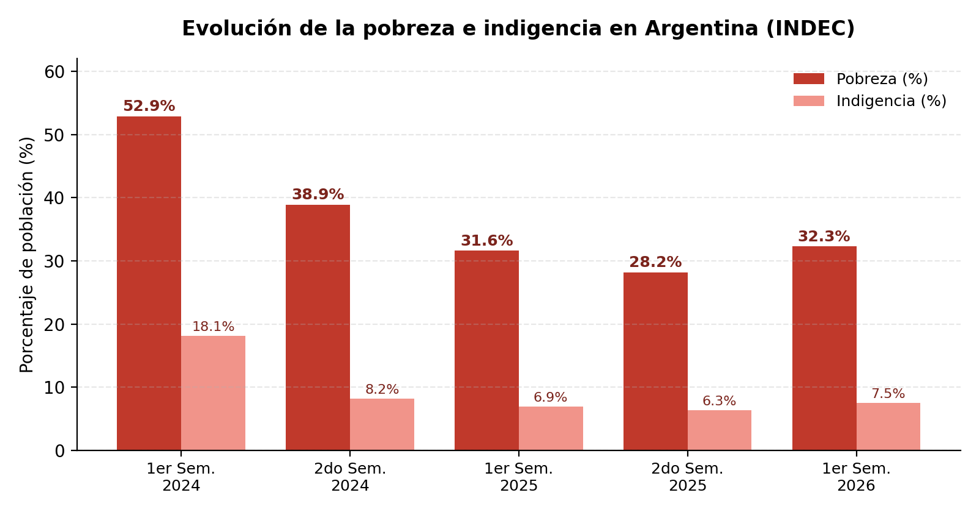
Graph: Authors' elaboration based on INDEC data
👶 CHILDREN, THE HARDEST HIT SECTOR
The deterioration had a particularly strong impact on the youngest. According to the statistical agency's age breakdown, child poverty went from 41.3% at the end of 2025 to 44.5% in the current measurement, well above the general average. The gap between generations once again puts the spotlight on a structural phenomenon in Argentina: children systematically concentrate the highest levels of poverty in the country.
🗺️ AN UNEVEN MAP: POVERTY BY REGION
The regional differences are marked. The Northeast (NEA) led the ranking with an incidence of 41.5%, followed by Cuyo with 36.7%. In Greater Buenos Aires, poverty reached 32.1%, although with a very wide gap internally: 13.9% in the City of Buenos Aires compared to 36.9% in the suburban districts. Further behind were the Northwest (31.5%), the Pampas region (30.3%) and, with the best record in the country, Patagonia (28.4%). Indigence was also higher in the NEA (10.5%) and in the GBA (8.4%).
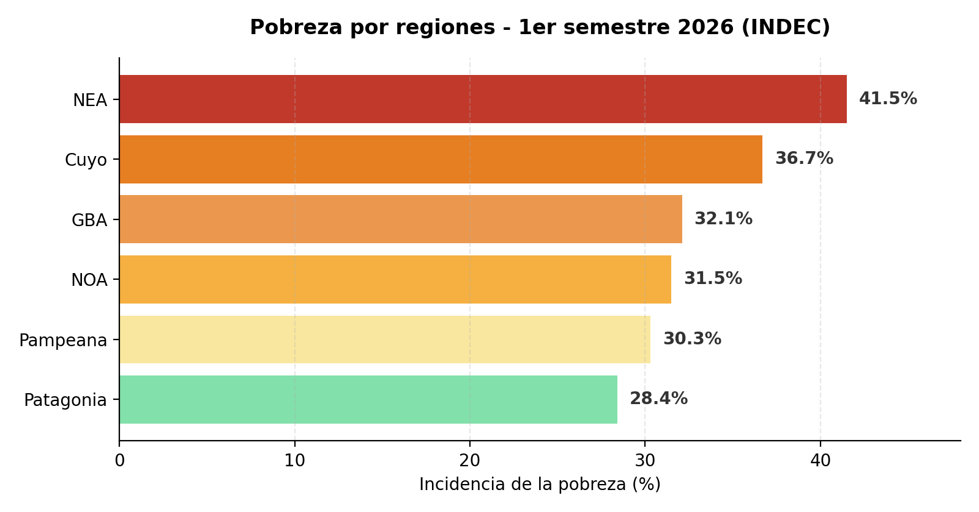
Graph: Authors' elaboration based on INDEC data
💸 INCOME THAT DOES NOT COVER THE BASKET
INDEC itself explained the deterioration based on the mismatch between household income and the cost of the reference baskets. During the first half of the year, the average family per capita income rose 11.5%, well below the 21.4% increase in the Basic Food Basket (CBA, which measures indigence) and the 19.6% increase in the Total Basic Basket (CBT, which measures poverty). This difference is also reflected in the so-called poverty gap – the distance between the income of poor households and the amount needed to overcome it – which in the first half of the year stood at 35.9%.
▪ Family per capita income: +11.5%
▪ Basic Food Basket (indigence): +21.4%
▪ Total Basic Basket (poverty): +19.6%
▪ Poverty gap: 35.9%
🏛️ THE GOVERNMENT'S READING
The economic team relativized the specific data and emphasized the longer-term comparison. The Minister of Economy, Luis Caputo, remarked through his social networks that, despite the rise compared to the previous semester, both poverty and indigence show a pronounced drop compared to the first half of 2024, when the indicators had reached 52.9% and 18.1% respectively. In the ruling party, they maintain that the rebound in the semester responds to specific factors and they hope that the trend will be reversed again in the next reports.
🔎 WHAT TO WATCH FROM HERE ON OUT
The new data reopens the debate on the social impact of the economic program and on the sustainability of the recovery of income in the face of the cost of living. Some social programs — such as Progresar, Acompañamiento Social and Volver al Trabajo — lost coverage in the period analyzed, a factor that economists and social organizations point to as part of the explanation. The next measurement, corresponding to the second half of 2026, will be key to confirming whether the jump was temporary or the beginning of a new trend.
📚 SOURCES CONSULTED
🔗 Clarín — https://www.clarin.com/
🔗 TN — All News — https://tn.com.ar/
Note prepared with official data from INDEC (Permanent Household Survey). The graphs are prepared by the authors.
Argentina and the United States launch the Andes-Atlantic Corridor: an infrastructure plan of up to US$ 7,000 million
Vaca Muerta, mining, railways, ports, energy and digital connectivity are at the center of a financing scheme planned for 2027.
Reading Time: 8–10 minutes
🇦🇷🇺🇸 A new roadmap for Argentina's infrastructure
Argentina and the United States announced on September 23, 2026, in New York, the launch of the Andes-Atlantic Corridor, an initiative aimed at strengthening the infrastructure that connects Argentine productive areas – in particular Vaca Muerta and mining regions in the northwest – with Atlantic ports and international markets. The scheme includes U.S. financing tools of up to US$ 7,000 million by 2027. The announcement was made by Argentine Foreign Minister Pablo Quirno and U.S. Assistant Secretary of State Christopher Landau, within the framework of the High-Level Week of the United Nations General Assembly.
A fundamental point to interpret the announcement is that the US$ 7,000 million is not equivalent to a single disbursement nor does it mean that the entire amount has already been approved. According to the information published about the agreement, it is a framework to mobilize financing for different projects; in particular, EXIM presented a preliminary proposal of up to US$ 6,000 million for the Argentina LNG project, subject to the corresponding procedures and approvals.
💰 What does the US$ 7,000 million really mean?
The figure is the focus of attention because it constitutes the financial ceiling announced for the program during 2027. However, it is worth differentiating three concepts: financing framework, indicative proposal and effective disbursement. The general agreement brings together projects in different stages and does not automatically allocate a certain amount to each work.
|
Component |
Amount/Situation |
What it entails |
|
Andes-Atlantic Corridor |
Up to US$ 7,000 million by 2027 |
Framework for mobilizing financing in strategic projects. |
|
Argentina LNG |
Preliminary proposal of up to US$ 6,000 million |
Financing subject to evaluation and approval by EXIM. |
|
Other projects |
Individual amounts not yet defined |
They include transportation, energy, mining, and digital connectivity. |
⛽ Vaca Muerta and Argentina LNG: the main energy focus
The largest concentration of resources mentioned in the first information is linked to Argentina LNG, the gas export project associated with Vaca Muerta involving YPF, Italy's Eni and XRG, from the United Arab Emirates. According to the published information, around US$ 6,000 million from the US scheme could support this project, while its total estimated investment throughout the development is much higher.
The first phase of Argentina LNG contemplates floating liquefaction units off Río Negro. The objective is to convert part of Vaca Muerta's gas production into LNG for export, which requires integrated infrastructure: production, pipelines, processing, liquefaction and terminals.
🚆 Railways, Ports and Waterways
The corridor is not limited to hydrocarbons. The understanding also identifies the need to rehabilitate and expand railways, waterways and ports to reduce the logistical bottlenecks that make it more expensive to move raw materials to international markets.
· Waterway and river logistics.
· Freight railways, including projects related to Belgrano Cargas and other lines.
· Possible rail connections between Vaca Muerta and Bahía Blanca.
· Port infrastructure and export output capacity.
· Oil and gas pipelines to expand energy transport capacity.
⚡ Electricity and energy infrastructure
Export expansion requires more than pipelines. The program contemplates electricity generation and transmission infrastructure, with references to projects such as AMBA I. The economic logic is to integrate energy production with networks capable of accompanying greater industrial and export activity.
⛏️ Lithium, copper and critical minerals
Northwestern Argentina occupies a central place in the mining dimension of the corridor. Lithium and copper appear among the resources considered strategic, in an international context in which governments and companies seek to diversify supply chains of minerals used in energy, electricity and industrial technologies. The challenge for Argentina is not only to extract minerals: it also includes infrastructure, processing, logistics, energy and investment conditions that allow geological resources to be transformed into export value chains.
🌐 The digital dimension: fibre, telecommunications and ARSAT
The infrastructure of the 21st century also travels through cables and networks. The agreement incorporates digital connectivity, telecommunications, fiber optics and projects related to ARSAT. This dimension seeks to accompany the productive expansion with greater data transmission capacity and secure connectivity.
🏗️ How could financing work?
The U.S. role is not limited to providing capital. The tools mentioned include EXIM mechanisms and the possibility of participation by the U.S. International Development Finance Corporation (DFC), in addition to private capital. It is also envisaged that U.S. companies will be able to compete in tenders or participate as contractors and subcontractors. This means that the program can combine financing, guarantees, insurance, provision of technology, equipment, and business participation.
🔎 What still needs to be defined
· The final allocation of the remaining funds after the main component of Argentina LNG.
· The projects that will receive effective financing and their execution schedules.
· The final financial conditions of each operation.
· Necessary approvals from U.S. agencies, especially where applicable to EXIM.
· The bidding, concession or contracting processes for each work.
· The technical, environmental, regulatory and feasibility studies that correspond to each project.
📈 Why can the corridor be relevant to the Argentine economy?
The potential relevance lies in the integration of several pieces that are usually analyzed separately: energy production + mining + transportation + ports + electricity + digital connectivity. If these networks increase their capacity in a coordinated manner, they could reduce physical export restrictions and improve Argentina's ability to place oil, gas, and minerals in foreign markets. However, these effects depend on projects moving from announcements and financial frameworks to contracts, works, and operations actually executed.
🌎 An initiative with a geo-economic dimension
The Andes-Atlantic Corridor should also be read within an international trend: the construction of economic corridors that link natural resources, logistics infrastructure and strategic supply chains. The United States has promoted corridor schemes in other regions through the Partnership for Global Infrastructure and Investment (PGI). The Argentine announcement is presented as the first initiative of that association in the Western Hemisphere, according to officials and sources quoted by Argentine media.
⚖️ Opportunities and challenges
|
Potential opportunities |
Challenges to be solved |
|
Increased energy and mineral export capacity |
Convert financial announcements to executed projects |
|
Logistical improvements and reduced bottlenecks |
Define priorities, amounts, and timelines |
|
Access to finance and technology |
Comply with approval processes and financial structuring |
|
Participation of suppliers and investors |
Resolve regulatory, environmental and contractual aspects |
|
Increased energy and digital connectivity |
Coordinate infrastructure projects that depend on each other |
🧭 The key: moving from ad to execution
The most important data to follow over the next few months will not only be the number of US$ 7,000 million, but also which projects are approved, what contracts are signed, what financing is disbursed and what works are actually started. The planned visit of U.S. officials to Argentina and the definition of concrete projects will be relevant stages to measure the evolution of the program.
📌 Conclusion
The Andes-Atlantic Corridor proposes a reorganization of Argentina's infrastructure around a central idea: connecting strategic resources with international markets through an integrated network of energy, transport, ports and technology. The framework of up to US$ 7,000 million by 2027 represents a significant scale, but its economic impact will depend on the transformation of that framework into approved financing, private investments, tenders, contracts and completed works. For Argentina, the challenge will be to take advantage of infrastructure to increase productive and export capacity, while for investors and financial organizations the central issue will be the technical, economic, regulatory and financial viability of each project.
🖼️ Suggested images for the article
For web publishing, it is recommended to use images whose license or authorization of use has been verified. These sources contain visual material related to the advertisement and/or the broker:
LA NACIÓN — announcement of the Andes-Atlantic Corridor: https://www.lanacion.com.ar/economia/estados-unidos-y-la-argentina-lanzan-un-ambicioso-corredor-de-infraestructura-con-financiamiento-por-nid23092026/
Forbes Argentina — Broker Launch: https://www.forbesargentina.com/today/argentina-estados-unidos-lanzaron-plan-conectar-vaca-muerta-mineria-puertos-atlantico-n98610
Infobae — keys and projects of the agreement: https://www.infobae.com/economia/2026/09/24/corredor-andes-atlantico-las-diez-claves-para-entender-el-acuerdo-de-inversiones-que-la-argentina-firmo-con-estados-unidos/
🔗 Journalistic sources and references
EXIM Bank of the United States: https://www.exim.gov/
Argentina.gob.ar — Trunk Waterway: https://www.argentina.gob.ar/node/513507
Editorial note: Article prepared with information available as of September 24, 2026. Amounts indicated as "up to" or "preliminary proposal" should not be interpreted as disbursements already made. Financial details and projects may be modified during the structuring and approval of each operation.
|
🌐🇦🇷 INTERNATIONAL NEWS MILEI AT THE UN 2026 The complete discourse, the breaking of the "sacred pact" and the new diplomatic escalation over the Malvinas 🗓️ September 23, 2026 | ⏱️ Reading time: 9 min midire.ar · News Editorial Office |
President Javier Milei spoke Wednesday for the third time before the UN General Assembly in New York, with a 19-minute speech that combined a frontal criticism of the multilateral organization, the vindication of Argentine sovereignty over the Malvinas Islands and a warning about the future of artificial intelligence. The message deepened the tension with the United Kingdom, which responded hours later in the same venue.
|
📅 Date |
Wednesday, September 23, 2026 |
|
📍 Location |
UN Headquarters, New York — 81st General Assembly |
|
⏱️ Duration |
19 minutes |
|
🎯 Central axes |
Criticism of the UN · Claim for Malvinas · Artificial intelligence · Alignment with the West |
|
🗣️ Background |
Milei's third speech before the agency (2024, 2025 and 2026) |
🖼️ UN General Assembly Hall, New York ( Wikimedia Commons)

🌐 Milei returns to the UN rostrum
The Argentine president took the floor before the 81st General Assembly of the United Nations around noon, Argentine time, on the day of the general debate that brings together the heads of state and government of the 193 member countries every September. His presentation came hours after the speeches of Brazil's Luiz Inácio Lula da Silva, who warned about what he defined as the most critical moment in the history of the organization, and the American Donald Trump, focused on the advance of artificial intelligence.
It was Milei's third appearance before the plenary since he assumed the presidency in December 2023. In his first speech, in 2024, he questioned the functioning of the body and the 2030 Agenda without mentioning the Malvinas issue; in 2025 he introduced the sovereignty claim for the first time. The 2026 edition took that proposal to a considerably harsher tone.
🗣️ "The sacred pact was broken": criticism of the organization
Milei structured his speech in three axes that he announced at the beginning: first, what the UN should have done and did not do; second, what it should not have done and yet did; and third, his position on the advance of artificial intelligence. He recalled that, 78 years ago, the organization committed itself to defending the sovereignty of nations and offering a forum for the peaceful resolution of conflicts.
"The sacred covenant, in fact, was broken"
— Javier Milei, President of Argentina
On that basis, he described the organization as "useless" and maintained that currently "it only serves to feed a caste of parasites." He argued that the institutions that were supposed to guarantee collective security and human rights did not fulfill that function and, instead, coexisted with the advance of chaos, violence and international terrorism on different global fronts.
🇦🇷🇬🇧 Malvinas, "national cause": resolution 3149 and oil sanctions
The section with the greatest impact of the speech was the one dedicated to the Malvinas, South Georgia and South Sandwich Islands. Milei defined the claim of sovereignty as a central issue of Argentine foreign policy and presented it as a concrete example of the distance between the words of international organizations and the deeds.
"Malvinas is a national cause for us"
— Javier Milei, before the General Assembly
The President recalled that 50 years ago the Assembly itself approved resolution 3149, which urges both parties to refrain from introducing unilateral modifications in the situation until the sovereignty dispute is resolved. According to his proposal, the UN failed to ensure that this resolution had practical consequences, which, he maintained, erodes the authority of the organization.
In this context, he ratified the tightening of sanctions on more than 60 foreign companies linked to oil exploration and exploitation projects in the North Malvinas Basin, which he described as illegal for operating without Argentine authorization on resources in the disputed area. He also advanced a step that he had not taken in previous speeches: he explicitly rejected that the inhabitants of the archipelago have a legitimate right to self-determination and described as invalid the referendums held there to define the sovereignty of the territory.
The President once again called on the United Kingdom to reopen bilateral negotiations and to discuss the exploitation of the natural resources of the area, although he clarified that Argentina "is not going to sit and wait" for the UN to act.
🖼️ Topographic map of the Falkland Islands (Malvinas) (Wikimedia Commons)

🇬🇧 London's response: Streeting, Burnham and diplomatic tension
Milei's speech came hours after British Prime Minister Andy Burnham in his own speech before the Assembly disavowed Argentina's sovereignty over the South Atlantic and stated that his country will stand firm in the face of any threat to the right of British territories to remain so, in direct reference to the Malvinas.
During the Argentine president's presentation, two members of the British diplomatic mission remained in the room following the simultaneous translation and taking notes. This episode added to an escalation that had begun weeks earlier, when the United Kingdom's Minister of Defense, Wes Streeting, described the islands as British based on the election of their inhabitants and maintained that his government's commitment to the territory is absolute and unwavering.
🌎 Regional Support: The OAS Declaration
Days before the speech at the UN, the Organization of American States (OAS) had adopted, unanimously and by acclamation, a new declaration of support for the Argentine claim, in which it urged the United Kingdom to resume bilateral negotiations suspended for decades. The Argentine Foreign Ministry described the continental support as a relevant sign in the diplomatic strategy promoted by the Government around the Malvinas cause.
🇺🇸🇮🇱 Alignment with the West: the United States, Israel and the meeting with Rubio
Milei ratified before the plenary what he defined as an "unambiguous" alignment with the West, the United States and Israel, based – as he explained – on a coincidence of values and strategic interests. After his speech, he held a meeting with the US Secretary of State, Marco Rubio, in which, according to reports, Washington's support for the Argentine position in the Malvinas dispute and the bilateral relationship in general were discussed.
Foreign Minister Pablo Quirno completed the message to the British representatives present at the organization, whom he urged to comply with their obligations in terms of decolonization, and described the presidential speech as forceful with respect to the defense of Western values and economic freedom.
🤖 Artificial intelligence: "The West must lead" the technological future
The third axis of the speech was dedicated to artificial intelligence. Milei argued that it is necessary for the West to lead global technological development and affirmed that Argentina will seek to position itself as a pole of development in the matter, joining the transformation underway. On that point he agreed, although from a different perspective, with Trump, who had dedicated a good part of his own speech to defending the advance of AI and proposing a new name for its most advanced capabilities.
The Argentine president spoke out against States assuming centralized control of this technology and stated that its development should be left in the hands of the private sector and decentralized innovation, in line with the free market principles that characterize its management.
📊 Milei's three speeches to the UN (2024-2026)
A comparison of the central axes that the President raised in each of his speeches before the General Assembly since he took office:
|
Edition |
Central axis |
Malvinas |
|
2024 |
Criticism of socialism, the welfare state and the UN 2030 Agenda |
No explicit mention of the cause |
|
2025 |
Claim for the first time of international support for sovereignty over the archipelago |
First formal claim of sovereignty before the plenary |
|
2026 |
Breaking the UN's "sacred pact", AI and alignment with the West |
"National cause", oil sanctions and rejection of island self-determination |
🖼️ Javier Milei, President of the Argentine Republic (Wikimedia Commons)

🔍 What changes compared to previous editions
The tone of the 2026 speech marked a leap from the previous two. If in 2024 the criticism focused on ideological issues and in 2025 the claim for the Malvinas was moderately added, this year the government decided to combine the diplomatic offensive – sanctions on companies, rejection of the self-determination of the islanders – with a more severe institutional criticism of the very body that hosts the claim. Foreign policy specialists quoted in the press coverage agree that the strategy sought to capitalize on the recent support of the OAS and raise the political cost for the United Kingdom at a time of greater international exposure of the dispute.
❓ Frequently Asked Questions
❓ When did Javier Milei speak at the UN in 2026?
The Argentine president addressed the 81st UN General Assembly on Wednesday, September 23, 2026, around noon Argentine time, at the headquarters in New York.
❓ What did Milei say about the Falkland Islands?
It defined the sovereignty claim as a "national cause," ratified sanctions on more than 60 companies for oil exploitation in the disputed area, rejected the validity of the referendums on self-determination held in the archipelago and called on the United Kingdom to reopen bilateral negotiations.
❓ How did the UK respond to the speech?
Prime Minister Andy Burnham had earlier ignored Argentine sovereignty in his own speech to the UN, and Defense Minister Wes Streeting previously maintained that the islands are British because their inhabitants choose to.
❓ What is resolution 3149 that Milei mentioned?
It is a resolution approved by the UN General Assembly 50 years ago that urges Argentina and the United Kingdom to refrain from introducing unilateral modifications in the situation of the Malvinas while the sovereignty dispute continues.
❓ What did the President propose about artificial intelligence?
He argued that the West must lead global technological development, opposed centralized state control of AI and anticipated that Argentina will seek to become a pole of development in the matter.
⚙️
Last import : 17/10/2026 &Sat, 17 Oct 2026 09:18:20 -0300amq0000002026; 09:18