











News of Friends -
Portal regional del sudeste de Córdoba: noticias, clima, recetas, fotos, foros y recursos exclusivos de Bell Ville y alrededores. ¡Sumate a MiDire!
ECONOMÍA Y MERCADOS · 11 DE SEPTIEMBRE DE 2026
El Tesoro licitó activos por US$5.573 millones y logró un rollover del 103% en un mercado mixto
El Gobierno adjudicó 8,41 billones de pesos en la primera licitación de septiembre, renovó los vencimientos del día y extendió parte de la deuda hacia 2027, mientras el riesgo país se mantiene estable por debajo de los 500 puntos.
|
11 de septiembre |
5 min de lectura |
Rollover: 103,46% |
El Tesoro argentino cerró este viernes la primera licitación de deuda de septiembre con un resultado que el mercado financiero interpretó como una señal de fortaleza relativa, en medio de una jornada de mercados internacionales mixtos y un riesgo país que se mantiene estable, por debajo de los 500 puntos básicos.
Según informó la Secretaría de Finanzas, el organismo que conduce la política de deuda del Ministerio de Economía recibió ofertas por 14,17 billones de pesos y adjudicó 8,41 billones, el equivalente a unos 5.573 millones de dólares al tipo de cambio de referencia del Banco Central. Frente a vencimientos por aproximadamente 8,1 billones de pesos, la operación implicó un rollover -renovación de deuda- del 103,46%, lo que significa que el Gobierno no solo cubrió los compromisos que caían ese día, sino que sumó financiamiento adicional.
La licitación recibió 5.010 ofertas y combinó instrumentos a tasa fija, títulos ajustados por inflación, bonos atados a tasas mayoristas y, como principal novedad, cuatro instrumentos dólar linked por un total de 665 millones de dólares nominales, pensados para inversores que buscan cobertura cambiaria de cara a un 2027 electoral que el propio mercado empieza a mirar con atención.
Qué instrumentos eligieron los inversores
El grueso de la colocación se concentró en la reapertura de la LECAP S13N6, con vencimiento el 13 de noviembre de 2026, que adjudicó 4,07 billones de pesos a una tasa interna de retorno efectiva anual (TIREA) del 27,88%. También se colocaron 688.925 millones de pesos de la letra ajustada por CER X29E7, con vencimiento en enero de 2027, a un rendimiento de corte del 5,50% anual sobre la inflación.
En los instrumentos atados a la tasa TAMAR, el Tesoro adjudicó 1,39 billones de pesos del TMF27 (febrero de 2027, TIREA 30,55%) y 1,28 billones del TML27 (julio de 2027, TIREA 31,66%). Del total adjudicado, 7,43 billones de pesos correspondieron a instrumentos en moneda local y 982.108 millones a títulos vinculados al dólar oficial.
Entre los instrumentos dólar linked se destacaron los 314 millones de dólares colocados en el D30O6, con vencimiento el 30 de octubre y una TIREA del 8,78%; los 63 millones de dólares de una nueva letra a fin de noviembre, con TIREA del 7,42%; los 154 millones del D31M7, con vencimiento en marzo de 2027 y TIREA de 7,58%; y los 134 millones del bono TZV27, con vencimiento en junio de 2027 y TIREA de 5,24%.
La lectura del mercado
Desde la sociedad de bolsa Puente destacaron que la estrategia del equipo económico apuntó a capitalizar la elevada demanda para colocar la mayor cantidad posible de instrumentos dólar linked sin convalidar un premio excesivo sobre las tasas del mercado secundario, en varios casos incluso por debajo de ellas. Esa lectura coincide con la de otros bancos y agentes de bolsa, que ven en la fuerte demanda por cobertura cambiaria una señal de cautela de los inversores institucionales, más que una alarma sobre la solvencia del Tesoro.
|
La estrategia se enfocó en aprovechar la elevada demanda para adjudicar la mayor cantidad posible en instrumentos dólar linked sin dar un premio excesivo. — Lectura de mercado atribuida a la sociedad de bolsa Puente |
El resultado se conoció en una rueda en la que el dólar mayorista y minorista se mantuvieron relativamente calmos: el dólar en el Banco Nación cerró la jornada en 1.530 pesos para la venta, mientras el Banco Central sumó compras de reservas por unos 5 millones de dólares. El riesgo país, el índice que elabora JP Morgan para medir el sobrecosto que paga la deuda argentina frente a la de Estados Unidos, venía de recortar 22 unidades en la semana previa hasta ubicarse en torno a los 490 puntos básicos, lejos de los máximos de años anteriores y en línea con la tendencia de baja que muestra desde comienzos de 2026.
En paralelo, el humor de los mercados globales fue dispar: una suba del precio del petróleo presionó a Wall Street, con caídas generalizadas en la mayoría de los sectores salvo las acciones energéticas, que treparon impulsadas por el mismo factor. Puertas adentro, la Bolsa porteña había mostrado una semana favorable, con el índice S&P Merval acumulando una suba de 2,3% hasta los 3.049.121 puntos, según el informe financiero semanal de Banco Provincia.
Datos clave de la licitación
|
Indicador |
Resultado |
|
Ofertas recibidas |
$14,17 billones (5.010 propuestas) |
|
Monto adjudicado |
$8,41 billones (≈ US$5.573 millones) |
|
Vencimientos del día |
≈ $8,1 billones |
|
Rollover |
103,46% |
|
Instrumento más colocado |
LECAP S13N6 (13/11/2026) — $4,07 billones, TIREA 27,88% |
|
Dólar linked colocado |
US$665 millones nominales en 4 instrumentos |
|
Dólar Banco Nación (cierre) |
$1.530 para la venta |
|
Riesgo país (JP Morgan) |
≈ 490 puntos básicos, -22 unidades en la semana |
|
S&P Merval (semana) |
+2,3% hasta 3.049.121 puntos |
Un tablero que mira hacia 2027
Más allá del resultado puntual, los analistas coinciden en que la licitación confirma una estrategia de fondo: extender los plazos de la deuda en pesos hacia 2027 y ofrecer instrumentos de cobertura cambiaria en un contexto donde el propio mercado empieza a descontar mayor volatilidad de cara al año electoral. Ese horizonte también explica por qué varias empresas privadas decidieron adelantar sus propias emisiones de deuda, aprovechando una ventana de liquidez y tasas relativamente bajas antes de que se acerque el proceso eleccionario.
Para el Gobierno, sostener rollovers superiores al 100% sin convalidar tasas de corte muy por encima del mercado secundario es, por ahora, la principal métrica de éxito de su estrategia financiera: implica que no necesita emitir pesos adicionales para cubrir sus vencimientos, lo que a su vez limita una de las principales fuentes de presión inflacionaria y cambiaria. La próxima licitación del Tesoro será, como cada mes, el nuevo termómetro de si esa estrategia sigue funcionando.
Fuentes consultadas
• Argentina.gob.ar — Resultado de la licitación del 11/09/2026 (Secretaría de Finanzas)
• El Cronista — “El Tesoro consiguió $8,4 billones en la licitación”
• Bloomberg Línea — “Gobierno argentino renovó más del 100% de los vencimientos de deuda”
• Eduardo German — “El Tesoro adjudicó $8,41 billones y renovó el 103,46%”
• Banco Provincia — Informe financiero semanal, 7 de septiembre de 2026
JUSTICE · CAUSE SHARED DREAMS
⚖️ The postponement of definitions in the "Shared Dreams" case
The Federal Oral Court 5 moved the verdict that was to be known this Friday to Monday, just one day before the deadline that the prosecutor's office considers the deadline for the statute of limitations for the case for alleged fraud in the housing program of the Mothers of Plaza de Mayo Foundation.
📅 Friday, September 11, 2026 ⏱️ Reading time: 12 min ✍️ Judicial Writing
The oral trial for the "Shared Dreams" case once again postponed a key definition. The Federal Oral Court 5 (TOF5) was scheduled to hear the last words of the nine defendants this Friday and announce the verdict on the same day, but decided on the time to divide the hearing into two sections and move the second part to Monday, September 14, just 24 hours before the date that the prosecution identifies as the limit for the statute of limitations of the criminal action.
⏳ A postponement of the time
This Friday's hearing in the courts of Comodoro Py was destined to close fifteen years of judicial proceedings. Judges Adriana Palliotti, Daniel Obligado and Adrián Grünberg were to hear the last words of the nine defendants and, then, announce the verdict on the alleged diversion of public funds in the social housing construction program administered by the Mothers of Plaza de Mayo Foundation.
However, unexpectedly, the TOF5 decided to divide the final statements of the defendants into two hearings. Only Sergio Schoklender was heard this Friday; the rest of the defendants who had not yet spoken – Daniel Alfredo Nasif, Silvia Karina Nasif, Claudio Freidin and Carlos Castellano – will do so only on Monday. The verdict, therefore, was set for that same day.
A judicial source linked to the file explained the court's criterion with a brief sentence: it is a complex case, with documentation that needs to be reviewed before defining responsibilities. By postponing the final words, the judges secured the two days of the weekend to advance in the deliberation, since the procedural code requires that the sentence be issued immediately after the closing of those presentations.
"It is a complex case and there is a lot of documentation to be reviewed"
— Judicial source linked to the file
⏰ At the edge of the clock: the race against prescription
The postponement is not a minor procedural detail: it reopens the possibility, already latent since the beginning of the debate, that the case is extinguished by the passage of time before there is a final sentence. The crime of fraudulent administration of public funds – the one investigated by this file – prescribes after six years, and that period runs from the last procedural act that interrupted it.
This is where the central discussion that runs through the final stretch of the trial arises. The defenses maintain that the criminal action has already been extinguished, because they take as a starting point the first summons to trial, made in July 2020. Prosecutor Diego Velasco, on the other hand, maintains that that first summons was annulled and that the count should begin only with the second summons, dated September 15, 2020. Under this interpretation, the six-year term expires next Tuesday, September 15, 2026.
With the verdict now set for Monday 14, the court is just one day away from that deadline according to the reading of the prosecution, which keeps the parties on tenterhooks and raises questions about what would happen if, for whatever reason, the reading of the sentence suffered a new setback.
📋 Nine defendants and sentences ranging from 4 to 6 years
The file reached this final instance with nine people in the dock, all of them protected by the presumption of innocence until there is a final sentence. Prosecutor Velasco, together with his colleague Argibay, asked for maximum sentences differentiated according to the role that each one would have had in the scheme of diversion of funds.
REQUESTS FOR PUNISHMENT FROM THE PROSECUTOR'S OFFICE
|
Julio De Vido |
Former Minister of Planning — 6 years in prison requested |
|
José López |
Former Secretary of Public Works — 6 years in prison requested |
|
Abel Fatala |
Former Undersecretary — 6 years in prison requested |
|
Sergio Schoklender |
Former representative of the Mothers Foundation — 6 years in prison requested |
|
Pablo Schoklender |
Former representative of the Mothers Foundation — 6 years in prison requested |
|
Daniel A. Nasif / Silvia K. Nasif |
Former provincial officials — 4 years' imprisonment, as secondary participants |
|
Claudio Freidin |
Former provincial official — 4 years in prison, as a secondary participant |
|
Carlos Castellano |
Former provincial official — 4 years in prison, as a secondary participant |
For Julio De Vido, an eventual conviction would imply his sixth sentence in corruption cases, a fact that the judicial chronicle itself highlights as part of the pattern surrounding the former minister. Hebe de Bonafini, historic president of the Mothers of Plaza de Mayo Foundation, was also among the original defendants, but her death in November 2022 extinguished the criminal action against her.
🗣️ What Schoklender said before the break
Sergio Schoklender was the only defendant who made use of his right to the last word this Friday. He thanked the work of his defenders and vindicated the social scope of the housing program that he administered together with his brother Pablo. He also launched an indirect criticism of former President Cristina Kirchner, today sentenced to six years in prison in the Vialidad case, by distancing himself from the phrase with which she appealed to history during her inquiry in that file.
Pablo Schoklender, José López, Julio De Vido and Abel Fatala, on the other hand, chose not to make use of their right to speak on this first day. Their peers Daniel Alfredo Nasif, Silvia Karina Nasif, Claudio Freidin and Carlos Castellano will have their turn on Monday, immediately before the court announces the ruling.
🏛️ Fifteen years of education: how it got here
"Shared Dreams" is the name of the social housing construction program that, between the mid-2000s and the beginning of 2010, was carried out by the Mothers of Plaza de Mayo Foundation with public funds transferred directly, without going through the control mechanisms provided for in the Public Works Law. The operational administration of the program was in the hands of the brothers Sergio and Pablo Schoklender, incorporated into the foundation despite their criminal records for a parricide committed in 1981.
The case began in 2011, after a series of journalistic investigations that exposed a standard of living that was difficult to justify with the income declared by the foundation's representatives. The prosecution maintains that around 20% of the budget allocated to the program would have been diverted to a network of companies and luxury goods.
The investigation first fell to the court of then-federal judge Norberto Oyarbide, whose handling of the file was questioned for its slowness before being removed. It was only in May 2019 that federal judge Marcelo Martínez de Giorgi closed the investigation stage and elevated the case to oral trial. Even so, the debate took almost seven more years to begin, delayed by incidents of the defenses, complex accounting expertise, the covid-19 pandemic and the late integration of the court.
🕰️ Chronology of the file
|
2011 |
The case for irregularities in the "Shared Dreams" housing program is initiated. |
|
2019 |
Judge Martínez de Giorgi closes the investigation and elevates the file to oral trial. |
|
Jul. 2020 |
First summons to trial, which the defenses use as a starting point to argue the statute of limitations. |
|
Sep. 2020 |
Second summons to trial, date that the prosecution takes as the valid beginning of the six-year period. |
|
Nov. 2022 |
Hebe de Bonafini dies; the criminal action against her is extinguished. |
|
Feb 11 2026 |
Initial date scheduled for the beginning of the oral trial. |
|
4 Mar. 2026 |
The trial finally begins, after a postponement due to the change of Carlos Castellano's lawyer. |
|
Sep 11 2026 |
The TOF5 postpones the closing of the last words and the verdict to Monday 14. |
|
Sep 14 2026 |
Rescheduled date for the remaining last words and the reading of the verdict. |
|
Sep 15 2026 |
Date that the prosecution identifies as the statute of limitations for most of the defendants. |
🏢 The political context of the file
The trial is taking place in a different scenario from that of the gestation of the program: the government of Javier Milei has publicly pointed to the case as an example of uncontrolled public management during the years of Kirchnerism, while sectors linked to human rights organizations warn of the risk that these political readings confuse the specific actions of former representatives of the foundation with the historical trajectory of the Mothers of Plaza de Mayo as an organization. The case is advancing, in any case, independently of this interpretative dispute: it is the judges of the TOF5 who must resolve, in the coming days, both the substantive issue and the statute of limitations.
🔮 The possible scenarios from Monday
✅ Conviction before the expiration: if the court issues a verdict on Monday the 14th, one day before the deadline maintained by the prosecution, the case would have a sentence and the discussion about the statute of limitations would be settled in the facts.
⚠️ Declaration of Statute of Limitations: If the court endorses the position of the defenses on the date of the start of the count, it could declare the criminal action extinguished for part or all of the defendants.
🚨 New procedural setback: any additional delay would leave the outcome practically on the deadline of Tuesday 15, with the risk of reopening the debate on the validity of a sentence issued after the deadline.
📊 Technical file of the case
KEY FACTS
|
Cover |
Alleged fraudulent administration of public funds — "Shared Dreams" program |
|
Tribunal |
Federal Oral Court No. 5 (Comodoro Py) — Judges Palliotti, Obligado and Grünberg |
|
Prosecutor's Office |
Diego Velasco, together with his colleague Argibay |
|
Defendants |
9 (originally 10, including Hebe de Bonafini, who died in 2022) |
|
Initiation of the case |
2011 |
|
Start of the oral trial |
4 March 2026, after 15 years of instruction |
|
Amount allegedly diverted |
About 20% of the program's budget, according to the prosecutor's office |
|
Limitation period |
6 years, counted from the last interruptive procedural act |
|
Deadline according to the prosecutor's office |
Tuesday, September 15, 2026 |
|
Next hearing |
Monday, September 14, 2026 — Last Remaining Words and Verdict |
📈
🖼️ Verified reference images
Photographs of coverage of court hearings such as this are, in general, journalistic material with reserved rights of each media and photographer. That is why they are not reproduced here as an archive, but as an absolute verified link to the original article, so that the material can be consulted and, if reused, the corresponding license can be requested, always citing the source and author.
Original article verified and active at the time of this publication · Photo credit: Ricardo Pristupluk / LA NACION
🔗 Infobae — Coverage of the postponement of the verdict (11/9/2026)
Additional source for contrast and data verification
Production note: due to network restrictions of the environment in which this document was generated, it was not possible to download and embed binaries of external images within the .docx. Absolute and verified links are left; it is recommended to manage the editorial use license before inserting any photograph in a final publication.
🖊️ Closing: a sentence that is played out for hours
Fifteen years after the investigation began, the "Shared Dreams" case reaches its final stretch literally against the clock. The decision of the TOF5 to stretch the schedule to the limit makes Monday, September 14 a hinge date: that day will be known both the last words of the missing defendants and the verdict that will define whether there was a crime, who is responsible and if the passage of time ended up playing in favor of any of the defendants. All this, on the eve of a Tuesday the 15th that the prosecutor's office marked in red as the limit of the statute of limitations.
|
🏛️ PRESSURE IN CONGRESS YOUNG DELINQUENCY AND DISABILITY EMERGENCY The opposition imposed a parliamentary timetable on the Casa Rosada that challenges the government's adjustment agenda ⏱️ Estimated reading time: 10 minutes midire.ar · Politics and Economics |
POLITICS · NATIONAL CONGRESS
The opposition forced the government to debate the delinquency of young people and the disability emergency
The Chamber of Deputies approved this Wednesday, with 249 votes in favor and only one against, a mandatory schedule of commissions to deal with more than 50 projects linked to over-indebtedness and credit delinquency of families – with young people as the hardest hit segment – and the extension of the Emergency Law on Disability. The opposition gathered the quorum without any surprises and dragged La Libertad Avanza, which days earlier had described the delay as a "non-relevant" problem, to vote together with the critical blocs for the same work scheme.
The result was read by a large part of the opposition as a political triumph that challenges the fiscal adjustment agenda of the Casa Rosada, while the ruling party tried, unsuccessfully, to avoid the session by negotiating with allied governors and then relativized what happened by pointing out that the dates of treatment were already scheduled in the commissions.
🖼️ Palace of the Congress of the Argentine Nation, seat of the Chamber of Deputies. See reference image (Wikimedia Commons) ↗ · Felipe Restrepo Acosta / Wikimedia Commons, CC BY-SA 4.0

🏛️ What happened on Wednesday in the Chamber of Deputies?
The special session, convened at the request of eight opposition blocs, began after 12 noon with 135 deputies present, six more than the 129 required by the regulations. The ruling party, which had tried to undermine the quorum by negotiating with provincial governors so that its legislators would not collaborate, changed its strategy on the time: it ordered their seats to take their places so as not to be exposed by voting against two causes with high social sensitivity.
La Libertad Avanza managed to avoid the "table" treatment – which required a special majority – of the extension of the Emergency on Disability, but ended up accompanying, together with all the opposition, the summons of the commissions to move forward with a report on specific dates. Karina Milei, secretary general of the Presidency, was present in the chamber until the evening to closely follow the negotiation.
• Disability: informative plenary of the Disability and Budget and Finance committees on Tuesday, September 16; opinion scheduled for Wednesday 23.
• Delinquency and indebtedness: informative meetings of the Finance and Consumer Protection commissions on Tuesday, September 15 and 22; signing of opinions on Tuesday 29.
📉 Young people, at the heart of the delinquency crisis
The phenomenon that drives much of the opposition's claim has a strong statistical basis. According to an analysis by financial analyst Matías Fernández, prepared from microdata from the Central Bank Debtors' Central Bank (BCRA) and the ARCA registry corresponding to June 2026, 5.86 million individuals registered at least one overdue debt in Argentina, 27.1% of the total debtors surveyed. The proportion almost doubled in less than two years: in July 2024 it was 13.6%.
|
Age group |
Estimated delinquency rate |
|
18 to 25 years old |
Between 37.6% and 42.8%, depending on the report and the age group used |
|
26 to 35 years old |
39,3% |
|
36 to 45 years old |
31% |
|
46 to 55 years old |
23,5% |
|
Median debt in people under 25 years of age |
$280,000 to $282,000, compared to more than $1,500,000 in those over 35 |
Methodological note: the figures combine different sources – Central de Debtors of the BCRA, consulting firm 1816, Centro de Estudios de la Ciudad (with support from the Friedrich Ebert Foundation) and the analysis of Matías Fernández – with age cuts and methodologies that do not always coincide exactly, so the percentages should be read as convergent approximations of the same phenomenon and not as a single and official data.
The government itself recognizes the increase, although with a different reading: in a meeting with legislators from his bloc, President Javier Milei maintained that delinquency "does not represent a relevant problem" at the country level and that the phenomenon would be concentrated in a limited segment of families.
🖼️ Credit and debit cards, one of the most pointed out financial instruments in the debate on delinquency. See reference image (Wikimedia Commons) ↗ · Wikimedia Commons
.jpg)
🧾 What the 50 bills on late payment propose
The files in the pipeline combine different approaches – from the declaration of a credit emergency to specific limits on the cost of financing – and share a central political condition: they cannot involve fiscal spending, to avoid being exposed to a presidential veto.
• Interest rate caps: one of the bills, on credit cards, proposes that the compensatory nominal rate should not exceed the average rate of wholesale fixed terms by more than 25%.
• Mandatory refinancing: payment plans of up to 36 months, with a minimum reduction of 50% of punitive interest and a grace period of 60 days.
• Suspension of attachments and executions: stopping certain legal actions against debtors while a payment agreement is being complied with, and protection of salary accounts against attachments.
• Regulation of fintechs and non-bank lenders: audits, rate caps, collection limits, and prohibition of loans granted "by single signature" in minutes.
• National Fund for the Recovery of Consumer Debts: a proposal seeks to create a fund that supports financial institutions, subsidizes rates for vulnerable sectors and absorbs bad loans.
In parallel to the national debate, at least 13 provinces, with governors of different political persuasions, have already launched their own local reliefs: debt refinancing, caps on salary discounts and subsidized rate lines for public employees and indebted retirees.
♿ A law with history: veto, insistence and suspension
The second cause on the agenda has a longer run. The Emergency Law on Disability, originally promoted by Deputy Daniel Arroyo (Union for the Homeland) and other legislators, declares an emergency in the matter throughout the country and provides for the updating of inflation benefit rates and a non-contributory pension equivalent to 70% of the minimum wage.
• July 2025: The Senate approves the law with broad consensus.
• August 2025: President Javier Milei vetoes the law, citing its fiscal cost.
• August 2025 (insistence): Deputies reject the veto with 172 votes – a special two-thirds majority – and the Senate does the same with 63 votes, something that has not happened since 2003.
• After insistence: the Executive Branch suspends the application of the law, already firm, until Congress specifies where the funds not foreseen in the Budget will come from.
• September 2026: the opposition imposes on Deputies the schedule to deal with the extension of the emergency, in force until December 31, 2026 and extendable until 2027.
|
💬 The Disability Commission is working and proposed a schedule that is the same, and it is strange that they have to come to a session for this. — Gabriel Bornoroni, head of the La Libertad Avanza bench in the Chamber of Deputies |
According to the Congressional Budget Office, the update of fees and benefits for protected workshops for people with disabilities would have an impact of between 0.22% and 0.42% of GDP, depending on the number of registrations that occur until the end of the year.
🖼️ International Symbol of Accessibility, visual reference of the rights of persons with disabilities. See reference image (Wikimedia Commons) ↗ · Wikimedia Commons, public domain

🥊 One more tug-of-war between the Executive and Congress
The result of the session reopened the dispute over the narrative between the ruling party and the opposition. From the critical blocs, the reading was unequivocal: they managed to install on the parliamentary agenda two issues that the Casa Rosada had tried to minimize. The government, on the other hand, sought to lower the political price of the outcome.
|
💬 We must not swallow the pill of empathy. Populism is not won by doing populism. — Javier Milei, in a meeting with legislators from La Libertad Avanza, on the eve of the session |
Spokesmen for the Casa Rosada, for their part, remarked that the approved schedules are "practically identical" to those already announced on September 2 by the libertarian presidents of the Disability and Finance commissions, and highlighted as their own achievement having prevented the delinquency projects from also being sent to the Budget and Finance commission, which, they maintain, prevents the opinions from implying additional fiscal spending.
Behind closed doors, according to reports, the secretary general of the Presidency, Karina Milei, had asked allied governors to withdraw their support for both treatments as a condition for holding electoral agreements for the October elections. The management did not prosper and several provincial governors – of different political persuasions – maintained their support for the session.
❓ Frequently Asked Questions
❓ What did the Chamber of Deputies vote on September 9, 2026?
It approved by 249 votes in favor and one against the summons of commissions to deal, with mandatory dates and opinions, the more than 50 projects on delinquency and family indebtedness and the extension of the Emergency Law on Disability.
❓ Why is it said that the opposition "imposed" the debate on the government?
Because La Libertad Avanza had tried to avoid the treatment by negotiating with governors so as not to lose the quorum, and President Javier Milei had described the delinquency as a non-relevant problem days before. Despite that, the ruling party ended up voting together with the opposition on the work schedule.
❓ When will the delinquency projects be dealt with in committee?
The Finance and Consumer Defense commissions will have informative meetings on Tuesday, September 15 and Tuesday, September 22, with the signing of opinions scheduled for Tuesday, September 29, 2026.
❓ When will the extension of the Disability Emergency be discussed?
The Disability and Budget and Finance committees are scheduled to hold an informative plenary session on Tuesday, September 16 and the signing of the report on Wednesday, September 23, 2026.
❓ Which age group has the highest delinquency rate in Argentina?
Young people between 18 and 25 years of age, with default rates that different reports place between 37.6% and 42.8% depending on the methodology used, well above other age groups.
❓ Why do delinquency bills avoid going through the Budget and Finance Committee?
Because a ruling that involves fiscal spending would enable an eventual presidential veto for cost reasons. By staying out of that commission, the opposition seeks to shield the initiatives against that possibility.
📌 Why it matters
Beyond the specific parliamentary result, the session of September 9 functioned as a measurement of forces in the face of the legislative elections in October. For the opposition, having dragged the ruling party to vote on the treatment of two sensitive issues – the debt of millions of families, with young people as the epicenter, and the rights of people with disabilities – is a sign of the numerical weakness of the government in the Chamber of Deputies. For the Casa Rosada, the challenge of the coming weeks will be to sustain in the commissions the demand that any ruling be free of fiscal cost, the limit that separates a symbolic opposition triumph from a law with a real budgetary impact.
🔎
ECONOMY · FOREIGN TRADE · AGRIBUSINESS
🌾 Record foreign exchange in Argentina's agricultural exports
The oilseed and cereal complex accumulated more than USD 19,000 million so far in 2026, driven by historic volumes of corn, wheat and sunflower, while the oil industry operates at its fastest pace in several seasons.
|
⏱ Reading |
Approximately 6 minutes (1274 words) |
|
📅 Published |
September 10, 2026 |
|
🏷 Keyword |
Argentina's agricultural export record |
|
🔑 Keywords secundarias |
Agricultural Currencies 2026 · export corn wheat sunflower · settlement of dollars from the countryside · agricultural withholdings |
|
📁 Category |
Economy / Foreign Trade / Agribusiness |
💵 The key number: USD 19.048 billion in eight months
Argentina's export agribusiness closed August with a figure that confirms a trend that has been marking the year: foreign exchange income from the oilseed and cereal complex exceeded 19,000 million dollars in the first eight months of 2026, sustained by historic volumes in the export of corn, wheat and sunflower, and by an oil industry that works at a pace not seen in several seasons.
According to the Agroindustrial Monitor prepared by the Chamber of the Oil Industry of the Argentine Republic (Ciara) and the Center of Cereal Exporters (CEC), the settlement of foreign currency in the sector reached 2,751 million dollars in August, 51.3% more than in the same month of 2025 and the third best August in the last 25 years, although 7% below the previous month. With this result, the accumulated January-August reached 19,048 million dollars.
The figure was 12% above the historical average 2008-2025 for that period, although it was 11% below the first eight months of 2025. Even so, the agency rated it as the second best result in the last four years and the fourth highest in the last nineteen seasons, a figure that confirms that, beyond the specific comparison with last year, 2026 is among the strongest years in the last two decades for the entry of agro-industrial dollars.
📊 Year-on-year growth ranking (cumulative 2026)
Comparison of the main year-on-year changes reported by the Ciara-CEC Agroindustrial Monitor.
|
Wheat (exp.) |
█████████████████████ |
+52.5% |
|
Sunflower pellets |
██████████████████████ |
+54.1% |
|
Liq. August |
█████████████████████ |
+51.3% |
|
Sunflower oil |
█████████████████ |
+42.4% |
|
Sunflower milling |
██████████ |
+25.4% |
|
Corn (exp.) |
██████ |
+14.9% |
🌽 Corn: the great protagonist of the semester
Corn was, once again, one of the main protagonists. In July, 5,473 thousand tons were exported, the highest amount recorded for that month since official records began. That volume boosted the accumulated for the first seven months of the year to 25,442 thousand tons, 14.9% above the same period in 2025 and the highest historical record for a January-July. The momentum did not stop there: in August, producers sold 7,654 thousand tons of corn, 47% more than in July and more than double the monthly average of the last twelve months, calculated at 3,706 thousand tons.
|
🖼️ Figure 1 — Soybeans performed well in the season Reuters file photo used by Infobae to illustrate the coverage of the Ciara-CEC Agroindustrial Monitor from July-August 2026. Source: Infobae / Reuters · alt: "Soybean cultivation in Argentine countryside, 2026 season" |

🌾 Wheat: from buying from Paraguay to exporting in record volume
Wheat also left a prominent mark, in a contrast that is worth noting: just a few months ago, Argentina had had to buy wheat from Paraguay for the first time in its history to supply the domestic market, an episode that had set off alarms about the available supply. However, July closed with 600 thousand tons exported, the fourth highest volume for that month since 2021, and the accumulated January-July climbed to 11,580 thousand tons, 52.5% more than in the same stretch of 2025, evidence that the recomposition of the crop was, in the end, much faster than expected.
🌻 Girasol: the complex that grew the most in the year
The sunflower complex completed the record chart. Grain exports reached 62 thousand tons in July and sunflower meal exports reached 222 thousand tons, both historical highs for that month. Crushing accompanied this momentum: the industry processed 547 thousand tons in July, the highest volume for that month since 2021, with a cumulative January-July of 3,422 thousand tons, 25.4% more than in 2025. By-products also showed strong dynamism: sunflower pellets accumulated 1,265 thousand tons in the year, 54.1% more than in 2025, and oil totaled 1,110 thousand tons, with a year-on-year increase of 42.4%.
🫘 Soybeans: record crushing and an increasing regional role
Soybeans, the historically most important complex for Argentine currencies, had a more moderate but equally robust performance. Crushing reached 4,146 thousand tons in July, the second highest volume for that month since 2021, with a cumulative 23,964 thousand tons in the first seven months, just 0.2% above the same period in 2025. A striking fact: imported soybeans accounted for 23% of the total crushing in July, which confirms that a large part of the Argentine oil industry is increasingly functioning as a regional processing platform and not only as a processor of the local harvest.
This processing rate led to the installed capacity of oil plants standing at 84% during July, six percentage points above the same month in 2025 and the third consecutive month above that level. In soybean by-products, flour exported 2,430 thousand tons in July, the fourth highest volume since 2021, although the accumulated 15,066 thousand tons was 1.9% below 2025; crude oil shipped 574 thousand tons, with a cumulative 3,414 thousand tons, 6.1% less than last year.
|
🖼️ Figure 2 — Foreign exchange settlement of the agro-export complex The August 2026 liquidation ($2.751 billion) was the third-best for that month in 25 years of historical series. Source: Infobae / Reuters · alt: "Illustrative chart of foreign exchange settlement of Argentine agriculture" |

🏛️ The economic policy decision behind the boom
Behind these numbers there is an explicit economic policy decision. In December 2025, the Minister of Economy, Luis Caputo, announced a permanent reduction in export duties (withholdings) for soybeans, wheat, corn, sunflower and other grains, in continuity with the rate reduction scheme that had already been in force since the beginning of that year and which required agro-exporters to anticipate the settlement of foreign currency within fifteen days of declaring a shipment. The government's stated objective was to stimulate the early settlement of the harvest to strengthen the Central Bank's reserves, which by mid-2026 still exhibited a negative net level of close to 5,500 million dollars.
The Rosario Stock Exchange estimates that the collection of export duties from the six main agricultural chains (soybeans, corn, wheat, sunflower, barley and sorghum) will be around 4,613 million dollars in 2026, an amount practically equal to that of 2025 despite the lower rates, thanks to the higher volume exported. The figure remains well below the highs of 2021 and 2022, when the war between Russia and Ukraine triggered international commodity prices and the collection reached 8,373 and 9,101 million dollars respectively, although it is 50% above the minimum of 2023, a year marked by the historic drought that hit the Argentine countryside.
🌎 Agriculture on the Argentine export map
The agro-export drive does not occur in a vacuum: it is part of a broader leap in Argentine foreign trade. Between January and July 2026, the country's total exports exceeded 58,000 million dollars, 23% more than in the same period of 2025 and the highest record for those seven months. The Chamber of Exporters projects that the year could close with about 103,200 million dollars in foreign sales, an all-time high supported by what is already described as a new export trident made up of energy, mining and agriculture, with a trade surplus that could approach 20,000 million dollars.
⚠️ The nuances: what the numbers do not show at first glance
Not everything is an upward curve without nuances. Different leaders in the agro-industrial chain have been warning, in parallel to the volume records, about the financial fragility of some links in the business: the defaults of companies such as Los Grobo, Surcos and SanCor during 2026 set off specific alerts about the sector's funding, even in a context of historic harvest and exports. At the same time, by the end of August, 51% of soybean production in the 2025/26 campaign still had no price set, which implies that a large part of the foreign exchange income in the coming months still depends on marketing decisions that the producers themselves have pending.
🔭 What's next: outlook for the end of 2026
Looking ahead to the rest of the year, the Rosario Stock Exchange projects that the exported volume of grains and derivatives could reach 113 million tons in 2026, almost 10 million tons more than the previous record of the 2018/19 campaign. Different private consultants estimate that the total contribution of foreign currency from agriculture could be between 34,500 and 36,000 million dollars by the end of the year, which would consolidate the sector, once again, as the main generator of genuine dollars in the Argentine economy.
🧾 Summary of key indicators (2026)
|
Indicator |
Value |
Variation |
|
Foreign Exchange Settlement (Jan-Aug 2026) |
USD 19,048 M |
+12% vs. historical average |
|
Foreign exchange settlement (August 2026) |
USD 2,751 M |
+51.3% YoY |
|
Corn exported (Jan-Jul 2026) |
25,442 thousand tons |
+14.9% YoY (record) |
|
Wheat exported (Jan-Jul 2026) |
11,580 thousand tons |
+52.5% YoY |
|
Sunflower milling (Jan-Jul 2026) |
3,422 thousand t |
+25.4% YoY |
|
Use of installed oil capacity (Jul.) |
84% |
+6 P.P. I.A. |
|
Projected DEX 2026 (6 chains) |
USD 4,613 M |
-1% YoY |
|
Total exports of the country (Jan-Jul) |
USD 58,000 M |
+23% YoY (record) |
❓ Frequently Asked Questions
🔹 How much did Argentine agriculture liquidate in dollars in 2026?
The agro-export complex accumulated USD 19,048 million between January and August 2026, according to the Ciara-CEC Agroindustrial Monitor, 12% above the historical average 2008-2025 for that period.
🔹 Which products set records in 2026?
Corn reached the highest volume exported in July and in the accumulated January-July of the entire historical series. Wheat and sunflower (grain, flour and milling) also registered highs for July.
🔹 Why did the government lower agricultural withholdings?
To encourage the early settlement of foreign currency and strengthen the Central Bank's reserves, which by mid-2026 remained in negative territory in net terms.
🔹 Is agriculture still the main generator of dollars in Argentina?
Yes, although it now shares prominence with energy and mining in what is described as a new export trident, in a year in which the country's total exports could exceed USD 100,000 million for the first time.
▸
▸
▸
▸
▸
▸
▸
▸
▸
▸
▸
▸
▸
📚 Sources consulted
iProfesional — The export agribusiness already accumulates US$19,048 million in 2026
Infobae — Record harvest, but fewer dollars: agriculture would contribute USD 34,500 million in 2026
NewsNQN — Argentina is on track for an all-time record of exports in 2026
Ruralnet — Agriculture would contribute more than US$ 36,000 million in 2026
Editorial note: images are referenced by verified absolute links to the original publications, rather than embedded as a binary file, due to technical constraints of the environment in which this document is generated. Each link leads to the actual image used by the cited source.
MiDire · Regional Computer Portal
🛢️ Oil Rises Above $100 Again: Middle East War Reopens Debate on Inflation, Mortgage Credit
The geopolitical escalation returns crude oil to an area that changes the accounts of governments, companies, consumers and banks. In Argentina, the question is transferred to the cost of money and the evolution of housing loans.
|
📅 UPDATE |
⏱️ READ |
🏷️ TOPIC |
🔎 The news in 30 seconds
Brent rose above US$100 a barrel again on September 9, driven by the intensification of the conflict in the Middle East and fears of further disruptions to oil transport and supply. Reuters reported an intraday high of US$100.66, while WTI reached US$95.77. The central concern is no longer just the price of a barrel: it is how long it can remain elevated and how it is transmitted to inflation, interest rates, activity and credit. citeturn0news33
At the same time, the Argentine financial system reaches this episode with an expansion of credit and a recovery of new mortgage registrations, mostly denominated in UVA. The Central Bank reported that in June total credit to the private sector increased 3.1% real monthly and 10.1% year-on-year; in addition, in April more than 95% of new mortgage registrations corresponded to UVA loans. citeturn0search1turn0search0
🛢️ Oil crosses the psychological barrier of US$100 again
The energy market reacted quickly to the new military escalation. Brent, the international benchmark for a significant part of oil operations, returned to above US$100 per barrel for the first time since July. U.S. WTI also advanced strongly. citeturn0news33turn0news47
The decisive factor is the risk to export routes. The Strait of Hormuz is a strategic corridor between the Persian Gulf and the Gulf of Oman; disruptions or threats to this route can upset the global balance between supply, demand, inventories and transport. citeturn1search0turn1search1
The market is also incorporating a geopolitical premium: operators pay more to cover themselves in a scenario in which attacks continue, damage to energy infrastructure increases or maritime traffic is further reduced. Some analysts are already contemplating scenarios of US$120 and, in extreme situations, even higher levels. citeturn0news48turn0news55
🌍 Why does US$100 matter so much?
The number has a strong psychological component, but also concrete economic effects. Persistently expensive oil makes fuel, transport, industrial production and logistics more expensive. The consequence may be more resilient inflation, precisely as central banks try to assess whether they can cut interest rates.
Oil also affects expectations. Businesses and households are beginning to anticipate higher costs; financial markets are pricing in a higher risk premium; and central banks must decide whether to prioritize growth or price stability. The reaction may be especially sensitive if the energy shock coincides with low inventories or refining problems. citeturn0news33turn0news47
🏦 The second front: what happens with mortgage credit
The connection to mortgages is neither direct nor automatic. The international price of oil alone does not determine Argentine mortgage rates. The transmission occurs through inflation, expectations, the cost of funding, monetary policy, financial risk, and households' ability to pay.
Data from the Central Bank show, however, that the Argentine mortgage market had been going through a stage of expansion. In April 2026, some 1,534 new mortgage debtors of individuals were incorporated and more than 95% of these operations were arranged in UVA. In the accumulated twelve months, the BCRA counted almost 39,800 new UVA mortgage registrations. citeturn0search0
June's information reinforces the credit recovery picture: the real balance of total financing to the private sector grew 3.1% month-on-month and 10.1% year-on-year, with increases in both domestic and foreign currency. citeturn0search1
📐 UVA: the variable that the home buyer must understand
UVA loans adjust the capital through the Purchasing Value Unit. Therefore, analyzing only the nominal rate may be insufficient. To evaluate an operation, the household must consider the evolution of the UVA, its future income, the installment-to-income ratio, the term and the specific conditions of the contract.
In a context of falling inflation, the system may be more predictable than during periods of high inflation; but an external shock that accelerates prices again may change expectations and increase pressure on household budgets. This does not mean that oil will be passed on one by one to the mortgage payment: the transmission depends on the general behaviour of prices and financial conditions.
🇦🇷 What does it mean for Argentina?
Argentina has a particularity: it is simultaneously a consumer and producer of hydrocarbons. The development of Vaca Muerta and the increase in local production modify the country's exposure to international shocks, although they do not eliminate their impact. The international price influences fuels, investments, exports, imports, tax collection and business decisions.
For households, the effect can appear in different ways: more expensive fuels, transportation, food and goods with a greater logistics component, changes in inflation expectations and financing conditions. For energy companies, on the other hand, a high international price can improve incentives to invest and expand production, depending on costs, infrastructure and regulation.
The reading, therefore, must avoid two extremes: not all the increase in oil prices is automatically negative for Argentina, nor does the production of Vaca Muerta insulate the economy from a global shock.
🏠 Will mortgage credit be stopped?
It cannot yet be said that the rise in oil prices will cause a slowdown in Argentine mortgage lending. The most recent available data from the BCRA shows an expansion of credit in June and a sustained recovery in new mortgage operations. citeturn0search1
What may change is the risk scenario. If the energy shock generates persistent inflation, banks could revise rates, terms, requirements or risk criteria. If, on the other hand, the geopolitical episode is transitory and the global energy supply normalizes, the impact on the mortgage market could be much less.
The key point will be to simultaneously observe inflation, rates, real wages, deposits, bank funding costs and new mortgage registrations. The BCRA itself publishes series of mortgage loans and UVAs with openings on balances and new operations, fundamental tools to follow the evolution of the market. citeturn0search6
📊 The five variables to watch
|
Variable |
What it indicates |
Why it matters |
|
🛢️ Brent |
International crude oil price |
Measures the intensity of energy shock |
|
📈 Inflation |
Price variation |
It conditions expectations and ability to pay |
|
🏦 Fees |
Cost of financing |
Affects the accessibility of credit |
|
🏠 New mortgages |
Debtor registrations |
Measure effective demand for housing |
|
💰 Real wages |
Disposable Income |
Determine the margin to face installments |
⚠️ Three possible scenarios
Scenario 1 · Containment: The escalation is limited, energy transit normalises and Brent falls. The inflationary shock would be more limited and the mortgage market could retain its recovery.
Scenario 2 · Prolonged stress: Oil remains elevated for weeks or months. Pressure on inflation, costs, and expectations increases, and banks could adopt a more cautious attitude.
Scenario 3 · Energy crisis: A serious interruption in supply or strategic infrastructure causes an additional jump in crude oil. In that case, the impact on inflation, rates and activity would be considerably greater.
🧭 The key: not to confuse an energy shock with a mortgage crisis
The recovery of Argentine mortgage credit and the rise in oil prices belong to two different markets, but they can be found through inflation and financial conditions. The challenge for banks and households will be to determine whether the shock is transitory or if it becomes a new energy price regime.
For those who are considering buying a home, the context demands a long-term view: it is not enough to compare the down payment. It is necessary to evaluate income, UVA update, insurance, associated expenses, term, savings capacity and safety margin in the face of macroeconomic changes.
For banks, the equation is equally complex: expanding credit can boost activity and housing, but unexpectedly high inflation can deteriorate the ability to pay. For this reason, the evolution of credit conditions will be one of the most important indicators in the coming months.
📰 Conclusion
Brent's return above $100 puts energy back at the center of the global economy. The escalation in the Middle East raised the risk of supply disruptions and reignited concerns about inflation and rates.
Argentina sees this scenario from a different position than other countries: it has an expanding hydrocarbon industry, but also an economy sensitive to inflation and the cost of financing. While the banking system shows signs of recovery in credit and UVA mortgages, the question is whether this trend can be sustained in the face of a prolonged energy shock.
The answer will depend less on the specific number that marks the barrel today than on its duration. In economics, US$100 can be a passing news; several months above that level can become a change of scenery.
🖼️ Recommended images and absolute links
For the article, it is advisable to use images with a clearly identified license. Wikimedia Commons offers reusable material and allows you to consult the specific conditions of each file. citeturn1search2turn1search4turn1search10
Oil / extractor pump — https://commons.wikimedia.org/wiki/File:Oil_Well_Pump_Jack_(53533734679).jpg — Photograph of a pump jack in North Dakota. License listed on Commons.
Strait of Hormuz — https://commons.wikimedia.org/wiki/File:Hormuz_map.png — Location map of the strait. CC BY-SA 3.0.
Alternate map of Hormuz — https://commons.wikimedia.org/wiki/File:Strait_of_Hormuz.jpg — Map of the strait; the file is in the public domain on Commons.
Buenos Aires — https://commons.wikimedia.org/wiki/File:Buenos-aires-skyline.jpg — Urban view to illustrate the Argentine section; see license/attribution on Commons.
📚 Main sources
Reuters, 9/09/2026: https://www.reuters.com/business/energy/brent-crude-rises-above-100-barrel-middle-east-conflict-escalates-2026-09-09/
Financial Times, 9/09/2026: https://www.ft.com/content/c8921e49-1d06-4d27-ab38-7a1d8e3d43fe
Central Bank of the Argentine Republic — Banking Report, June 2026: https://www.bcra.gob.ar/publicaciones/informe-sobre-bancos-junio-de-2026/
BCRA — Credit Conditions Survey, second quarter 2026: https://www.bcra.gob.ar/publicaciones/encuesta-de-condiciones-crediticias-ecc-segundo-trimestre-de-2026/
BCRA — Loans and other assets: https://www.bcra.gob.ar/prestamos-y-otros-activos-de-las-entidades-financieras/
Wikimedia Commons — Strait of Hormuz: https://commons.wikimedia.org/wiki/Strait_of_Hormuz
📚 EDUCATION • OECD REPORT
PISA 2025: Argentina suffers its worst educational drop in almost two decades and regresses in the three subjects evaluated
The country obtained its lowest scores since 2006 and fell, for the first time simultaneously, in Science, Reading and Mathematics. Eight out of ten students do not reach the expected basic level in Mathematics.
📅 September 8, 2026 🏷️ Society / Education ⏱️ Reading time: 6 min ✍️ Writing
The results of the PISA 2025 tests, released Tuesday by the Organization for Economic Cooperation and Development (OECD), confirmed a sharp setback in the Argentine education system. For the first time since there is a comparable series, the country fell simultaneously in the three areas evaluated – Science, Reading and Mathematics – and registered its worst performance in almost twenty years. The collapse occurs in the midst of an educational deterioration that is hitting much of the world, although Argentina is among the countries that regressed the most in Latin America.
📉 An unprecedented collapse: the numbers of the fall
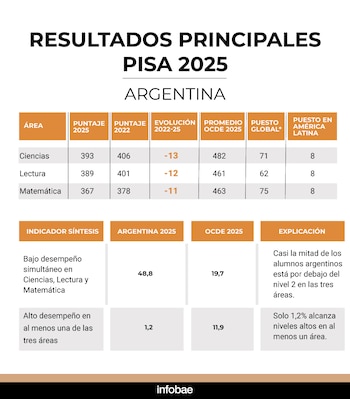
In the 2025 edition, the ninth since this international assessment was taken, Argentina obtained 393 points in Science, 389 in Reading and 367 in Mathematics. The three results were below those of PISA 2022 and you have to go back to 2006 to find lower figures in Science and Reading. In Mathematics, on the other hand, the country scored the worst score in its entire comparable historical series.
The drop was 13 points in Science (from 406 to 393), 12 points in Reading (from 401 to 389) and 11 points in Mathematics (from 378 to 367). In the ranking of the 91 participating education systems, Argentina was ranked 71st in Science, 62nd in Reading and 75th in Mathematics.
🔻 393 points in Science (-13 compared to 2022) — 71st place out of 91
🔻 389 points in Reading (-12 compared to 2022) — 62nd place out of 91
🔻 367 points in Mathematics (-11 compared to 2022) — 75th place out of 91, the worst in the historical series
Behind the general averages, an even more worrying picture appears when observing performance levels. In Mathematics, only 24% of Argentine students reached the basic level (level 2) or higher, compared to 65% of the OECD average; that is, three out of four adolescents fail to solve the minimum problems expected for their age. In Reading, 40% reached the basic level and in Science 41%, compared to 69% and 74% in the OECD respectively.
The most eloquent indicator combines the three subjects: 48.8% of Argentine 15-year-old students perform poorly in Science, Reading and Mathematics at the same time, almost triple the 19.7% observed in the OECD average. At the other extreme, only 1.2% of Argentine students achieve the highest levels of performance in any of the three areas, compared to 11.9% of the countries of the organization.
🌎 Argentina, eighth in the Latin American ranking
Compared to the rest of the region, Argentina remains in the bottom half of the table. Among the 13 Latin American countries that participated in PISA 2025, the country ranked eighth in the three subjects evaluated. Uruguay and Chile lead almost all the regional rankings, followed by Costa Rica, Colombia, Mexico, Brazil and Peru, which generally surpass Argentina.
|
Country |
Science |
Reading |
Mathematics |
|
Uruguay |
445 |
423 |
405 |
|
Chile |
442 |
436 |
403 |
|
Costa Rica |
424 |
416 |
387 |
|
Mexico |
414 |
408 |
388 |
|
Colombia |
414 |
399 |
381 |
|
Brazil |
409 |
408 |
377 |
|
Peru |
406 |
390 |
382 |
|
Argentina |
393 |
389 |
367 |
|
Ecuador |
393 |
s/d |
366 |
PISA 2025 scores by country in Latin America. Source: OECD / Argentines for Education.
Beyond the relative position, what worries specialists most is the speed of the setback: although most countries in the region stagnated or fell slightly between 2022 and 2025, Argentina is among those that worsened the most. In Mathematics, in fact, it registered the largest drop in the entire regional bloc, with 11 points less than in the previous edition. Only Costa Rica and El Salvador managed to avoid setbacks in the three areas evaluated.
🧮 Mathematics, the most critical area
Mathematics has been, for several editions, the weakest point of the Argentine education system, and in 2025 it deepened its deterioration. The proportion of students who reach at least the basic level has been falling steadily: it was 31% in 2018, fell to 27% in 2022 and now stands at 24%. At the highest levels of the scale (5 and 6) the Argentine presence is practically nil, while in the OECD it reaches 8% of students.
● 2018 → 31% of students reached the basic level
● 2022 → 27% reached the basic level
● 2025 → 24% reached the basic level (76% do not)
PISA 2025 also incorporated a computational problem-solving test, which measures the ability to use digital programming and modeling tools to solve new situations. Argentina obtained 403 points, well below the OECD average of 500, and was ninth among the 13 Latin American countries evaluated in this new competition.
📱 Cell phones, noise and digital distraction in the classroom
The complementary questionnaires that accompany the test allow us to reconstruct the climate inside the classroom, and there Argentina exhibits several indicators above the international average. 55% of students said that their classmates are distracted by cell phones or other devices during most science classes, compared to 28% in the OECD; and only 37% attend schools where the use of cell phones is prohibited throughout the establishment, compared to 49% in the countries of the organization.
The disorder inside the classroom is also more marked: 58% of Argentine students said that noise interrupts most or all of the science classes, almost double the 31% recorded in the OECD, and 47% said that their classmates do not listen to the teacher. Unpunctuality was added to the list of problems: 66% of adolescents were late to school at least once in the two weeks prior to the test, ten points higher than the international average.
In the midst of this panorama, a favorable fact appears: the assessment of teachers by the students themselves. 78% of Argentine students consider that their science teacher is interested in everyone's learning, 73% that they continue to explain until the course understands and 79% that they offer extra help when necessary; all three percentages exceed the OECD average.
🗣️ The voices of the education sector
"The results of PISA 2025 confirm a trend that we cannot ignore," said Víctor Volman, executive director of Argentinos por la Educación, who remarked that the recent improvement in some indicators of Learning is not enough if there is not a sustained strategy throughout the school career, with a special focus on Mathematics.
— Víctor Volman, executive director of Argentines for Education
From a regional perspective, specialists in educational evaluation point out that reading is today the area that is regressing the most globally, and that Latin America faces this trend from already low learning levels, which deepens the gap with the best-performing education systems.
🌐 A global phenomenon: the OECD also hits its historic low
Argentina's collapse does not occur in isolation. The OECD report points out that PISA 2025 recorded the lowest average scores since the beginning of assessment in Science, Reading and Mathematics, although the behavior was not the same in the three subjects: while Science remained relatively stable in most education systems, the fall in Reading and Mathematics continued and deepened.
East Asian education systems were once again at the top of the ranking. Chinese provinces grouped as B-S-J-Z (Beijing, Shanghai, Jiangsu and Zhejiang) and Singapore topped the combined results of the three subjects, followed by Estonia, Japan, South Korea, Macau, Taipei and the United Kingdom.
Among the factors that the OECD itself mentions to explain the global deterioration are the decrease in reading for pleasure, changes in the digital habits of adolescents, persistent problems with school attendance and less family interaction around school life. The organization insists that learning loss is a long-term process that cannot be explained only by school closures during the pandemic.
🔎 How the Study Was Done
PISA evaluates 15-year-old students in Science, Reading and Mathematics every three years, with a focus on the ability to apply knowledge to new situations and not on the mastery of specific curricular content. More than 760,000 students from 91 countries and economies participated in this edition, representing some 33 million adolescents worldwide. In Argentina, the sample included 11,093 students from 412 schools, representative of about 609,100 15-year-olds, and the test was administered in digital format, as in 2022.
📊 Historical evolution of Argentina's scores (2006–2025)
|
Subject matter |
2006 |
2009 |
2012 |
2018 |
2022 |
2025 |
|
Science |
391 |
401 |
406 |
404 |
406 |
393 |
|
Reading |
374 |
s/d |
s/d |
402 |
401 |
389 |
|
Mathematics |
s/d |
s/d |
s/d |
s/d |
378 |
367 |
n.d.: No representative data available in this comparison. Source: OECD / Argentines for Education, report "How did Argentina fare in PISA 2025?".
📰 Sources consulted
🔗 La Nación — PISA 2025 tests: Argentina falls again in all subjects
🔗 Infobae — Argentina fell in reading, math and science: worst results since 2006
🔗 Minute One — Argentina obtained the worst result in 20 years
🔗 360 More News — Argentina fell again in all subjects
🔗 RosarioMix — The worst data since 2006
🔗 Mi Periódico — Argentina falls in all areas
🖼️ Reference images (absolute links)
As they are copyrighted material of each medium, the photographs are not embedded in this document; their source links are listed for consultation or licensing.
🔗 Student taking an exam in a classroom (Infobae)

🔗 Infographic: Argentina fell in the three areas evaluated (Infobae)
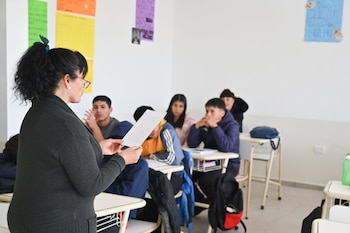
🔗 Public high school (Infobae)
{ "@context": "https://schema.org", "@type": "NewsArticle", "headline": "PISA 2025: Argentina cae en todas las materias", "datePublished": "2026-09-08", "articleSection": "Educación", "keywords": "PISA 2025, Argentina, OCDE, educación" }
POLITICAL AND ECONOMIC ANALYSIS · ARGENTINA
Milei's 1,000 days: the complete balance of a management that changed Argentina
A stabilized economy by dint of adjustment, reforms halfway through, open court cases, a geopolitical turn towards Washington and a relentless war with the unions: this is how the libertarian government reaches a symbolic milestone in its mandate.
|
✍️ Newsroom | 📅 September 6, 2026 |
⏱️ Estimated reading time: 11 minutes |
Javier Milei celebrated 1,000 days at the helm of the Casa Rosada this month, a symbolic milestone that led the country's main media and analysts to review in depth the effects of his administration. He came to power on December 10, 2023, promising a fiscal chainsaw and a "cultural battle" against the political caste; today, a little more than a year after seeking re-election in the 2027 legislative elections, he exhibits a more orderly but still convalescent economy, a Congress that approved structural reforms, although with concrete limits, a Justice that investigates his inner circle and a relationship with trade unionism that knows no truces.
The ruling party itself recognizes that the next stage will be decisive: in the Ministry of Finance they are betting on closing 2027 with monthly inflation close to zero, while the opposition and a large part of the union arc insist that the adjustment left social wounds still open. This report reconstructs, with official and private data, the five fronts that define the balance of these first thousand days: the macroeconomy, legislative reforms, judicial files, geopolitical rearrangement and the pulse with the unions.
Poverty: the data that divides waters
Poverty had an erratic behavior. It reached a peak of 52.9% in the first half of 2024 – the impact of the initial adjustment – and then fell to 28.2% in the second half of 2025, the lowest record since 2018. Indigence, meanwhile, went from 11.9% in the second half of 2023 to 6.3% in the same period of 2025. However, the official methodology for measuring poverty is the subject of questions from specialists
The unemployment rate climbed from 5.7% in the fourth quarter of 2023 to 7.8% in the first quarter of 2026. More than 30,000 companies closed in the last two and a half years, according to union and opposition sources. The minimum wage has lost 40.5% of its purchasing power since November 2023, according to the Interdisciplinary Institute of Political Economy of the UBA.
💰 1. The economy: the adjustment that changed the social thermometer
The economic result most cited by the government itself is the slowdown in inflation. Milei received an economy that was dragging an inertia of more than 200% annually and started his administration with a devaluation that shot up the price index to 25.5% per month in December 2023. According to the latest official data, corresponding to July 2026, the monthly increase stood at 2.1% and the year-on-year at 33.8%, while different private consultants project that August will have closed between 1.4% and 2%.
📌 Key fact
|
Indicator |
Dec 2023 |
Sept. 2026 |
|
Monthly inflation |
25,5 % |
≈ 2.1% |
|
Year-on-year inflation |
211,4 % |
33,8 % |
|
Country risk (EMBI) |
1,923 bp |
≈ 491 bp |
|
Official dollar (sale) |
≈ $820* |
≈ $1,529 |
|
Poverty |
41,7 % |
28,2 % |
|
Homelessness |
11,9 % |
6,3 % |
*Value of the official dollar immediately after the December 2023 devaluation. Sources: BCRA, INDEC, JP Morgan (EMBI+).
Country risk, which measures the markets' distrust of the Argentine State's ability to pay, plummeted from 1,923 basis points at the start of the administration to a range close to 491 points by the beginning of September 2026. At the same time, the government is holding a fiscal surplus unprecedented in more than a decade and a record of agro-industrial exports, while poverty fell from 41.7% to 28.2% of the population and indigence fell from 11.9% to 6.3%, according to the latest half-yearly measurement available from INDEC.
The exchange rate itself illustrates the reorganization: the official exchange rate went from $390 at the end of Alberto Fernández's government to $820 after the devaluation jump of December 2023, and today it stands at around $1,529. The Executive itself admits that the pending discussion is no longer whether there was stabilization, but how to transform it into sustained growth in wages, credit and activity.
📜 2. Reforms and Congress: what was approved and what fell by the wayside
In two years and nine months, Congress sanctioned 68 laws under the current administration, most of them promoted by the ruling party itself, although the pace was decreasing: 44 in 2024, 17 in 2025 and a significantly lower number so far in 2026. The Government maintains in force the mega DNU 70/2023, achieved a limited version of the Bases Law and advanced with a labor reform designed in agreement with business sectors and related unions.
✅ What he achieved
▸ Sustained validity of DNU 70/2023, the regulatory pillar of economic deregulation.
▸ Approval of a reduced version of the Bases Law, with delegated powers and benefits for large investments (RIGI).
▸ A limited labor reform, negotiated with unions and businessmen aligned with the ruling party.
▸ Specific agreements with Peronist governors and allies of the PRO and the Radicalism, supported by the distribution of funds.
❌ What he did not achieve
▸ The electoral reform, which did not gather the necessary votes in the chamber.
▸ The filling of the two vacancies in the Supreme Court: the lists of Ariel Lijo and Manuel García-Mansilla did not prosper.
▸ Prevent the parliamentary ratification of the university and emergency financing laws of the Garrahan Hospital, after the massive federal march of April 2024, items that the Executive chose not to execute.
⚖️ 3. The judicial front: Libra, Andis and an incomplete Supreme Court
The file that most eroded the presidential image is that of the crypto asset $LIBRA: in February 2025 Milei promoted a token in his X account that collapsed hours later and caused millions of dollars in losses to investors. Federal prosecutor Eduardo Taiano formally charged him with alleged abuse of authority, influence peddling, fraud and bribery, and ordered an expert examination of the phones of the President and his sister Karina. An investigative commission in the Chamber of Deputies described the episode as a planned operation and not an improvised event.
"The launch and promotion of $Libra was not improvised or accidental on the part of the president."
— Maximiliano Ferraro, deputy and former president of the investigative commission
In parallel, the scandal of the National Agency for Disability (Andis) – unleashed by leaked audios of former head Diego Spagnuolo, a friend and former personal lawyer of the President – investigates an alleged network of overpricing in the purchase of medicines, with Justice and Congress also pointing to Karina Milei. To this picture was added, between March and June 2026, the Manuel Adorni property scandal, pointed out by much of the press as the most damaging to the presidential image so far in the term.
At the institutional level, the Ministry of Justice – in charge of Juan Bautista Mahiques since 2026 – accelerated the appointment of 180 judges, prosecutors and defenders, reducing a large part of the subrogations in the federal courts of Comodoro Py. However, the government failed to fill the two vacancies on the Supreme Court, which continues to function with only three of the five members required by law, nor did it appoint an attorney general, a position that Eduardo Casal has held on an interim basis for almost a decade.
🌎 4. Geopolitics: alignment with Trump and the Falklands charter
Libertarian foreign policy was defined by an unconditional alignment with the United States, first with Joe Biden and then, more intensely, with Donald Trump. That link was decisive in September 2025, when the electoral defeat in the province of Buenos Aires led to a run on the exchange rate that was only contained after a financial assistance package from Washington, implemented through currency exchange mechanisms (swap). U.S. support was combined with defense gestures, such as the purchase of F-16 fighter jets, and with investment promotion missions such as the so-called "Argentina Week" in New York.
The episode with the greatest impact came in the first days of September 2026, when Trump admitted that his administration was reviewing the historic US position on the sovereignty of the Falkland Islands, traditionally aligned with the United Kingdom since the 1982 war. The news generated an immediate national broadcast of Milei, although diplomats consulted by the Argentine press warn that Trump's gesture would respond more to a dispute with British Prime Minister Keir Starmer on other geopolitical fronts – such as the Strait of Hormuz and NATO – than to a genuine turn in favor of the Argentine claim.
"Yesterday something very strong happened regarding the most important and sacred cause that we Argentines have"
— Javier Milei, in radio statements
Different analysts remark that the government seeks to capitalize electorally on this enthusiasm for 2027, presenting Argentina as a strategic actor in the South Atlantic and Antarctica in the framework of the global competition between power blocs.
🤝⚡ 5. Trade unions: the most belligerent relationship of the libertarian era
Few relations were as hostile as the one Milei built with the organized labor movement. CGT leaders maintain that, for the first time in democracy, a president decided to cut off all channels of formal dialogue with the CGT, which the government itself publicly describes as part of "the caste" to be overthrown in its cultural battle. That confrontation led to successive general strikes from the first months of the administration and a permanent legal dispute over the labor reform implemented by decree, questioned by different courts.
The tension deepened in 2026 with the official attempt to advance in a revision of the collective bargaining agreements, which also exposed an internal fracture within the CGT itself: a sector of more combative unions – including UTHGRA, the UTA, La Fraternidad, the UOM and ATE, grouped in the United Trade Union Front – is pushing for a 36-hour national strike and accuses the CGT leadership of excessive moderation. At the same time, another union sector, led by Luis Barrionuevo and allies of Carlos Acuña, maintained channels of dialogue with the ruling party from the very beginning of the administration, in what was informally known as Milei's "union leg".
🏛️ 6. The internal chessboard: Karina Milei and the allies who fell by the wayside
Inside the Casa Rosada, the map of power has also changed substantially in these thousand days. Karina Milei, secretary general of the Presidency and sister of the president, consolidated practically absolute control over the assembly of electoral lists, imposing herself on advisor Santiago Caputo after the 2025 legislative elections. In that same period, the relationship with Vice President Victoria Villarruel deteriorated sharply and the electoral partnership with former President Mauricio Macri was extinguished, two alliances that had been central to the start of the mandate.
🔮 7. What's next: what's at stake for Milei until 2027
With 415 days to go until the general elections of October 24, 2027, a good part of the official movements are already explained in electoral terms. The economic team led by Luis Caputo – who also completes 1,000 consecutive days at the helm of the Ministry of Finance – aims to reach the decisive stretch of 2027 with monthly inflation close to zero and tangible signs of improvement in activity, credit and income, without giving up the fiscal anchor that constitutes the heart of the libertarian program.
The ruling party itself admits that the discussion on the economic course is already settled in its favor in a large part of public opinion, but recognizes that the pending equation – how to transform the macroeconomic order into growth with social improvement – will be the one that finally determines whether these first 1,000 days were the foundation of a lasting transformation or just the first half of an unfinished process.
📚 SOURCES AND LINKS CONSULTED
🔗 Central de Noticias Madariaga — Javier Milei celebrates 1,000 days as president
🔗 Cholila Online — Milei's 1,000 Days: Between Reforms, Internal Disputes and Challenges
🔗 El Economista — Falkland Islands: Trump-UK Fight Opens Window for Argentina
🔗 Profile — Libra and Andis, Karina Milei's double judicial nightmare
🔗 El Economista — Libra Case escalates: opposition deputies denounce a "planned operation" by Milei
🔗 iProfesional — Javier Milei was charged for the $LIBRA scandal: how the case continues
🔗 iProfesional — Milei promotes a "total war" against the CGT
Note: for copyright reasons, this document does not reproduce photographs of agencies or media. Editorial images can be consulted by following the links to the sources cited above.
|
🇦🇷 🛢️ ⚓ MIDIRE.AR POLITICAL AND GEOPOLITICAL ANALYSIS Sanctions on the oil companies of Malvinas and the Integrated Naval Base: what Milei announced and what the national network scene left in the background A decree to accelerate sanctions in force since 2011, a DNU to finance the Ushuaia Integrated Naval Base and the shadow of the U.S. Southern Command over the South Atlantic 📅 September 4, 2026 ⏱️ Estimated reading time: 13 minutes ✍️ Editorial midire.ar |
Sovereignty and Strategy: Milei's Announcement Revealing the Commitment to an "Integrated" Naval Base with the U.S.
The Argentine president toughens sanctions on oil companies over the Sea Lion project in a speech that, behind the scenes, consolidates a long-standing desire of Washington: a strategic base in the South Atlantic.
On the night of September 3, President Javier Milei led a message on national television of about 15 minutes, surrounded by his entire cabinet, the head of the Chamber of Deputies, Martín Menem, and the Minister of Security, Patricia Bullrich. In this context, he announced three simultaneous measures: a decree to accelerate sanctions against oil companies operating in the Malvinas Islands without Argentine authorization, a Decree of Necessity and Urgency (DNU) to expand the funds of the Ministry of Defense destined to build an "integrated naval base" in Tierra del Fuego, and the sending to Congress of a draft "Law for the Defense of National Sovereignty" that creates a National Security Council.

President Javier Milei led the announcement accompanied by his entire cabinet.
The announcement combined, in the same discursive package, a legal tool that has existed for more than a decade with an infrastructure and financing decision that does represent a concrete novelty. That combination is what ran through the political reactions of the next day: while the ruling party presented it as an unprecedented hardening against the United Kingdom, a good part of the opposition and specialists in the Malvinas issue pointed out that the sanctions invoked were already in force, and that the real turning point is the Integrated Naval Base of Ushuaia and its link with the United States.
🎙️ The announcement on national television: what Milei said
In his message, Milei maintained that the United Kingdom is in a position to extract oil from the subsoil of the Argentine Sea and affirmed that his government will not allow it. He also questioned the right of self-determination of the islanders and reaffirmed Argentina's historical claim to the archipelago.
|
❝ The Malvinas are Argentine by history and by right — Javier Milei, on national television |
The president announced that that same night he would sign a decree to "provide greater speed" to the sanctioning procedures imposed by Law 26,659 against those who participate in oil extraction initiatives in territory under British occupation. He specified that the focus is on the Sea Lion project, located in front of the Falklands and operated by the Israeli Navitas Petroleum and the British Rockhopper Exploration, which according to the Government plan to start offshore exploitation in the coming months on certified reserves of more than 1,300 million barrels.
According to the President himself, the Argentine Foreign Ministry had already sent about 180 notes of discouragement to companies and more than 29 countries linked to projects on the islands. The new sanctions aim to disqualify companies from operating in the Argentine mainland – and also their shareholders, directors, suppliers and financial advisors – that participate directly or indirectly in the unauthorized exploitation, and to expose them to lawsuits in absentia.
The three measures announced
|
Measurement |
Instrument |
Core content |
|
Sanctions on oil companies |
Presidential decree |
Accelerates Law 26,659 proceedings against Sea Lion, its shareholders, directors and suppliers |
|
Integrated Naval Base |
DNU |
Expands Defense resources to build base in Tierra del Fuego and add telecommunications capabilities |
|
Law for the Defense of National Sovereignty |
Bill to Congress |
Toughens Law 26,659 and creates a National Security Council (Foreign Ministry, Defense, Intelligence, Economy) |
⚖️ Sanctions: what's new and what already existed
The fact that was most repeated by the technical and political questions to the announcement is that Law 26,659 is not a new law. It was unanimously sanctioned in 2011, promoted in the legislative debate by the filmmaker and then legislator Fernando "Pino" Solanas, and already contemplates disqualifications of up to 20 years and prison sentences of up to 15 years for those who explore or exploit hydrocarbons without Argentine authorization on the continental shelf, including the Malvinas. The law reaches not only extractive companies, but also shareholders, logistics service providers and technical or financial advisors.
The Argentine State itself had already applied that law in 2022, when it disqualified Navitas Petroleum for 20 years from operating in the country. Specialists and opposition leaders – including former Foreign Minister Jorge Taiana – remarked that exploration and exploitation activities in the Malvinas already had sanctions provided for in laws 26,659 and 26,915, and that the novelty of Milei's announcement consists of speeding up administrative procedures and expanding the universe of subjects reached, not in creating a non-existent tool.
The questioning of the timing also appeared strongly. The Buenos Aires Minister of Government, Carlos "Carli" Bianco, pointed out that 267 days have passed since Navitas and Rockhopper communicated, on December 10, 2025, their final decision to invest in Sea Lion, without the national government taking effective measures despite already having Law 26,659 as an available tool.
🏗️ The Naval Base as a Strategic "Cover-up"
However, the harshness of the discourse against the oil companies seems to be the smokescreen for a maneuver of greater significance: the consolidation of a U.S. military enclave in southern Argentina.
The announcement of the base comes just months after President Milei received the then head of the U.S. Southern Command, General Laura Richardson, in Ushuaia. That meeting, which Fuegian Governor Gustavo Melella refused to attend, had already sown suspicion about the true destination of the work. On that occasion, Milei defined the base as a "development port closer to Antarctica" to provide logistical support to cruise ships and scientific ships, but subsequent movements indicate a military purpose.
"Integration" with the U.S.
The adjective "integrated" in the name of the base is no coincidence. Opposition sources and legislators warn that Milei's government is negotiating the active participation of the United States in the infrastructure, something that the president himself denied, although his actions indicate otherwise.
- Physical Presence: Richardson's visit in 2024 was the first public step. U.S. civilian and military delegations traveled to Tierra del Fuego.
- Geopolitical Discourse: Milei linked the construction of the base with his new foreign policy doctrine, aligned with the West and with President Donald Trump, who hinted that he will reevaluate the U.S. position on the Malvinas.
- Warnings from the Opposition: Former Defense Minister Agustín Rossi recalled that Milei has already offered the U.S. to participate in the work on two occasions, while Deputy Aldo Leiva warned that "Malvinas cannot be a bargaining chip between Donald Trump and the United Kingdom." Mercosur parliamentarian Alejandro Deanes was more blunt: "Tierra del Fuego cannot be a bargaining chip."
The image of the sharp drop in the shares of the oil companies (Navitas and Rockhopper) contrasts with the discreet but accelerated planning of a base that, for critics, represents an unprecedented cession of sovereignty, hidden under nationalist rhetoric.
🚢 The Integrated Naval Base: the real strategic leap

The Ushuaia Naval Base, in the southernmost tip of Tierra del Fuego, is the project that the government seeks to accelerate.
Unlike the sanctions, the Integrated Naval Base does represent an element with concrete and recent development. The project was not born with the current management: its antecedents date back to a study financed in 2011 with support from the Inter-American Development Bank (IDB) and an initiative presented in the Chamber of Deputies in 2016, which defined Ushuaia as a logistics platform for maritime control of the South Atlantic and support for Antarctic operations.
Effective construction began in 2022, during the administration of Alberto Fernández, with Jorge Taiana at the head of the Ministry of Defense; that year, budget funds were allocated for the dock and equipment, and the foundation stone was laid. With Milei's inauguration at the end of 2023, the budget adjustment ordered by the new government paralyzed a large part of these works.
In 2024, however, Milei traveled to Ushuaia with the then head of the U.S. Southern Command, General Laura Richardson, and presented the base as part of bilateral strategic cooperation, although at that time there were no concrete definitions on U.S. financing. In 2025 it was the turn of Richardson's successor at the head of that force, Admiral Alvin Holsey, who also visited the Ushuaia facilities. During 2026, the government sought to advance a technical and financial agreement with Washington, without there being, until the September 3 announcement, a formally closed financing.
Antarctica, interoceanic routes and the Chinese chessboard
The geographical relevance of Ushuaia – some 1,000 kilometers from the Antarctic Peninsula and on the Drake Passage and the Strait of Magellan – explains why the project arouses interest beyond the dispute over the Malvinas. For Washington, Argentina's extreme south has strategic value due to its projection towards Antarctica, interoceanic maritime routes and as a possible counterweight to the Chinese presence in the region, in particular to the space station installed in Neuquén, which U.S. defense agencies have been monitoring for years.
In this context, the government's decision to rule out the development of port infrastructure in Río Grande with the eventual participation of Chinese capital is also inscribed, a possibility that had generated concern in the United States due to the location of Tierra del Fuego in front of the South Atlantic and its projection towards the white continent. Milei's foreign policy maintained, from the beginning of his administration, a priority alignment with Washington and the rejection of Chinese presence in infrastructure considered sensitive.
🇺🇸 Washington's footprint and the crossed versions

Platforms such as the Sea Lion project are the focus of the new sanctions announced by the government.
The presidential announcement itself acknowledged that the DNU seeks to "expand" Defense resources "with the priority purpose" of building the base and increasing the country's telecommunications capabilities, and that the facility will turn Tierra del Fuego into the "most important logistics hub in the South Atlantic." Some media that covered the announcement directly linked the work to U.S. financing, while others remarked that it is an expansion of national funds without there being, so far, a formalized international agreement.
The Ministry of Defense had previously informed Congress that there is no agreement with the United States to build a joint base, that Washington did not provide materials or funds and that there are no plans to cede land or buildings; according to that official response, the project is of "execution and exclusive control of the Argentine State." In the same vein, Foreign Minister Pablo Quirno assured in radio statements that the future facility "will be a completely Argentine base," although he acknowledged that the country today has fiscal space to face the investment without altering the balance of public accounts.
Faced with these official definitions, sectors of the opposition maintain a different reading: they accuse Milei of having offered to share the future base of Ushuaia with the administration of Donald Trump, within the framework of what they consider a broader strategic alignment with the United States and Israel, the two countries that the President himself identifies as his main foreign policy allies. The presidential spokesman himself, Manuel Adorni, had defined the project at the time as a joint initiative framed in the integration of Argentina into the "Western and developed world," although he clarified on that same occasion that there were no concrete definitions on the financial contribution of the United States.
The contrast between the two versions – a "completely Argentine" base according to the government, and a project with a US imprint according to part of the opposition – is, strictly speaking, the core of the public discussion that opened up after the September 3 message, beyond the chapter on oil sanctions.
🗳️ Political reactions: official support and crossed criticism
Within La Libertad Avanza, Minister Patricia Bullrich celebrated the announcements as a defense of sovereignty "with facts." Malvinas veterans also supported the measures and asked to participate in the legislative debate on the reform of Law 26,659.
From the opposition, the criticism was concentrated on two axes. The first, legal: Jorge Taiana and other leaders stressed that the sanctions were already provided for in the legislation in force for more than a decade and that a good part of the announced package does not innovate on that point. The second, historic: Taiana himself recalled that the construction of the Ushuaia Integrated Naval Base began in 2022 during his tenure as head of Defense, with a different objective than the one Milei is now proposing, and that it was the current administration that stopped these works when he took office.
|
❝ It took 267 days for Thatcher's fan to comply with the law — Carlos "Carli" Bianco, Buenos Aires Minister of Government |
Former Foreign Minister Santiago Cafiero said that Milei "had to back down" and resume the diplomatic work of previous administrations. Deputy Victoria Tolosa Paz ironically questioned the discursive turn of the President, who knew how to publicly vindicate Margaret Thatcher, and accused him of opportunism. Other opposition leaders were harsher: they spoke of an attempt to "galtierize" the presidential figure – in reference to the last president of the military dictatorship, who declared war on the United Kingdom over the islands in 1982 – and warned about the risks of using the Malvinas cause to create a National Security Council in terms of military cooperation with Washington.
A discursive turn with respect to history itself
The use of the State's regulatory and sanctioning apparatus to restrict the activity of private companies contrasts with the discourse of deregulation and reduction of the State that characterized the Government since December 2023, a point that different journalistic analyses pointed out as one of the most visible paradoxes of the announcement: one of the main tools recovered by the Executive – Law 26,659 – was sanctioned during a political stage that Milei turned into one of his main discursive adversaries.
🌍 International context: Malvinas, Sea Lion and regional neighbors

The Falkland Islands, at the center of the sovereignty dispute reactivated by the presidential announcement.
The Argentine announcement generated a response from the United Kingdom, which maintains its historical position on the administration of the archipelago and the right to self-determination of its inhabitants, a principle that Milei directly questioned in his speech. The Sea Lion project, at the center of the new sanctions, is pointed out by the Argentine government as the initiative that motivated the acceleration of the package of measures, given the imminence that its operators will move forward with offshore exploitation.
In Chile, the Ministry of Defense has been following the Ushuaia project with public attention since the beginning of 2026, as part of parliamentary consultations on a possible U.S. participation in port infrastructure at the southern tip of the continent, both in the Pacific and the Atlantic. The Chilean authorities have so far ruled out that the project generates a formal alarm, although they acknowledged that the issue is closely monitored due to its relationship with access to Antarctica and with the revision of the Antarctic Treaty scheduled for 2048.
🔍 Analysis: Two ads in one, with very different weights
Read as a whole, the message of September 3 combined an announcement of high communicational impact – "new" sanctions on companies operating in the Malvinas – with a substantive decision that had remained relatively in the background of information until then: the reactivation, with expanded funds, of a military infrastructure project that had been stopped since the beginning of Milei's administration and that today advances in parallel to an increasingly close rapprochement with the United States Southern Command.
This asymmetry is precisely what fueled the critical readings: if the sanctions invoked had already been in force since 2011 and the State had already applied them in 2022, much of the "new" news load of the announcement falls on the Integrated Naval Base and the DNU that expands its funds, a chapter with more far-reaching geopolitical implications – link with Washington, position vis-à-vis China, Antarctic projection – than the oil sanctions alone. The government, for its part, insists that it is an exclusively Argentine project and denies the existence of a formal agreement with the United States.
Neither of the two readings is incompatible with the verifiable facts as of the closing of this note: it is true that Law 26,659 pre-exists the announcement, it is true that the Ushuaia work was stopped by Milei's own government between 2023 and 2024, and it is also true that, according to the official information available, there is no closed international agreement that turns the base into a binational project. What the episode leaves in question – and what is expected to mark the legislative discussion to come, both of the reform of Law 26,659 and of the draft Law for the Defense of National Sovereignty – is to what extent the reactivation of the Integrated Naval Base, within the framework of a strategic realignment with the United States, ends up weighing more heavily in the long term than the sanctioning chapter that made the headlines of the day.
🧭 Future Implications
Milei's government presented a draft Law for the Defense of National Sovereignty that includes the creation of a National Security Council. This seeks to articulate Defense, Economy and Intelligence to protect "critical infrastructure." However, ambiguity persists: Will Argentina protect its sovereignty or will it be the shield for a foreign presence?
While the United Kingdom reiterates its "unwavering commitment" to the islanders, Milei's strategy seems to bet that Washington's favor, in exchange for a strategic military base, will deter London in the energy dispute. Sea Lion, which plans to extract oil 220 km from the islands, has become the trigger, but the naval base in Tierra del Fuego is the real long-term bet.
🔍 Conclusion
Milei's announcement is a classic example of modern geopolitics: a discourse of hard sovereignty against foreign interests (British and Israeli oil companies) that hides a tactical move of strategic alignment with the United States. The Ushuaia naval base, a stalled and forgotten project, is now reemerging as the center of a new bilateral relationship that could redefine the balance of power in the South Atlantic. On the chessboard, sanctions are the piece that moves in plain sight, but the basis is the move that really defines the game.
❓ Frequently Asked Questions
▸ What did Javier Milei announce about the Malvinas oil companies?
A decree to accelerate the sanctions of Law 26,659 against companies that exploit hydrocarbons in the Malvinas Islands without Argentine authorization, with a focus on the Sea Lion project, operated by Navitas Petroleum and Rockhopper Exploration.
▸ Is Law 26,659 a new law?
No. It was unanimously sanctioned in 2011 and already provided for disqualifications of up to 20 years and sentences of up to 15 years in prison. The Argentine State had already applied it in 2022 against Navitas Petroleum.
▸ What is the Ushuaia Integrated Naval Base?
A military infrastructure and logistics project in Tierra del Fuego, with antecedents since 2011 and works started in 2022, designed as a control platform for the South Atlantic and support for Antarctic operations.
▸ Does the United States finance the Integrated Naval Base?
According to the Argentine Ministry of Defense, there is no formal agreement with the United States for a joint base or contributions of U.S. materials or funds. The project is advancing in parallel with visits by Southern Command chiefs and a diplomatic rapprochement with Washington.
▸ Why did the opposition question the announcement?
Because he considers that the sanctions had already been in place for more than a decade and that it was Milei's own government that paralyzed the construction of the naval base when he took office in 2023.
▸ What other measures did Milei announce along with the sanctions?
A DNU to expand Defense funds for the naval base and telecommunications, and a bill that creates a National Security Council made up of the Ministry of Foreign Affairs, Defense, Intelligence and Economy.
🔍 Sources and References
- El Nacional, "Milei announces sanctions on oil companies in the Malvinas/Falklands and the construction of a naval base in Tierra del Fuego", 2026.
- La Nación, "The integrated naval base in Ushuaia, a very expensive work that stalled during the last few years," 2026.
- La Nación, "Quirno assured that companies that participate in operations in Malvinas will not be able to do so in Vaca Muerta", 2026 .
- BBC News Mundo, "Milei announces sanctions on oil companies in the Malvinas/Falklands and the construction of a naval base in Tierra del Fuego", 2026 .
- El Destape, "Malvinas: criticism and distrust of the opposition in the face of Milei's drastic turn", 2026 .
- Infobae, "What Milei said about the construction of a naval base in Tierra del Fuego", 2026.
- Forbes Argentina, "Milei Effect: Oil Companies' Shares Fall Behind Sea Lion," 2026.
- La Gaceta, "Malvinas Cause: Milei announced the creation of a naval base in Tierra del Fuego and sanctions on oil companies", 2026.
- Diario Popular, "A Mercosur parliamentarian warned that 'Tierra del Fuego cannot be a bargaining chip'", 2026.
- El Destape, "Milei confirmed the construction of the integrated naval base promoted by the U.S.", 2026.
Note prepared with information from journalistic and official sources available until September 4, 2026. The status of financing and the eventual international agreement for the Integrated Naval Base may be modified in the coming weeks as the Government formalizes the DNU and Congress debates the reform of Law 26,659.

🧩
|
🏛️ UNIVERSITY CONFLICT The joint meeting failed: University teachers' unions go on national strike The Government offered 3% and the unions rejected it; Human Capital Ordered Not to Stop midire.ar · News and analysis · September 2, 2026 |
TENSION IN PUBLIC UNIVERSITIES
University conflict: the parity failed and the teachers' unions go on national strike
The national government offered a 3% recomposition for September; the unions described it as "unacceptable" and called for a 24-hour strike. Human Capital warned the unions not to affect the teaching of classes.
📅 September 2, 2026 🕒 Reading Time: 6 minutes 📰 Section: Education/Politics
🏛️ A new chapter in the university conflict
The joint meeting between the national government and the teaching and non-teaching unions of public universities ended on Tuesday, September 1, without an agreement. The meeting, convened by the Ministry of Human Capital within the framework of the salary negotiation provided for by the University Financing Law, failed to unblock the salary dispute that has been going through the university system for months.
After the failure of the dialogue, the main union federations – Conadu, Conadu Histórica and Fedun, among others – resolved a 24-hour strike with a national scope for this Wednesday, September 2. In different provinces, grassroots unions such as Adicus and SiDUNSJ (San Juan) adhered to the call.
🖼️ See image: Faculty of Law, University of Buenos Aires (UBA)
.jpg)
Fuente: Wikimedia Commons
💰 The official offer and the union's rejection
According to the union representatives, the Executive Branch presented at the negotiating table a proposal for a 3% increase for September salaries, to which was added another 3% already committed in June for the month of October. The portfolio led by Sandra Pettovello maintained that, in this way, the consolidated offer reaches 6% bimonthly for the teaching staff of national universities.
The unions, however, stressed that the October tranche had already been agreed in a previous parity agreement, so they consider that the only effectively new improvement is the 3% of September. For the federations, that figure is far from compensating for the accumulated salary loss.
|
❝ The parity has remained inconclusive. The formal offer by the national government was for a 3% increase in the salaries of university teachers. — Emiliano Cagnasi, Secretary General of ADUBA and representative of Fedun |
The Association of Teachers of the UBA (ADUBA) described the official proposal as "unacceptable" and described the meeting as a "monologue" on the part of the authorities. Clara Chevalier, general secretary of Conadu, pointed out that the unions brought their entire parity agenda to the table, while the government limited itself to repeating the 3 percent offer.
The wage gap under discussion
|
Concept |
Reclamo gremial |
Official offer |
|
Salary recomposition |
31.2% due as of July |
3% for September |
|
Legal framework invoked |
University Financing Law (27.795) |
Budget availability |
|
Cumulative increase cited |
Loss of more than 30% |
6% bimestral (Sept.–Oct.) |
|
Next instance |
Continuity of the plan of struggle |
Meeting called for 9/17 |
⚖️ The judicial background: the University Financing Law
The salary conflict is crossed by a long judicial litigation. Federal Judge Martín Cormick had granted a precautionary measure that orders the Executive Branch to comply "immediately" with articles 5 and 6 of Law 27,795, on the Financing of University Education and Recomposition of Teacher Salaries, which establish the updating of teaching and non-teaching salaries and student scholarships with reference to inflation from December 2023.
On June 25, 2026, the Supreme Court of Justice of the Nation – signed by Horacio Rosatti, Carlos Rosenkrantz and Ricardo Lorenzetti – unanimously rejected the extraordinary appeal of the national State and left that precautionary measure firm, although the resolution did not generate an immediate salary impact on itself because the substantive case is still pending. According to the unions, the Government has accumulated more than two months of non-compliance with that ruling.
Oscar Vallejos, assistant secretary of CONADU Histórica and secretary of Training of the CTA, said that the Executive convenes the paritarias "for the sole purpose of gaining time in Justice," in reference to the three-day period that Judge Cormick gave the Government to report on compliance with the law.
📢 The Government's injunction to the unions
Faced with the confirmation of the strike, the Ministry of Human Capital came out to urge the union organizations to desist from the measure and urged not to alter the normal teaching of classes in national universities. Despite the official claim, the unions ratified their decision to strike this Wednesday, despite the injunction of the national portfolio.
|
❝ The Government creates this joint body for the sole purpose of gaining time in Justice. — Oscar Vallejos, Assistant Secretary of CONADU Histórica |
The official statement itself confirmed, however, that there will be a new instance of dialogue: the Undersecretary of University Policies called for the resumption of negotiations on Thursday, September 17, with the aim of giving continuity to the parity process. The unions have not yet confirmed whether they will attend that meeting.
🗓️ What will happen on Wednesday
● 24-hour national strike in public universities throughout the country, with the adhesion of Conadu, Conadu Histórica, Fedun and provincial grassroots unions.
● On Thursday, September 3, the plenary session of the National Interuniversity Council (CIN) will be held, where the authorities of the universities will define the next steps.
● Human Capital maintains the call to resume the parity negotiation on September 17.
● The unions warn that, if there is no progress, the plan of struggle could be deepened with new measures of force.
🔮 Next steps and prospects
The university conflict adds to a broader scenario of tension between the national government and different union sectors over the wage bid in the face of inflation. The combination of a firm court ruling that demands the updating of salaries and scholarships, an official offer that the unions consider insufficient, and a plan of struggle that already includes a new strike, anticipates that the negotiation in mid-September will be decisive for the course of the conflict.
Meanwhile, uncertainty about the teaching of classes and the demand for compliance with the University Financing Law will continue to mark the agenda of Argentine public universities in the coming weeks.
🖼️ See image: Casa Rosada, seat of the national Executive Branch

Fuente: Wikimedia Commons
❓ Frequently Asked Questions
❓ Why did the university parity fail?
Because the government offered a 3% increase for September (plus another 3% already agreed for October) and the unions considered it insufficient in the face of a demand for recomposition close to 31.2%.
❓ When is the university teaching strike?
The 24-hour national strike was called for Wednesday, September 2, 2026 in public universities throughout the country.
❓ What did the Government ask of the unions?
The Ministry of Human Capital ordered the unions to desist from the strike and not to affect the normal teaching of classes, although the unions ratified the strike.
❓ What does the University Financing Law establish?
Law 27,795 provides for the updating of teaching and non-teaching salaries and student scholarships with reference to inflation from December 2023; a judicial precautionary measure, ratified by the Supreme Court on June 25, 2026, requires immediate compliance.
❓ Will there be a new joint meeting?
Yes, the Government called for the resumption of negotiations on Thursday, September 17, 2026.
University teachers' strike 2026: the parity failed
The university teaching parity failed: the government offered 3% and the unions called a national strike for 9/2. Human Capital warned not to stop.
/university-conflict-paritary-failure-national-strike-teachers
{"@context":"https://schema.org","@type":"NewsArticle","headline":"University conflict: parity failed and teachers' unions go on national strike","datePublished":"2026-09-02T08:00:00-03:00","dateModified":"2026-09-02T08:00:00-03:00","author":{"@type":"Organization","name":"midire.ar"},"publisher":{"@type":"Organization","name":"midire.ar"},"articleSection":"Education","keywords":"university teaching strike, paritaria, University Financing Law","inLanguage":"en-AR"}
{"@context":"https://schema.org","@type":"FAQPage","mainEntity":[{"@type":"Question","name":"Why did the university parity fail?","acceptedAnswer":{"@type":"Answer","text":"The Government offered 3% for September and the unions demand a recomposition close to 31.2%."}},{"@type":"Question","name":"When is the university teachers' strike?","acceptedAnswer":{"@type":"Answer","text":"Wednesday, September 2, 2026, 24-hour national strike."}}]}
✈️ Airport strike in Argentina: ATE announced 48 hours of measures and warns of delays and cancellations
The protest of ANAC workers is scheduled for Thursday, September 3 and Friday, September 4. The assemblies and mobilizations will be concentrated from 9 a.m. to 12 p.m. and from 6 p.m. to 9 p.m.
|
Date |
Update |
Reading |
Category |
|
September 2, 2026 |
11:20 · Argentina |
8 minutes |
News · Services |
|
🔴 IN SUMMARY |
What happens to flights on Thursday, September 3 and Friday, September 4
Passengers who have flights scheduled in Argentina on Thursday, September 3 and Friday, September 4 must consider possible alterations in their itineraries. The Association of State Workers (ATE) confirmed a 48-hour national measure that reaches workers of the National Civil Aviation Administration (ANAC) and that will be developed through strikes, assemblies and mobilizations in more than 27 airports.
The impact does not necessarily mean that all flights will be canceled. The critical point is in the time slots defined for the protest: from 9 a.m. to 12 p.m. and from 6 p.m. to 9 p.m. on both days. The impact on certain airport services can have knock-on effects on departures, arrivals, connections and rescheduling, even when a flight does not coincide exactly with the beginning of an assembly.
The information available at the close of this note does not allow us to affirm that there is a definitive list of canceled flights. The recommendation for travelers is to check the status of each operation directly with the airline and avoid going to the airport without previously confirming the situation.
📍 Where the measure will be felt
The protest has a federal scope and was announced in more than 27 airports. Among the most relevant terminals mentioned in the reports are Ezeiza and Aeroparque, as well as regional airports in different provinces.
|
Terminal / area |
Expected situation |
Recommendation |
|
Ezeiza (EZE) |
Possible delays, rescheduling or cancellations in protest slots. |
Check with the airline before leaving. |
|
Aeroparque (AEP) |
Possible impact on domestic and regional flights. |
Check flight status and connections. |
|
Regional airports |
Variable scope according to personnel and services affected. |
Confirm operation with the airline. |
🕘 Protest schedules
|
THURSDAY 3 SEPTEMBER |
|
FRIDAY, SEPTEMBER 4 |
Outside these slots, the operation should continue, but the recovery of the system can take time and a one-off change can have an impact on subsequent flights.
💰 Why is the strike taking place?
According to the ATE statement, the conflict has as its axis the claim for wage and labor breaches that the union attributes to the national government. The union maintains that since January certain additional payments linked to parity agreements have not been paid and demands the reopening of sectoral negotiations.
· Payment of salaries contemplating the agreed increases corresponding to extra-parity items.
· Opening of the sectoral parity.
· Financing for the operational tasks of the Rescue and Fire Fighting Service (SSEI) and for Inspection at airports.
ATE also maintains that working conditions have deteriorated and links the conflict to a loss of purchasing power that, according to its own estimate, exceeds 40% since the beginning of the current national administration. This figure is an assessment of the union and must be differentiated from an independent statistical measurement.
⚖️ A key point: ANAC is not the same as air traffic controllers
In the coverage of the conflict it is important to distinguish ANAC workers from air traffic controllers. ANAC is the civil aeronautical authority and has personnel dedicated, among other functions, to airport health, inspection and the Rescue and Fire Fighting Service. Air navigation services are managed by EANA, so a measure by ATE-ANAC should not be automatically presented as a strike of controllers.
ANAC itself had already clarified in a previous conflict that a ATE-ANAC measure did not necessarily imply an interruption of operational safety nor did it amount to a strike by controllers. For the September 2026 situation, the agency reported that the competent authorities are evaluating the scope and conditions of the measure.
📋 What the regulatory framework says about essential services
Argentine aeronautical regulations consider certain services related to air navigation essential and establish mechanisms to preserve minimum services during union measures. ANAC Resolution 173/2026 regulated the provision and modality of public and essential air navigation services during union actions and established operational continuity criteria.
Among other provisions, the regulation establishes that certain aircraft – such as public and health aircraft – should not be affected by the measure and contemplates rules for flights that are already in operation and for destinations with a single daily frequency. This constitutes a general regulatory framework and should not be confused with the specific union announcement of September 3 and 4.
🧳 What passengers should do
· Check the status of the flight on the app, website or official channels of the airline before heading to the airport.
· If the flight is confirmed, keep track because an operational modification may occur later.
· Arrive with additional time if the company maintains the operation, especially in the strips near the beginning or end of the protest.
· Do not assume that a cancelled flight is automatically rescheduled: check the airline's instructions.
· If there is a connection, check each section of the itinerary separately.
· Keep receipts of purchase, communications from the airline and extraordinary expenses in case of possible claims.
· For health, humanitarian, organ and official flights, the situation has a differentiated treatment according to the ATE announcement.
|
⚠️ IMPORTANT FOR TRAVELERS |
🏙️ The impact on the country's connectivity
The relevance of the measure exceeds the passengers who take off during protest hours. Air transport works like a network: a delay at a headland can alter an aircraft's rotation, crew availability, passenger boarding on connections, and the scheduling of subsequent flights.
The risk is especially sensitive in the main connectivity nodes. Ezeiza concentrates a large part of international traffic and Aeroparque has a central role in domestic and regional connectivity. At airports in the interior, an interruption can have a proportionally greater effect when there are fewer daily frequencies and fewer immediate land alternatives.
🗣️ Two positions in the face of the conflict
ATE maintains that the protest is a consequence of the lack of responses to its demands for wages and operational financing. The union's general secretary, Rodolfo Aguiar, said that the organization communicated the measure in advance to open a negotiation instance.
From the official side, ANAC indicated that it is evaluating the scope and conditions of the measure and recalled that aeronautical activity involves essential services subject to minimum benefits. The difference between the two positions will be decisive in knowing the final operational impact.
🔎 Can there be an extension of the conflict?
ATE warned that, if a dialogue is not opened, the conflict could deepen. For now, the announced measure covers Thursday, September 3 and Friday, September 4, 2026. Any extension, modification of schedules or new call must be considered a novelty and should not be anticipated as a confirmed fact.
❓ Frequently Asked Questions
When is the airport strike?
The measure announced by ATE is scheduled for Thursday, September 3 and Friday, September 4, 2026.
At what times will there be measures?
The announced slots are from 9 a.m. to 12 p.m. and from 6 p.m. to 9 p.m. during both days.
Will all flights be cancelled?
No. The measure may generate delays, rescheduling and cancellations, but there is no basis to affirm that all flights will be canceled.
What flights are guaranteed according to ATE?
The union reported that during the protest periods it will guarantee health, humanitarian, organ and official transport flights.
Does it affect Aeroparque and Ezeiza?
Yes, both were mentioned among the main nodes reached by the protest.
Is it a strike by air traffic controllers?
It should not be confused. The measure involves ANAC workers; air navigation services and controllers have a different institutional structure.
What should someone who has a ticket do?
Check the status of the flight directly with the airline and follow their instructions before going to the airport.
📸 Recommended images for publication
It is recommended to use images with verified reproduction rights. The following references were located during the research and can be used as a starting point for editorial selection:
Main image: airport / ATE-ANAC protest
https://ate.org.ar/wp-content/uploads/2026/09/Aeropuerto-e1788289792539.jpeg
Source: Association of State Workers (ATE). Check conditions of use and attribution before publishing.
Image of Aeroparque / passengers and aircraft
https://aviacionlinecdn.eleco.com.ar/media/2025/05/pasajeros_abordando_un_boeing_737_800_de_aerolineas_argentinas_en_el_aeroparque_jorge_newbery_de_buenos_aires.JPG
Source: Aviacionline. Verify license, photo credit and reuse conditions.

🔗 Sources consulted
ATE · statement on the day of action on 3 and 4 September 2026: https://ate.org.ar/260901-paros-anac/
LA NACION · 48-hour announcement of protests at airports: https://www.lanacion.com.ar/politica/ate-anuncio-un-plan-de-48-horas-de-protestas-en-los-aeropuertos-de-todo-el-pais-nid01092026/
Diario Río Negro · impact on flights in Neuquén and Río Negro: https://www.rionegro.com.ar/servicios/paro-de-ate-en-aeropuertos-que-vuelos-podrian-sufrir-demoras-o-cancelaciones-a-neuquen-y-rio-negro-4706232/
Argentina.gob.ar · ANAC Resolution 173/2026: https://www.argentina.gob.ar/normativa/nacional/norma-424194/texto
Argentina.gob.ar · ANAC and airport services: https://www.argentina.gob.ar/noticias/todos-los-aeropuertos-funcionan-con-la-seguridad-operacional-adecuada
Editorial note: The information corresponds to the status of the known conflict as of September 2, 2026. Operating conditions may change. For travel decisions, the official communication of the airline and the airport authorities prevails.
Last import : 13/09/2026 &Sun, 13 Sep 2026 13:42:35 -0300pmq0000002026; 13:42